
埃塞俄比亚糖尿病患者糖尿病酮症酸中毒的治疗结果。基于医院的研究。
Treatment outcomes of diabetic ketoacidosis among diabetes patients in Ethiopia. Hospital-based study.
机构信息
School of pharmacy, College of Medicine and Health Science, University of Gondar, Gondar, Ethiopia.
Department of Epidemiology and Biostatistics, Institute of Public Health, College of Medicine and Health Science, University of Gondar, Gondar, Ethiopia.
出版信息
PLoS One. 2022 Apr 5;17(4):e0264626. doi: 10.1371/journal.pone.0264626. eCollection 2022.
BACKGROUND
There was limited data on treatment outcomes among patients with diabetic ketoacidosis (DKA) in Ethiopia.
OBJECTIVE
The aim of the study was to determine the treatment outcomes of DKA patients attending Debre Tabor General Hospital.
METHOD
A retrospective study was conducted at Debre Tabor General Hospital and data were collected from June 1 to June 30 of 2018. Participants included in the study were all diabetic patients with DKA admitted from August 2010 to May 31, 2018. The primary outcomes were the treatment outcomes of DKA including (in-hospital glycemic control, the length of hospital stay and in-hospital mortality). The statistical analysis was carried out using Statistical Package for Social Sciences (SPSS) version 22. Descriptive statistics was presented in the form of means with standard deviation and binary regression was conducted to determine factors that affect length of hospital stay among DKA patients.
RESULT
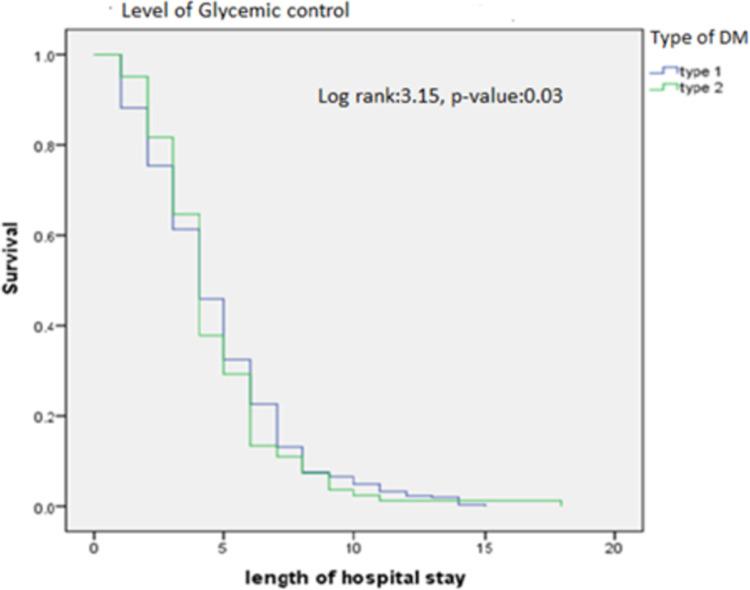
387 patients were included in the study. The mean age of patients was 33.30± 14.96 years. The most common precipitating factor of DKA was new onset diabetes mellitus 150(38.8%). The mean length of hospital stay was 4.64(±2.802) days. The mean plasma glucose at admission and discharge was 443.63(±103.33) and 172.94 (±80.60) mg/dL, respectively. The majority 370 (95.60%) of patients improved and discharged whereas 17 (4.40%) patients died in the hospital. Patients with mild and moderate DKA showed short hospital stay; AOR: 0.16 [0.03-0.78] and AOR:0.17[0.03-0.96] compared with severe DKA. Diabetic ketoacidosis precipitated by infection were nearly five times more likely to have long hospital stay than DKA precipitated by other causes; AOR: 4.59 [1.08-19.42]. In addition, serum glucose fluctuation during hospitalization increased the likelihood of long hospital stay, AOR: 2.15[1.76-2.63].
CONCLUSIONS
New onset type 1 diabetes was the major precipitating factor for DKA. Admitted DKA patients remained in hospital for a duration of approximately five days. About five out of hundred DKA patients ended up with death in the hospital. Infection, serum glucose fluctuations and severity of DKA were determinants of long hospital stay. Early prevention of precipitating factors and adequate management of DAK are warranted to reduce length of hospital stay and mortality.
背景
埃塞俄比亚有关糖尿病酮症酸中毒(DKA)患者治疗结果的数据有限。
目的
本研究旨在确定在德布雷塔博尔综合医院就诊的 DKA 患者的治疗结果。
方法
这是一项在德布雷塔博尔综合医院进行的回顾性研究,数据收集时间为 2018 年 6 月 1 日至 6 月 30 日。纳入研究的参与者均为 2010 年 8 月至 2018 年 5 月 31 日期间因 DKA 入院的糖尿病患者。主要结局为 DKA 的治疗结果,包括(住院期间血糖控制、住院时间和住院期间死亡率)。统计分析使用社会科学统计软件包(SPSS)版本 22 进行。描述性统计以平均值±标准差表示,二元回归用于确定影响 DKA 患者住院时间的因素。
结果
本研究共纳入 387 例患者。患者的平均年龄为 33.30±14.96 岁。DKA 最常见的诱发因素是新发糖尿病 150 例(38.8%)。平均住院时间为 4.64±2.802 天。入院时和出院时的平均血浆葡萄糖分别为 443.63±103.33 和 172.94±80.60mg/dL。大多数 370 例(95.60%)患者病情改善并出院,17 例(4.40%)患者在医院死亡。轻度和中度 DKA 患者的住院时间较短;AOR:0.16[0.03-0.78]和 AOR:0.17[0.03-0.96],与重度 DKA 相比。由感染引起的 DKA 比由其他原因引起的 DKA 发生长时间住院的可能性高近五倍;AOR:4.59[1.08-19.42]。此外,住院期间血糖波动增加了住院时间延长的可能性,AOR:2.15[1.76-2.63]。
结论
新发 1 型糖尿病是 DKA 的主要诱发因素。入院的 DKA 患者住院时间约为 5 天。大约每 100 名 DKA 患者中就有 5 名在医院死亡。感染、血糖波动和 DKA 的严重程度是导致住院时间延长的决定因素。需要早期预防诱发因素并充分管理 DAK,以缩短住院时间和降低死亡率。

 Zotero 插件