
探索失眠与过敏性疾病和哮喘的遗传关联:一项双向孟德尔随机化研究。
Exploring genetic association of insomnia with allergic disease and asthma: a bidirectional Mendelian randomization study.
机构信息
School of Public Health, Shanghai Jiao Tong University School of Medicine, 227 South Chongqing Road, Huangpu District, Shanghai, 200025, China.
Shanghai Ninth People's Hospital, Shanghai Jiao Tong University School of Medicine, Shanghai, China.
出版信息
Respir Res. 2022 Apr 7;23(1):84. doi: 10.1186/s12931-022-02009-6.
BACKGROUND
Insomnia is highly prevalent among patients with allergic disease and asthma; however, few studies have investigated their causal relationship. We aim to explore the causal association between insomnia and allergic disease/asthma by performing bidirectional Mendelian randomization (MR) study.
METHODS
Instrumental variables were constructed using single nucleotide polymorphisms (SNPs). Summary statistics for insomnia, allergic disease, and asthma were obtained from four large-scale genome-wide association studies (GWAS) of European ancestry. The pleiotropy analysis was applied by using the MR-Egger intercept test and the MR pleiotropy residual sum and outlier (MR-PRESSO) test. MR analyses were conducted by using inverse variance weighted (IVW), weighted median, and MR-Egger method.
RESULTS
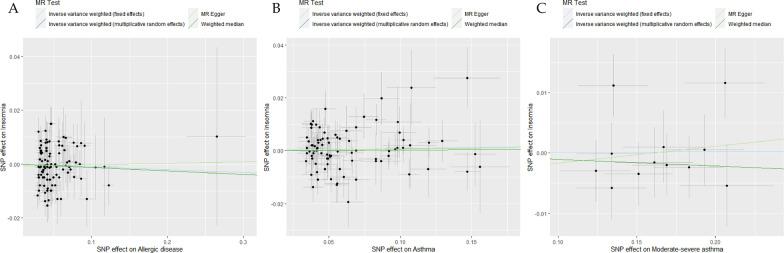
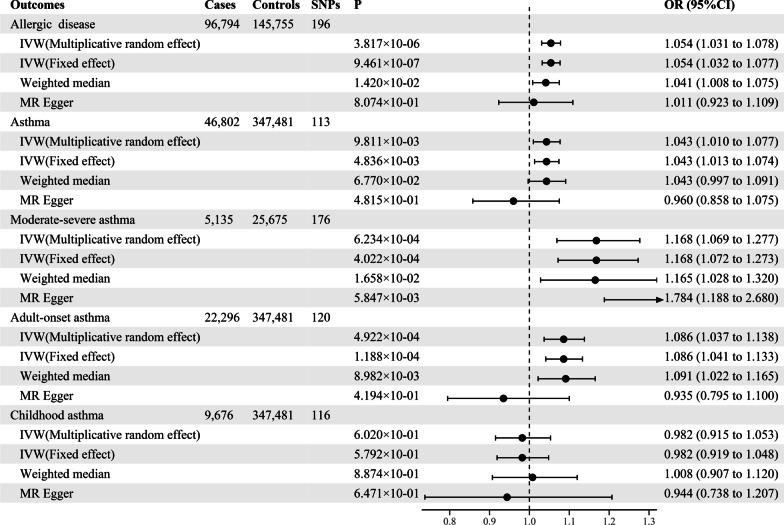
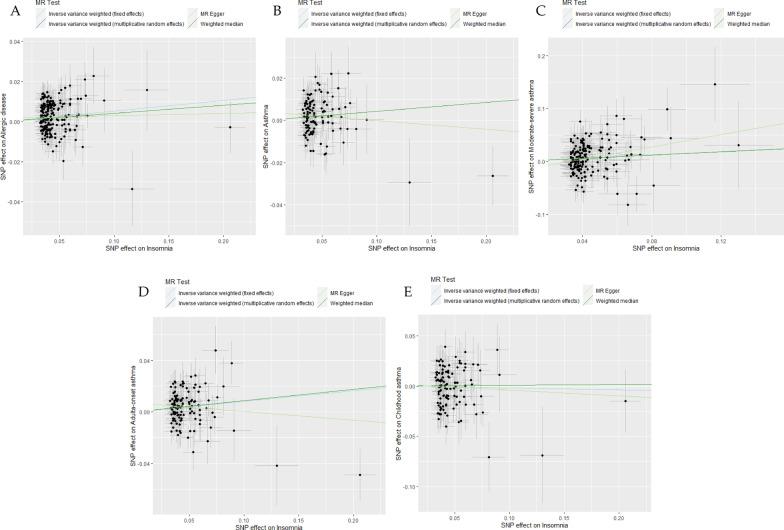
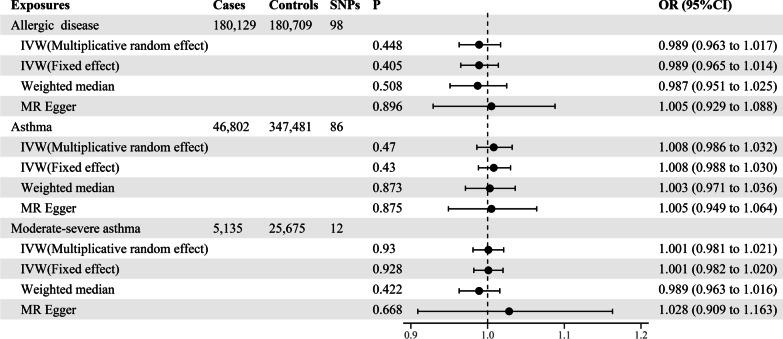
Based on the multiplicative random effects IVW method, the MR analysis showed that genetically predicted insomnia was causally associated with an increased risk of allergic disease [odds ratio (OR) = 1.054, 95% confidence interval (CI) = 1.031-1.078, P = 3.817 × 10], asthma (OR = 1.043, 95% CI = 1.010-1.077, P = 9.811 × 10), moderate-severe asthma (OR = 1.168, 95% CI = 1.069-1.277, P = 6.234 × 10), and adult-onset asthma (OR = 1.086, 95% CI = 1.037-1.138, P = 4.922 × 10). In bidirectional analyses, we did not find evidence supporting the reverse causality relations.
CONCLUSIONS
Our MR study suggested that genetically predicted insomnia was the risk factor for allergic disease and asthma. Improving sleep quality could be one of the cornerstones in the prevention of allergic disease and asthma.
背景
过敏疾病和哮喘患者普遍存在失眠;然而,很少有研究探讨它们之间的因果关系。我们旨在通过进行双向孟德尔随机化(MR)研究来探索失眠与过敏疾病/哮喘之间的因果关联。
方法
使用单核苷酸多态性(SNP)构建工具变量。使用来自欧洲裔人群的四项大规模全基因组关联研究(GWAS)的失眠、过敏疾病和哮喘的汇总统计数据。使用 MR-Egger 截距检验和 MR 多效性残差和异常值(MR-PRESSO)检验进行多效性分析。使用逆方差加权(IVW)、加权中位数和 MR-Egger 方法进行 MR 分析。
结果
基于乘法随机效应 IVW 方法,MR 分析表明,遗传预测的失眠与过敏疾病风险增加相关[比值比(OR)=1.054,95%置信区间(CI)=1.031-1.078,P=3.817×10]、哮喘(OR=1.043,95%CI=1.010-1.077,P=9.811×10)、中重度哮喘(OR=1.168,95%CI=1.069-1.277,P=6.234×10)和成人发病哮喘(OR=1.086,95%CI=1.037-1.138,P=4.922×10)。在双向分析中,我们没有发现支持反向因果关系的证据。
结论
我们的 MR 研究表明,遗传预测的失眠是过敏疾病和哮喘的危险因素。改善睡眠质量可能是预防过敏疾病和哮喘的基石之一。
 Zotero 插件