
克服 COVID-19 大流行期间生物医学废物产生增加带来的挑战。
Overcoming challenges due to enhanced biomedical waste generation during COVID-19 pandemic.
机构信息
Biofuels and Bioprocessing Research Center, ITER, Siksha 'O' Anusandhan (Deemed to be University), Bhubaneswar 751030, India; Vasudev Higher Secondary School, Talcher, Angul 759100, India.
Biofuels and Bioprocessing Research Center, ITER, Siksha 'O' Anusandhan (Deemed to be University), Bhubaneswar 751030, India.
出版信息
Sci Total Environ. 2022 Aug 1;832:155072. doi: 10.1016/j.scitotenv.2022.155072. Epub 2022 Apr 7.
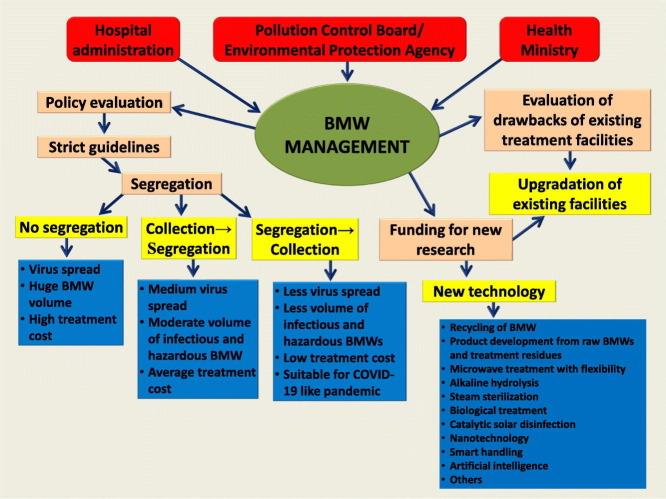
Biomedical wastes (BMWs) are potentially infectious to the environment and health. They are co-dependent and accumulative during the ongoing coronavirus disease-2019(COVID-19) pandemic. In India the standard treatment processes of BMWs are incineration, autoclaving, shredding, and deep burial; however, incineration and autoclaving are the leading techniques applied by many treatment providers. These conventional treatment methods have several drawbacks in terms of energy, cost, and emission. But the actual problem for the treatment providers is the huge and non-uniform flow of the BMWs during the pandemic. The existing treatment methods are lacking flexibility for the non-uniform flow. The Government of India has provisionally approved some new techniques like plasma pyrolysis, sharp/needle blaster, and PIWS-3000 technologies on a trial basis. But they are all found to be inadequate in the pandemic. Therefore, there is an absolute requirement to micromanage the BMWs based on certain parameters for the possible COVID-19 like pandemic in the future. Segregation is a major step of the BMW management. Its guideline may be shuffled as segregation at the entry points followed by collection instead of the existing system of the collection followed by segregation. Other steps like transportation, location of treatment facilities, upgradation of the existing treatment facilities, and new technologies can solve the challenges up to a certain extent. Technologies like microwave treatment, alkaline hydrolysis, steam sterilization, biological treatment, catalytic solar disinfection, and nanotechnology have a lot of scopes for the treatment of BMWs. Hi-tech approaches in handling and transportation are found to be fruitful in the initial steps of BMW management. End products of the treated BMWs can be potentially fabricated for the application in the built environment. Some policies need to be re-evaluated by the health care facilities or government administrations for efficient BMW management.
生物医学废物(BMW)对环境和健康具有潜在的传染性。在持续的 2019 年冠状病毒病(COVID-19)大流行期间,它们是相互依存和累积的。在印度,BMW 的标准处理工艺是焚烧、高压灭菌、粉碎和深埋;然而,焚烧和高压灭菌是许多处理供应商采用的主要技术。这些传统的处理方法在能源、成本和排放方面存在一些缺点。但是,对于处理供应商来说,实际问题是大流行期间 BMW 的巨大且不均匀的流量。现有的处理方法在处理非均匀流量方面缺乏灵活性。印度政府临时批准了一些新技术,如等离子体热解、尖锐/针爆器和 PIWS-3000 技术,供试验使用。但在大流行期间,它们都被发现是不够的。因此,在未来可能发生类似 COVID-19 的大流行时,绝对需要根据某些参数对 BMW 进行微观管理。分类是 BMW 管理的重要步骤。其指导方针可能会被打乱,即从入口处进行分类,然后进行收集,而不是现有的先收集后分类的系统。其他步骤,如运输、处理设施的位置、现有处理设施的升级和新技术,可以在一定程度上解决挑战。微波处理、碱性水解、蒸汽灭菌、生物处理、催化太阳能消毒和纳米技术等技术在 BMW 处理方面有很大的应用空间。在 BMW 管理的初始阶段,处理和运输方面的高科技方法被证明是富有成效的。经过处理的 BMW 的最终产品可潜在地用于建筑环境中的应用。卫生保健设施或政府管理部门需要重新评估一些政策,以实现高效的 BMW 管理。

 Zotero 插件