
宿主细胞基因/人乳头瘤病毒DNA甲基化标志物的检测:一种有前景的宫颈癌筛查方法
Detection of Host Cell Gene/HPV DNA Methylation Markers: A Promising Triage Approach for Cervical Cancer.
作者信息
Zhang Lingyi, Tan Wenxi, Yang Hongmei, Zhang Songling, Dai Yun
机构信息
Laboratory of Cancer Precision Medicine, The First Hospital of Jilin University, Changchun, China.
Department of Gynecology and Obstetrics, The Second Hospital of Jilin University, Changchun, China.
出版信息
Front Oncol. 2022 Mar 25;12:831949. doi: 10.3389/fonc.2022.831949. eCollection 2022.
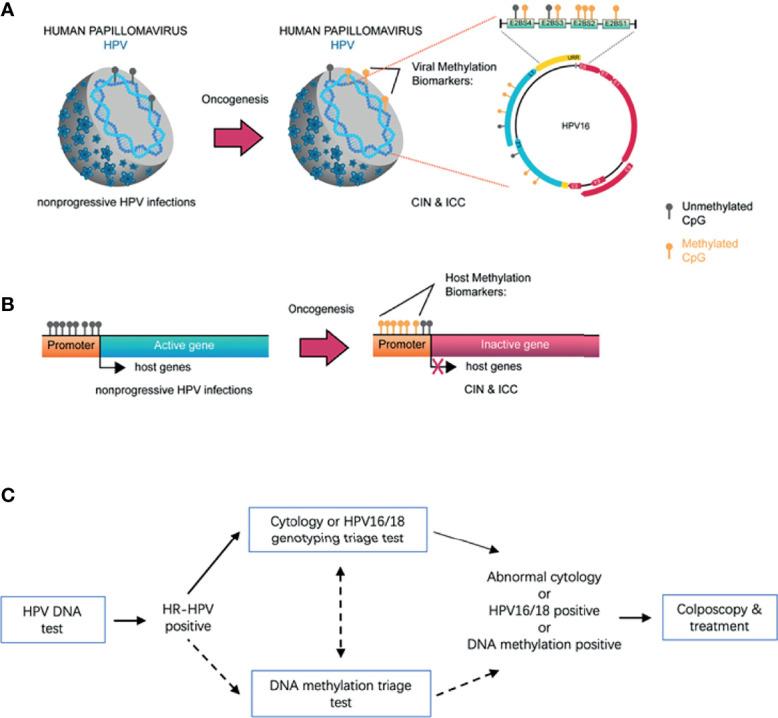
Cervical cancer is the most prevalent gynecologic malignancy, especially in women of low- and middle-income countries (LMICs). With a better understanding of the etiology and pathogenesis of cervical cancer, it has been well accepted that this type of cancer can be prevented and treated early screening. Due to its higher sensitivity than cytology to identify precursor lesions of cervical cancer, detection of high-risk human papillomavirus (HR-HPV) DNA has been implemented as the primary screening approach. However, a high referral rate for colposcopy after HR-HPV DNA detection due to its low specificity in HR-HPV screening often leads to overtreatment and thus increases the healthcare burden. Emerging evidence has demonstrated that detection of host cell gene and/or HPV DNA methylation represents a promising approach for the early triage of cervical cancer in HR-HPV-positive women owing to its convenience and comparable performance to cytology, particularly in LMICs with limited healthcare resources. While numerous potential markers involving DNA methylation of host cell genes and the HPV genome have been identified thus far, it is crucial to define which genes or panels involving host and/or HPV are feasible and appropriate for large-scale screening and triage. An ideal approach for screening and triage of CIN/ICC requires high sensitivity and adequate specificity and is suitable for self-sampling and inexpensive to allow population-based screening, particularly in LMICs. In this review, we summarize the markers of host cell gene/HR-HPV DNA methylation and discuss their triage performance and feasibility for high-grade precancerous cervical intraepithelial neoplasia or worse (CIN2+ and CIN3+) in HR-HPV-positive women.
宫颈癌是最常见的妇科恶性肿瘤,在低收入和中等收入国家(LMICs)的女性中尤为常见。随着对宫颈癌病因和发病机制的深入了解,人们已经普遍认识到这种癌症可以通过早期筛查来预防和治疗。由于其在识别宫颈癌前病变方面比细胞学具有更高的敏感性,高危型人乳头瘤病毒(HR-HPV)DNA检测已被用作主要的筛查方法。然而,由于HR-HPV筛查特异性低,HR-HPV DNA检测后阴道镜检查的转诊率较高,这往往导致过度治疗,从而增加了医疗负担。新出现的证据表明,检测宿主细胞基因和/或HPV DNA甲基化是一种很有前景的方法,可用于对HR-HPV阳性女性进行宫颈癌的早期分流,因为它具有便利性,且在性能上与细胞学相当,特别是在医疗资源有限的LMICs中。虽然到目前为止已经确定了许多涉及宿主细胞基因和HPV基因组DNA甲基化的潜在标志物,但确定哪些涉及宿主和/或HPV的基因或基因组合适用于大规模筛查和分流至关重要。一种理想的CIN/ICC筛查和分流方法需要高敏感性和足够的特异性,并且适用于自我采样且成本低廉,以便进行基于人群的筛查,特别是在LMICs中。在这篇综述中,我们总结了宿主细胞基因/HR-HPV DNA甲基化的标志物,并讨论了它们对HR-HPV阳性女性中高级别宫颈癌前上皮内瘤变或更严重病变(CIN2+和CIN3+)的分流性能和可行性。

 Zotero 插件