
二维红外光谱理论揭示两种 CL-20 共晶中的分子间振动能量转移过程。
Intermolecular Vibration Energy Transfer Process in Two CL-20-Based Cocrystals Theoretically Revealed by Two-Dimensional Infrared Spectra.
机构信息
Xi'an Modern Chemistry Research Institute, Xi'an 710065, China.
Department of Physics and Engineering Physics, University of Saskatchewan, Saskatoon, SK S7N 5E2, Canada.
出版信息
Molecules. 2022 Mar 26;27(7):2153. doi: 10.3390/molecules27072153.
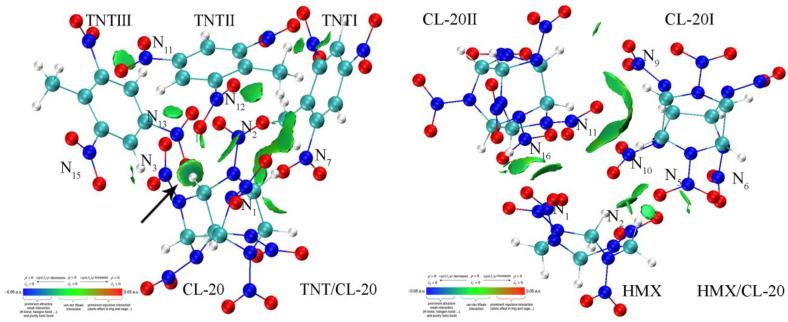
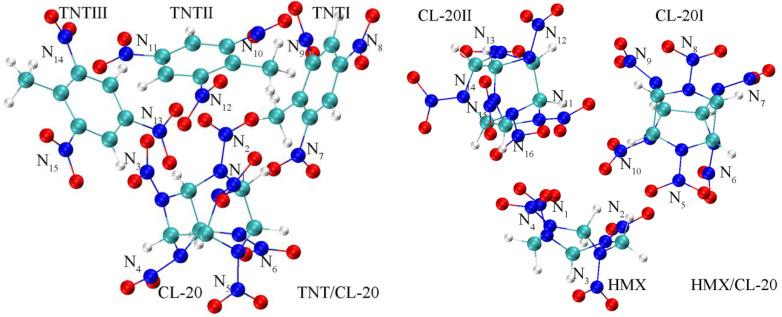
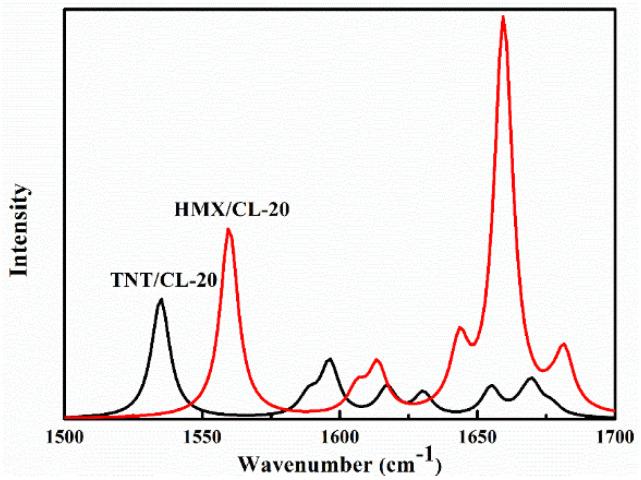
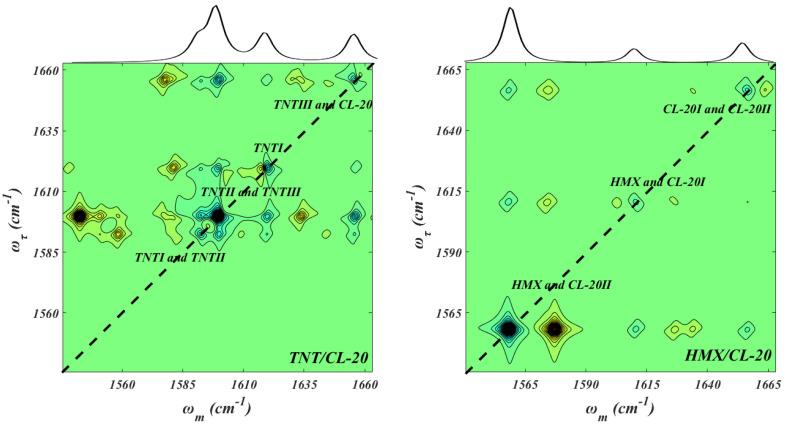
Inspired by the recent cocrystallization and theory of energetic materials, we theoretically investigated the intermolecular vibrational energy transfer process and the non-covalent intermolecular interactions between explosive compounds. The intermolecular interactions between 2,4,6-trinitrotoluene (TNT) and 2,4,6,8,10,12-hexanitro-2,4,6,8,10,12-hexaazaisowurtzitane (CL-20) and between 1,3,5,7-tetranitro-1,3,5,7-tetrazocane (HMX) and CL-20 were studied using calculated two-dimensional infrared (2D IR) spectra and the independent gradient model based on the Hirshfeld partition (IGMH) method, respectively. Based on the comparison of the theoretical infrared spectra and optimized geometries with experimental results, the theoretical models can effectively reproduce the experimental geometries. By analyzing cross-peaks in the 2D IR spectra of TNT/CL-20, the intermolecular vibrational energy transfer process between TNT and CL-20 was calculated, and the conclusion was made that the vibrational energy transfer process between CL-20 and TNTII (TNTIII) is relatively slower than between CL-20 and TNTI. As the vibration energy transfer is the bridge of the intermolecular interactions, the weak intermolecular interactions were visualized using the IGMH method, and the results demonstrate that the intermolecular non-covalent interactions of TNT/CL-20 include van der Waals (vdW) interactions and hydrogen bonds, while the intermolecular non-covalent interactions of HMX/CL-20 are mainly comprised of vdW interactions. Further, we determined that the intermolecular interaction can stabilize the trigger bond in TNT/CL-20 and HMX/CL-20 based on Mayer bond order density, and stronger intermolecular interactions generally indicate lower impact sensitivity of energetic materials. We believe that the results obtained in this work are important for a better understanding of the cocrystal mechanism and its application in the field of energetic materials.
受近期的共晶和高能材料理论的启发,我们从理论上研究了爆炸物分子间的振动能量转移过程和非共价相互作用。通过计算二维红外(2D IR)光谱和基于 Hirshfeld 分割的独立梯度模型(IGMH)方法,分别研究了 2,4,6-三硝基甲苯(TNT)与 2,4,6,8,10,12-六硝-2,4,6,8,10,12-六氮杂异伍兹烷(CL-20)以及 1,3,5,7-四硝-1,3,5,7-四氮杂环辛烷(HMX)与 CL-20 之间的分子间相互作用。通过比较理论红外光谱和优化的几何形状与实验结果,理论模型可以有效地再现实验几何形状。通过分析 TNT/CL-20 的 2D IR 光谱中的交叉峰,计算了 TNT 和 CL-20 之间的分子间振动能量转移过程,并得出结论,CL-20 和 TNTII(TNTIII)之间的振动能量转移过程相对较慢,而 CL-20 和 TNTI 之间的振动能量转移过程则较快。由于振动能量转移是分子间相互作用的桥梁,因此使用 IGMH 方法可视化了弱分子间相互作用,结果表明 TNT/CL-20 的分子间非共价相互作用包括范德华(vdW)相互作用和氢键,而 HMX/CL-20 的分子间非共价相互作用主要包括范德华相互作用。此外,我们根据 Mayer 键序密度确定了 TNT/CL-20 和 HMX/CL-20 中的分子间相互作用可以稳定触发键,并且通常分子间相互作用越强,含能材料的撞击感度越低。我们相信,这项工作的结果对于更好地理解共晶机制及其在含能材料领域的应用具有重要意义。

 Zotero 插件