
根部施用硫脲缓解干旱胁迫与提高光合色素、渗透调节剂、抗氧化酶以及块茎产量有关,并抑制了马铃薯品种的氧化应激。
Alleviation of drought stress by root-applied thiourea is related to elevated photosynthetic pigments, osmoprotectants, antioxidant enzymes, and tubers yield and suppressed oxidative stress in potatoes cultivars.
机构信息
College of Plant Science and Technology, Huazhong Agricultural University, Wuhan, China.
College of Life Sciences, Yan'an University, Yan'an, Shaanxi, China.
出版信息
PeerJ. 2022 Apr 7;10:e13121. doi: 10.7717/peerj.13121. eCollection 2022.
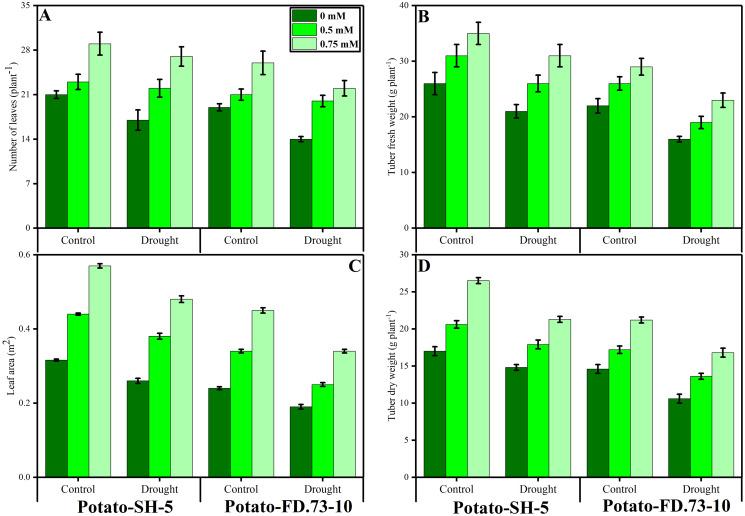
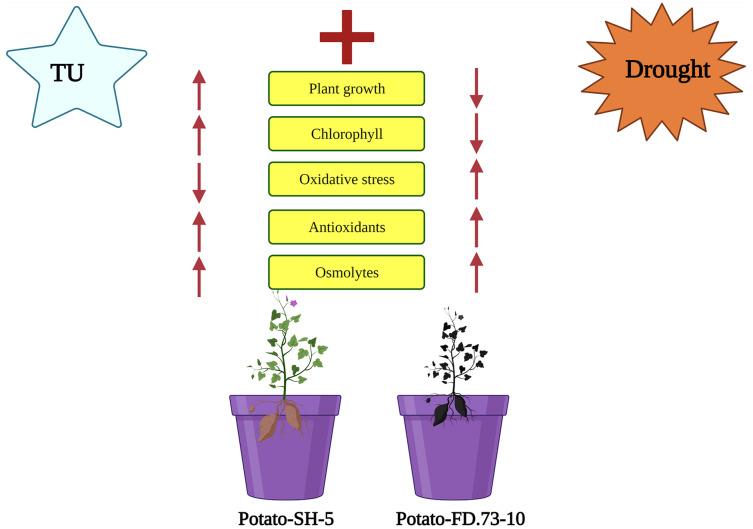
The growth and productivity of plants are enhanced by the use of thiourea (TU) under stressful conditions. When TU is applied as a rooting medium, it improves plant growth characteristics and other physiological parameters in stressed environment. A pot experiment was conducted in the botanical garden of the Government College University, Faisalabad 38000, Pakistan to examine the TU-mediated fluctuations in some crucial physio-biochemical parameters and the oxidative defense of potatoes under a restricted water supply. For this purpose, two potato cultivars (potato-SH-5 and potato-FD-73) were sown in pots containing 10 kg of soil. Water was regularly applied to the pots until germination. After 2 weeks of germination, drought stress with 65% field capacity was imposed, while the control was subjected to 100% field capacity. TU, as a rooting medium, was applied at the vegetative stage (0 (no application), 0.5, 0.75 mM). A substantial reduction in the total number of leaves, leaf area, tuber biomass (fresh and dry weight), photosynthetic pigments, membrane permeability, and leaf relative water content (RWC) was recorded in plants under drought stress conditions as compared to control plants. The damaging effects of water stress were more critical for cv. potato-FD-73 as compared to cv. potato-SH-5. In contrast, drought stress enhanced the malondialdehyde (MDA) and hydrogen peroxide (HO) content while also increased antioxidant enzyme activities (superoxide dismutase (SOD), peroxidase (POD), and catalase (CAT)) and triggered the accumulation of soluble proteins, soluble sugars, proline, and phenolic and anthocyanin contents. However, TU applied as rooting medium at 0.5 and 0.75 mM was effective in reducing the detrimental effects of water stress in both cultivars. Furthermore, increasing levels of TU enhanced chlorophyll pigments, dissolved proteins, complete dissolved sugars, and enzymatic capabilities of POD, SOD, and CAT, while reducing the MDA and HO in both cultivars under stress conditions. In conclusion, TU improved the yield and chlorophyll pigments of potato plants by mitigating the adverse effects of drought stress through reduced EL, MDA, and HO contents and improved activities of enzymatic and non-enzymatic antioxidants and osmoprotectants.
在胁迫条件下,使用硫脲(TU)可促进植物的生长和生产力。当 TU 用作生根介质时,它可以改善植物在胁迫环境中的生长特性和其他生理参数。本研究在巴基斯坦费萨拉巴德政府学院大学植物园进行了盆栽实验,以研究 TU 介导的在限制供水条件下土豆一些关键生理生化参数和氧化防御的波动。为此,将两个马铃薯品种(马铃薯-SH-5 和马铃薯-FD-73)播种在装有 10 公斤土壤的花盆中。定期向花盆浇水,直到发芽。发芽后 2 周,施加 65%田间持水量的干旱胁迫,而对照则施加 100%田间持水量。TU 作为生根介质,在营养生长阶段(0(不施用)、0.5、0.75 mM)施用。与对照植株相比,干旱胁迫下植株的总叶片数、叶面积、块茎生物量(鲜重和干重)、光合色素、膜通透性和叶片相对含水量(RWC)显著减少。与 cv. potato-SH-5 相比,cv. potato-FD-73 植株受水分胁迫的破坏效应更为严重。相比之下,干旱胁迫会增加丙二醛(MDA)和过氧化氢(HO)的含量,同时提高抗氧化酶活性(超氧化物歧化酶(SOD)、过氧化物酶(POD)和过氧化氢酶(CAT))并触发可溶性蛋白质、可溶性糖、脯氨酸和酚类和花色素苷含量的积累。然而,在 0.5 和 0.75 mM 时作为生根介质施用的 TU 有效降低了两个品种的水分胁迫的有害影响。此外,增加 TU 水平可以提高两个品种在胁迫条件下的叶绿素色素、可溶性蛋白质、完全溶解糖以及 POD、SOD 和 CAT 的酶活性,同时降低 MDA 和 HO 的含量。综上所述,TU 通过降低 EL、MDA 和 HO 的含量,提高了酶和非酶抗氧化剂和渗透保护剂的活性,减轻了干旱胁迫对马铃薯植株的不利影响,提高了马铃薯植株的产量和叶绿素色素含量。




 Zotero 插件