
一种用于监测 BAX 早期激活的动力学荧光偏振配体分析。
A kinetic fluorescence polarization ligand assay for monitoring BAX early activation.
机构信息
Laboratory of Mitochondrial Biology in Human Health and Disease, Icahn School of Medicine at Mount Sinai, One Gustave L. Levy Place, New York, NY 10029, USA.
Department of Oncological Sciences, Icahn School of Medicine at Mount Sinai, One Gustave L. Levy Place, New York, NY 10029, USA.
出版信息
Cell Rep Methods. 2022 Mar 28;2(3). doi: 10.1016/j.crmeth.2022.100174. Epub 2022 Mar 9.
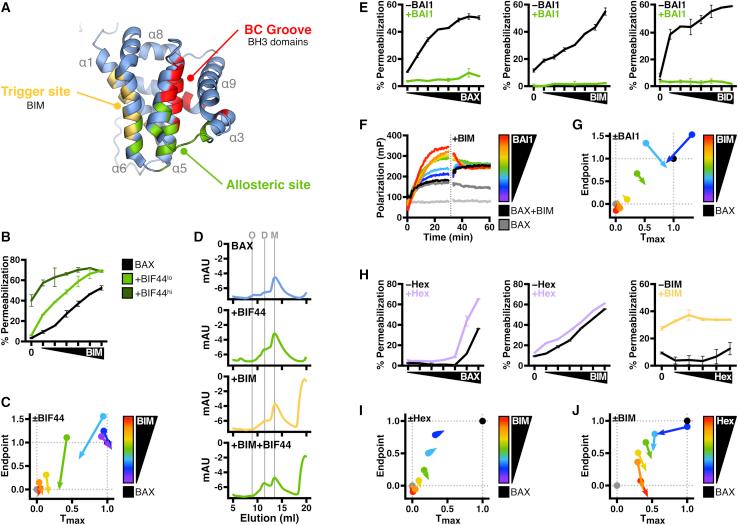
Developmental, homeostatic, and pharmacological pro-apoptotic signals converge by activating the BCL-2 family member BAX. Studies investigating molecular regulation of BAX are commonly limited to methodologies measuring endpoint phenotypes and do not assess activation of monomeric BAX. Here, we present FLAMBE, a fluorescence polarization ligand assay for monitoring BAX early activation, that measures activation-induced release of a peptide probe in real time. Using complementary parallel and tandem biochemical techniques, we validate, corroborate, and apply FLAMBE to a contemporary repertoire of BAX modulators, characterizing their contributions within the early steps of BAX activation. Additionally, we use FLAMBE to reveal that historically "dead" BAX mutants remain responsive to activation as quasi-functional monomers. We also identify data metrics for comparative analyses and demonstrate that FLAMBE data align with downstream functional observations. Collectively, FLAMBE advances our understanding of BAX activation and fills a methodological void for studying BAX with broad applications in cell biology and therapeutic development. BAX activation studies are invaluable platforms for studying cellular and pharmacological modulators of apoptosis. The gold standard for studying BAX function relies on membrane permeabilization assays, which assess the pore-forming activity of oligomeric BAX. However, there are currently no rapid or kinetic assays to interrogate real-time activation of monomeric BAX in solution, thereby limiting any molecular insights that occur upstream of mitochondrial permeabilization. Furthermore, available methods to observe the activation of monomeric BAX suffer from low throughput and static observations. To address this methodological gap, we developed FLAMBE, a kinetic fluorescence polarization-based assay to measure monomeric BAX activation in solution via concomitant displacement of a labeled peptide. This approach maintains the benefits of rapid kinetic data generation in a low-cost microplate format without requiring specialized equipment or large quantities of protein. FLAMBE compliments available experimental strategies and expands the accessibility of investigators to monitor early steps within the BAX activation continuum.
发育、内稳态和药理学的促凋亡信号通过激活 BCL-2 家族成员 BAX 而汇聚。研究 BAX 分子调控的常用方法通常局限于测量终点表型的方法,而不评估单体 BAX 的激活。在这里,我们提出了 FLAMBE,一种用于监测 BAX 早期激活的荧光偏振配体测定法,可实时测量激活诱导的肽探针释放。使用互补的平行和串联生化技术,我们验证、证实并将 FLAMBE 应用于当代 BAX 调节剂库,在 BAX 激活的早期步骤中对其进行特征描述。此外,我们使用 FLAMBE 揭示了历史上“死亡”的 BAX 突变体仍然可以响应激活,成为准功能单体。我们还确定了用于比较分析的数据指标,并证明 FLAMBE 数据与下游功能观察结果一致。总的来说,FLAMBE 推进了我们对 BAX 激活的理解,并为研究 BAX 提供了一种方法学空白,在细胞生物学和治疗开发中有广泛的应用。BAX 激活研究是研究细胞和药理学凋亡调节剂的宝贵平台。研究 BAX 功能的金标准依赖于膜通透性测定法,该方法评估寡聚 BAX 的孔形成活性。然而,目前还没有快速或动力学测定法来实时检测溶液中单体 BAX 的激活,从而限制了在线粒体通透性之前发生的任何分子见解。此外,现有的观察单体 BAX 激活的方法存在通量低和静态观察的问题。为了解决这个方法学差距,我们开发了 FLAMBE,这是一种基于动力学荧光偏振的测定法,通过同时置换标记肽来测量溶液中的单体 BAX 激活。这种方法在保持低成本微孔板格式快速动力学数据生成优势的同时,无需特殊设备或大量蛋白质。FLAMBE 补充了现有的实验策略,并扩大了研究人员监测 BAX 激活连续体早期步骤的可及性。
 Zotero 插件