
多发性硬化症患者行走时的疲劳、抑郁和焦虑。
Fatigue, Depression, and Anxiety Among Ambulating Multiple Sclerosis Patients.
机构信息
Physical Therapy Department, King Fahad Medical City, Riyadh, Saudi Arabia.
College of Medicine, King Saud University, Riyadh, Saudi Arabia.
出版信息
Front Immunol. 2022 Mar 29;13:844461. doi: 10.3389/fimmu.2022.844461. eCollection 2022.
BACKGROUND
Multiple sclerosis (MS) is an inflammatory disease associated with adverse effects: including depression, anxiety, fatigue, which may affect physical activity and the quality of life (QoL) among patients with MS (pwMS).
OBJECTIVE
This study aims to assess the prevalence of depression, anxiety, and fatigue among pwMS who have no physical disability in Saudi Arabia, and demonstrate any correlation between these factors and physical activity as well as the QoL.
METHODS
A cross-sectional study was conducted in the Neuroimmunology outpatient clinics in King Fahad Medical City (KFMC) and King Saud University Medical City (KSUMC) in Riyadh City, KSA. The Arabic version of the Hospital Anxiety and Depression Scale (HADS) was used to measure anxiety and depression levels. The HADS scores were then categorized into three levels according to the total points: normal (0-7 points), borderline (7-10 points), and anxiety/depression (11 - 21 points). The Arabic version of the Fatigue Severity Scale (FSS) was used to measure fatigue (cut-off point ≥5). The physical activity was measured by the Arabic version of the short form of the International Physical Activity Questionnaire (IPAQ), which measure time spent walking, moderate- and vigorous-intensity physical activity of at least 10 minutes duration. The QoL was also measured by the Arabic version of the EuroQOL five-dimensional (EQ-5D-3L) instrument (i.e., mobility, self-care, usual activities, pain/discomfort, and anxiety/depression).
RESULTS
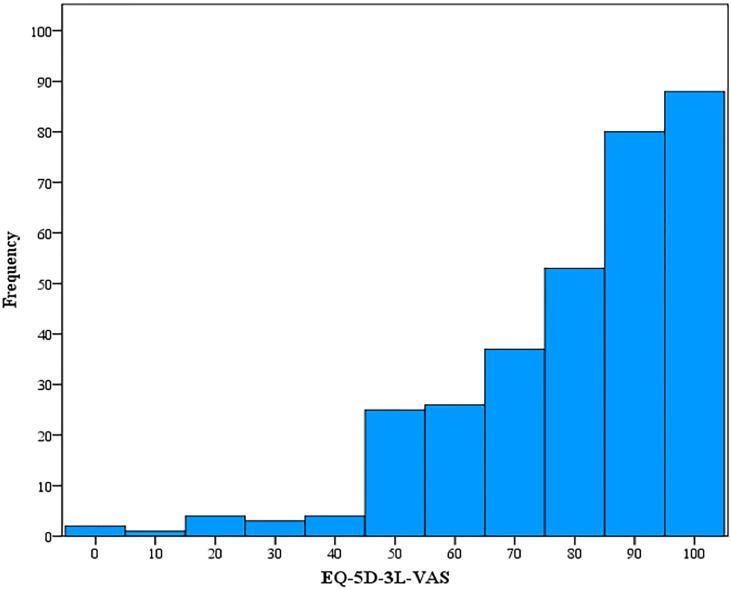
A total of 323 pwMS participated in this study, 83 had scores that indicated anxiety (25.7%) and 44 had depression (13.6%). The majority of patients had scores with the normal range of depression and anxiety (70% and 57% respectively). The mean of EuroQol Group visual analogue scale (EQ-VAS) score was 80.43 (SD=19.8). 156 (48.3%) out of 323 pwMS reported fatigue while the remainder had no fatigue (n=167, 51.7%). The results indicate that only 143 patients (44.3%) had participated in vigorous physical activity during the last 70 days, with a median of 3 days per week (IQR= 5-3) and a median of 60 minutes per day 0 (Interquartile range: IQR = 60-30). Only 149 patients (49.2%) had patricpated in moderate physical activities during the previous week with a median of 3 days per week (IQR = 5-3) and a median of 40 minutes per day (IQR = 60-30). 194 patients had participated in walking activities (60.0%) with a median of 5 days per week (IQR = 7-3) and a median of 45 minutes per day (IQR = 60-30). The results revealed that fatigue was positively correlated with depression (r = 0.407, p-value < 0.001) and anxiety (r = 0.289, p-value < 0.001).
CONCLUSION
The current study shows depression, anxiety, and fatigue tend to be correlated and clustered together among pwMS in our cohort. However, fatigue is not associated with the intensity of physical activity undertaken. The results of this study are important for the improvement of the clinical management of MS patients.
背景
多发性硬化症(MS)是一种与不良反应相关的炎症性疾病:包括抑郁、焦虑、疲劳,这些可能会影响 MS 患者(pwMS)的身体活动和生活质量(QoL)。
目的
本研究旨在评估沙特阿拉伯无身体残疾的 pwMS 中抑郁、焦虑和疲劳的患病率,并表明这些因素与身体活动以及 QoL 之间存在任何相关性。
方法
在沙特阿拉伯利雅得市的法赫德国王医疗城(KFMC)和沙特国王大学医疗城(KSUMC)的神经免疫门诊进行了一项横断面研究。使用医院焦虑和抑郁量表(HADS)的阿拉伯语版本来衡量焦虑和抑郁水平。然后,根据总分将 HADS 评分分为三个等级:正常(0-7 分)、边界(7-10 分)和焦虑/抑郁(11-21 分)。使用疲劳严重程度量表(FSS)的阿拉伯语版本来衡量疲劳(临界值≥5)。身体活动通过阿拉伯语短版国际体力活动问卷(IPAQ)来衡量,该问卷测量步行时间、至少 10 分钟的中强度和高强度体力活动。QoL 也通过阿拉伯语版欧洲五维健康量表(EQ-5D-3L)仪器(即移动性、自我护理、日常活动、疼痛/不适和焦虑/抑郁)来衡量。
结果
共有 323 名 pwMS 参与了这项研究,其中 83 名患者的焦虑评分(25.7%)和 44 名患者的抑郁评分(13.6%)较高。大多数患者的抑郁和焦虑评分处于正常范围(分别为 70%和 57%)。156 名(48.3%)pwMS 报告有疲劳,其余 167 名(51.7%)无疲劳。结果表明,只有 143 名患者(44.3%)在过去 70 天内进行了剧烈的身体活动,中位数为每周 3 天(IQR=5-3),每天 60 分钟(IQR=60-30)。只有 149 名患者(49.2%)在前一周进行了中等强度的身体活动,中位数为每周 3 天(IQR=5-3),每天 40 分钟(IQR=60-30)。194 名患者参加了步行活动(60.0%),中位数为每周 5 天(IQR=7-3),每天 45 分钟(IQR=60-30)。结果显示,疲劳与抑郁(r=0.407,p 值<0.001)和焦虑(r=0.289,p 值<0.001)呈正相关。
结论
本研究表明,在我们的队列中,pwMS 中抑郁、焦虑和疲劳往往相互关联并聚集在一起。然而,疲劳与所进行的身体活动强度无关。本研究结果对改善 MS 患者的临床管理具有重要意义。


 Zotero 插件