
恢复期和接种疫苗血清对 SARS-CoV-2 原始株、Beta、Delta 和奥密克戎变异株临床分离株的免疫原性。
Immunogenicity of convalescent and vaccinated sera against clinical isolates of ancestral SARS-CoV-2, Beta, Delta, and Omicron variants.
机构信息
Vaccine and Infectious Disease Organization, University of Saskatchewan, Saskatoon, SK S7N 5E3, Canada.
Department of Veterinary Microbiology, University of Saskatchewan, Saskatoon, SK S7N 5B4, Canada.
出版信息
Med. 2022 Jun 10;3(6):422-432.e3. doi: 10.1016/j.medj.2022.04.002. Epub 2022 Apr 14.
BACKGROUND
SARS-CoV-2 Omicron variant of concern (VOC) has evolved multiple mutations within the spike protein, raising concerns of increased antibody evasion. In this study, we assessed the neutralization potential of COVID-19 convalescent sera and sera from vaccinated individuals against ancestral SARS-CoV-2 and VOCs.
METHODS
The neutralizing activity of sera from 65 coronavirus disease (COVID-19) vaccine recipients and convalescent individuals against clinical isolates of ancestral SARS-CoV-2 and Beta, Delta, and Omicron VOCs was assessed using a micro-neutralization assay.
FINDINGS
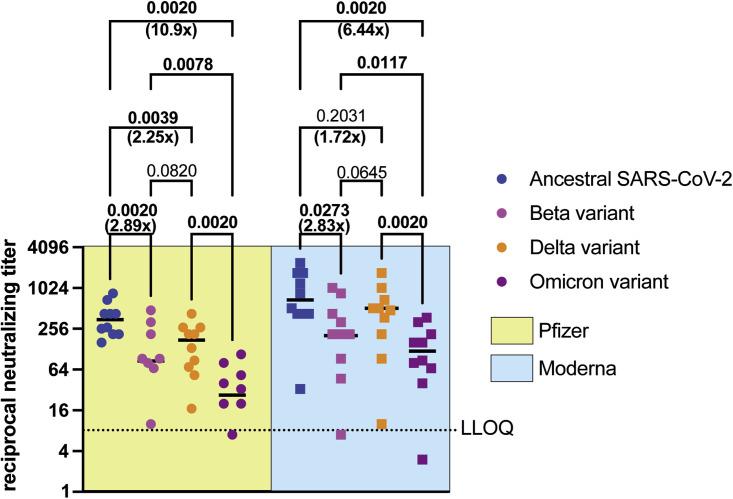
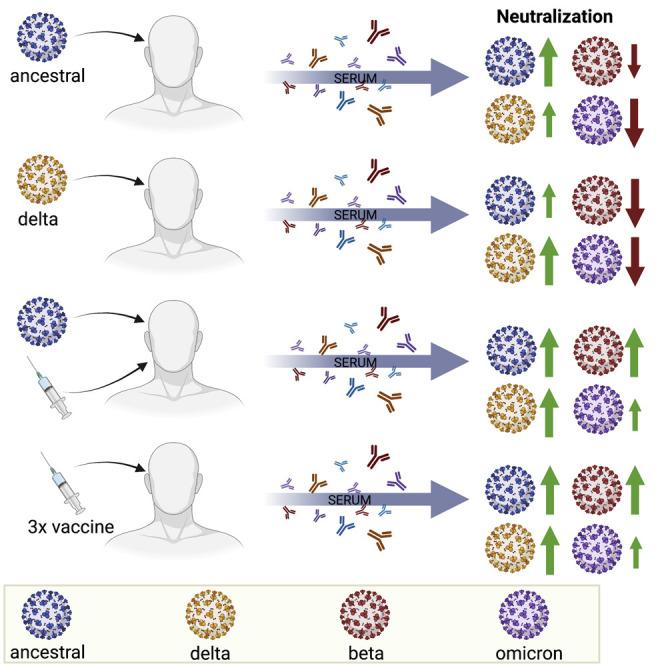
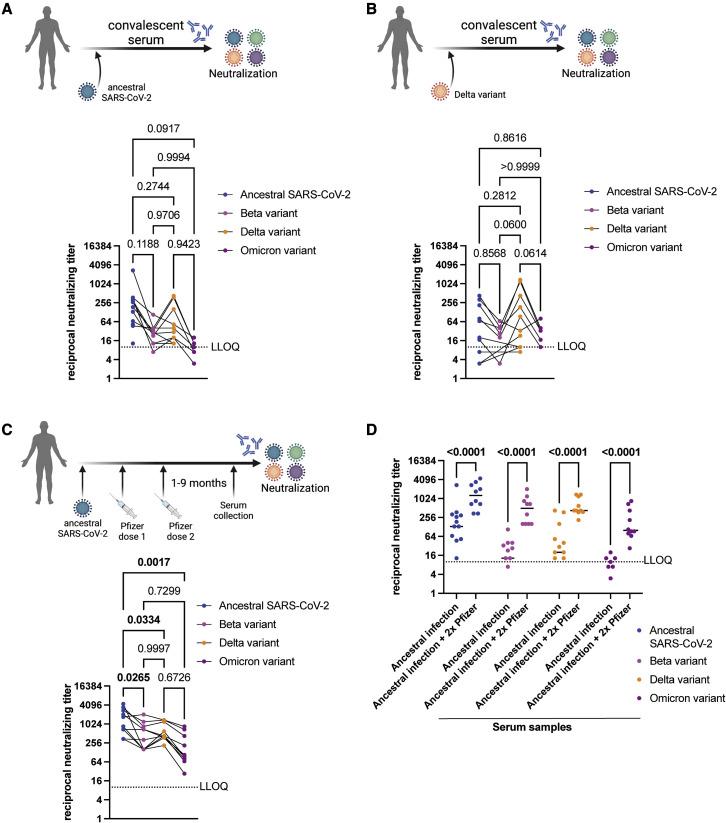
Convalescent sera from unvaccinated individuals infected by the ancestral virus demonstrated reduced neutralization against Beta and Omicron VOCs. Sera from individuals that received three doses of the Pfizer or Moderna vaccines demonstrated reduced neutralization of the Omicron variant relative to ancestral SARS-CoV-2. Sera from individuals that were naturally infected with ancestral SARS-CoV-2 and subsequently received two doses of the Pfizer vaccine induced significantly higher neutralizing antibody levels against ancestral virus and all VOCs. Infection alone, either with ancestral SARS-CoV-2 or the Delta variant, was not sufficient to induce high neutralizing antibody titers against Omicron.
CONCLUSIONS
In summary, we demonstrate that convalescent and vaccinated sera display varying levels of SARS-CoV-2 VOC neutralization. Data from this study will inform booster vaccination strategies against SARS-CoV-2 VOCs.
FUNDING
This research was funded by the Canadian Institutes of Health Research (CIHR). VIDO receives operational funding from the Government of Saskatchewan through Innovation Saskatchewan and the Ministry of Agriculture and from the Canada Foundation for Innovation through the Major Science Initiatives for its CL3 facility.
背景
SARS-CoV-2 关注的奥密克戎变异株(VOC)在刺突蛋白内发生了多次突变,引发了对抗体逃逸能力增强的担忧。在这项研究中,我们评估了 COVID-19 恢复期血清和接种疫苗个体血清对原始 SARS-CoV-2 和 VOC 的中和潜力。
方法
使用微量中和测定法评估了 65 名冠状病毒病(COVID-19)疫苗接种者和恢复期个体血清对临床分离的原始 SARS-CoV-2 和 Beta、Delta 和 Omicron VOC 的中和活性。
发现
未接种疫苗的个体感染原始病毒后产生的恢复期血清对 Beta 和 Omicron VOC 的中和作用降低。接种三剂辉瑞或 Moderna 疫苗的个体血清对 Omicron 变异体的中和作用相对于原始 SARS-CoV-2 降低。先前感染过原始 SARS-CoV-2 并随后接种两剂辉瑞疫苗的个体血清对原始病毒和所有 VOC 诱导出显著更高的中和抗体水平。仅感染原始 SARS-CoV-2 或 Delta 变异体不足以诱导针对 Omicron 的高中和抗体滴度。
结论
总之,我们证明了恢复期和接种疫苗的血清对 SARS-CoV-2 VOC 的中和作用存在不同程度的差异。本研究的数据将为 SARS-CoV-2 VOC 的加强接种策略提供信息。
资助
这项研究由加拿大卫生研究院(CIHR)资助。VIDO 通过其 CL3 设施从萨斯喀彻温省政府通过创新萨斯喀彻温省和农业部获得运营资金,并从加拿大创新基金会获得主要科学计划的资金。

 Zotero 插件