
严重精神疾病与心血管疾病风险之间关联的时间趋势:系统评价和荟萃分析。
Temporal trends in associations between severe mental illness and risk of cardiovascular disease: A systematic review and meta-analysis.
机构信息
Institute of Applied Health Research, University of Birmingham, Birmingham, United Kingdom.
Norwich Medical School, University of East Anglia, Norwich, United Kingdom.
出版信息
PLoS Med. 2022 Apr 19;19(4):e1003960. doi: 10.1371/journal.pmed.1003960. eCollection 2022 Apr.
BACKGROUND
Severe mental illness (SMI; schizophrenia, bipolar disorders (BDs), and other nonorganic psychoses) is associated with increased risk of cardiovascular disease (CVD) and CVD-related mortality. To date, no systematic review has investigated changes in population level CVD-related mortality over calendar time. It is unclear if this relationship has changed over time in higher-income countries with changing treatments.
METHODS AND FINDINGS
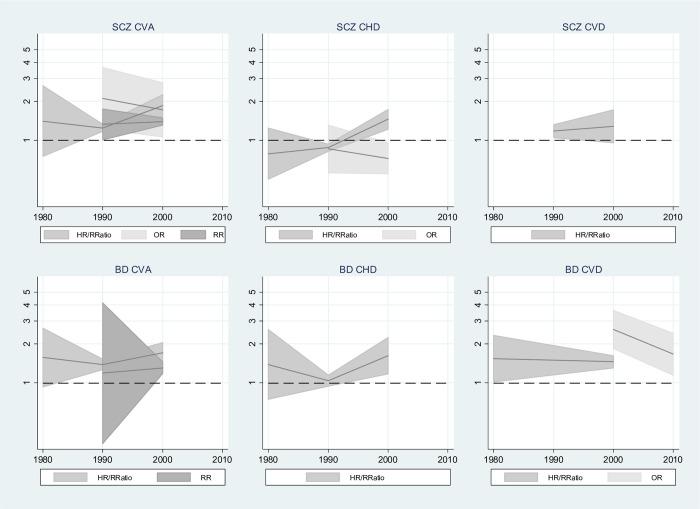
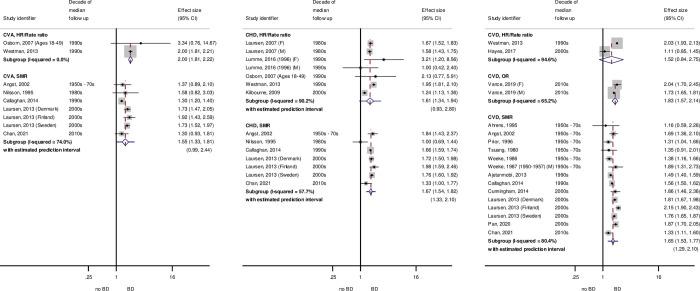
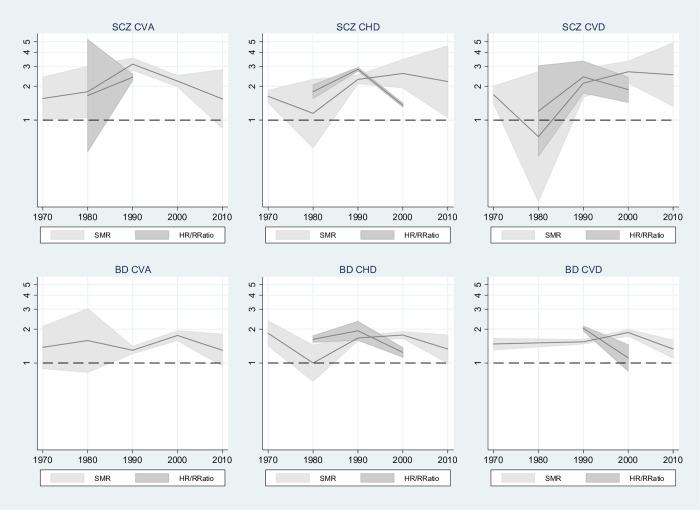
To address this gap, a systematic review was conducted, to assess the association between SMI and CVD including temporal change. Seven databases were searched (last: November 30, 2021) for cohort or case-control studies lasting ≥1 year, comparing frequency of CVD mortality or incidence in high-income countries between people with versus without SMI. No language restrictions were applied. Random effects meta-analyses were conducted to compute pooled hazard ratios (HRs) and rate ratios, pooled standardised mortality ratios (SMRs), pooled odds ratios (ORs), and pooled risk ratios (RRs) of CVD in those with versus without SMI. Temporal trends were explored by decade. Subgroup analyses by age, sex, setting, world region, and study quality (Newcastle-Ottawa scale (NOS) score) were conducted. The narrative synthesis included 108 studies, and the quantitative synthesis 59 mortality studies (with (≥1,841,356 cases and 29,321,409 controls) and 28 incidence studies (≥401,909 cases and 14,372,146 controls). The risk of CVD-related mortality for people with SMI was higher than controls across most comparisons, except for total CVD-related mortality for BD and cerebrovascular accident (CVA) for mixed SMI. Estimated risks were larger for schizophrenia than BD. Pooled results ranged from SMR = 1.55 (95% confidence interval (CI): 1.33 to 1.81, p < 0.001), for CVA in people with BD to HR/rate ratio = 2.40 (95% CI: 2.25 to 2.55, p < 0.001) for CVA in schizophrenia. For schizophrenia and BD, SMRs and pooled HRs/rate ratios for CHD and CVD mortality were larger in studies with outcomes occurring during the 1990s and 2000s than earlier decades (1980s: SMR = 1.14, 95% CI: 0.57 to 2.30, p = 0.71; 2000s: SMR = 2.59, 95% CI: 1.93 to 3.47, p < 0.001 for schizophrenia and CHD) and in studies including people with younger age. The incidence of CVA, CVD events, and heart failure in SMI was higher than controls. Estimated risks for schizophrenia ranged from HR/rate ratio 1.25 (95% CI: 1.04 to 1.51, p = 0.016) for total CVD events to rate ratio 3.82 (95% CI: 3.1 to 4.71, p < 0.001) for heart failure. Incidence of CHD was higher in BD versus controls. However, for schizophrenia, CHD was elevated in higher-quality studies only. The HR/rate ratios for CVA and CHD were larger in studies with outcomes occurring after the 1990s. Study limitations include the high risk of bias of some studies as they drew a comparison cohort from general population rates and the fact that it was difficult to exclude studies that had overlapping populations, although attempts were made to minimise this.
CONCLUSIONS
In this study, we found that SMI was associated with an approximate doubling in the rate ratio of CVD-related mortality, particularly since the 1990s, and in younger groups. SMI was also associated with increased incidence of CVA and CHD relative to control participants since the 1990s. More research is needed to clarify the association between SMI and CHD and ways to mitigate this risk.
背景
严重精神疾病(SMI;精神分裂症、双相情感障碍(BDs)和其他非器质性精神病)与心血管疾病(CVD)风险增加和 CVD 相关死亡率有关。迄今为止,尚无系统评价调查过随着治疗方法的改变,人群水平 CVD 相关死亡率随时间变化的情况。目前还不清楚在高收入国家,随着治疗方法的改变,这种关系是否随时间发生了变化。
方法和发现
为了解决这一差距,进行了一项系统评价,以评估 SMI 与 CVD 之间的关联,包括时间变化。检索了七个数据库(最后检索日期为 2021 年 11 月 30 日),以确定高收入国家人群中 SMI 与 CVD 死亡率或发病率的比较,研究时间持续≥1 年。没有语言限制。采用随机效应荟萃分析计算 SMI 与无 SMI 人群相比 CVD 死亡率或发病率的合并危险比(HR)和率比、合并标准化死亡率比(SMR)、合并优势比(OR)和合并风险比(RR)。通过十年进行时间趋势探索。根据年龄、性别、环境、世界区域和研究质量(纽卡斯尔-渥太华量表(NOS)评分)进行亚组分析。叙述性综合分析包括 108 项研究,定量综合分析包括 59 项死亡率研究(≥1841356 例病例和 29321409 例对照)和 28 项发病率研究(≥401909 例病例和 14372146 例对照)。与对照组相比,大多数比较中 SMI 患者的 CVD 相关死亡率风险更高,除了 BD 的总 CVD 相关死亡率和混合 SMI 的脑血管意外(CVA)。精神分裂症的估计风险大于 BD。汇总结果范围从 SMR = 1.55(95%置信区间(CI):1.33 至 1.81,p < 0.001),用于 BD 的 CVA 到 HR/率比= 2.40(95%CI:2.25 至 2.55,p < 0.001),用于精神分裂症的 CVA。对于精神分裂症和 BD,20 世纪 90 年代和 2000 年代发生的 CHD 和 CVD 死亡率的 SMR 和合并 HR/率比值大于 20 世纪 80 年代(80 年代:SMR = 1.14,95%CI:0.57 至 2.30,p = 0.71;2000 年代:SMR = 2.59,95%CI:1.93 至 3.47,p < 0.001),并且包括年龄较小的人群的研究。SMI 的 CVA、CVD 事件和心力衰竭发生率高于对照组。精神分裂症的估计风险范围从 HR/率比 1.25(95%CI:1.04 至 1.51,p = 0.016)到心力衰竭的总 CVD 事件的率比 3.82(95%CI:3.1 至 4.71,p < 0.001)。BD 患者的 CHD 发生率高于对照组。然而,对于精神分裂症,只有高质量的研究显示 CHD 升高。20 世纪 90 年代以后发生的结局研究的 CVA 和 CHD HR/率比值较大。研究的局限性包括一些研究的偏倚风险较高,因为它们是从一般人群的发病率中得出的比较队列,而且很难排除存在重叠人群的研究,尽管已经尽力将其最小化。
结论
在这项研究中,我们发现 SMI 与 CVD 相关死亡率的比率比大约增加了一倍,特别是自 20 世纪 90 年代以来,并且在年轻人群中更为明显。自 20 世纪 90 年代以来,SMI 与 CVA 和 CHD 的发病率增加有关。需要进一步研究来阐明 SMI 与 CHD 之间的关联以及减轻这种风险的方法。


 Zotero 插件