
停用司美格鲁肽后的体重反弹和心脏代谢影响:STEP 1 试验延伸。
Weight regain and cardiometabolic effects after withdrawal of semaglutide: The STEP 1 trial extension.
机构信息
Department of Cardiovascular and Metabolic Medicine, Institute of Life Course and Medical Sciences, University of Liverpool, Liverpool, UK.
University College London Centre for Obesity Research, Division of Medicine, University College London, London, UK.
出版信息
Diabetes Obes Metab. 2022 Aug;24(8):1553-1564. doi: 10.1111/dom.14725. Epub 2022 May 19.
AIM
To explore changes in body weight and cardiometabolic risk factors after treatment withdrawal in the STEP 1 trial extension.
MATERIALS AND METHODS
STEP 1 (NCT03548935) randomized 1961 adults with a body mass index ≥ 30 kg/m (or ≥ 27 kg/m with ≥ 1 weight-related co-morbidity) without diabetes to 68 weeks of once-weekly subcutaneous semaglutide 2.4 mg (including 16 weeks of dose escalation) or placebo, as an adjunct to lifestyle intervention. At week 68, treatments (including lifestyle intervention) were discontinued. An off-treatment extension assessed for a further year a representative subset of participants who had completed 68 weeks of treatment. This subset comprised all eligible participants from any site in Canada, Germany and the UK, and sites in the United States and Japan with the highest main phase recruitment. All analyses in the extension were exploratory.
RESULTS
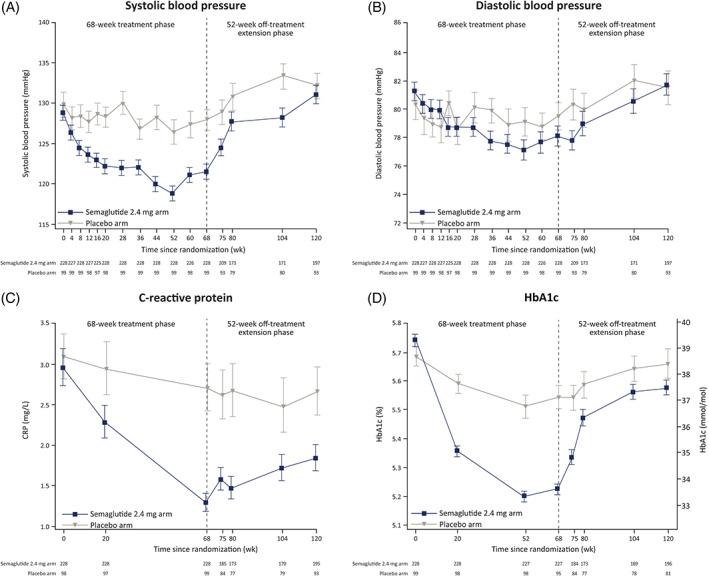
Extension analyses included 327 participants. From week 0 to week 68, mean weight loss was 17.3% (SD: 9.3%) with semaglutide and 2.0% (SD: 6.1%) with placebo. Following treatment withdrawal, semaglutide and placebo participants regained 11.6 (SD: 7.7) and 1.9 (SD: 4.8) percentage points of lost weight, respectively, by week 120, resulting in net losses of 5.6% (SD: 8.9%) and 0.1% (SD: 5.8%), respectively, from week 0 to week 120. Cardiometabolic improvements seen from week 0 to week 68 with semaglutide reverted towards baseline at week 120 for most variables.
CONCLUSIONS
One year after withdrawal of once-weekly subcutaneous semaglutide 2.4 mg and lifestyle intervention, participants regained two-thirds of their prior weight loss, with similar changes in cardiometabolic variables. Findings confirm the chronicity of obesity and suggest ongoing treatment is required to maintain improvements in weight and health.
目的
在 STEP 1 试验扩展中探索治疗停药后体重和心血管代谢危险因素的变化。
材料和方法
STEP 1(NCT03548935)将 1961 名身体质量指数(BMI)≥30kg/m(或≥27kg/m 伴有≥1 种与体重相关的合并症)且无糖尿病的成年人随机分为两组,分别接受每周一次皮下注射司美格鲁肽 2.4mg(包括 16 周的剂量递增)或安慰剂,作为生活方式干预的辅助治疗。第 68 周时,停止治疗(包括生活方式干预)。停药后扩展评估了完成 68 周治疗的代表性亚组参与者进一步一年的情况。该亚组包括来自加拿大、德国和英国任何地点,以及美国和日本主要阶段招募最多的地点的所有符合条件的参与者。扩展分析中的所有分析均为探索性分析。
结果
扩展分析包括 327 名参与者。从第 0 周到第 68 周,司美格鲁肽组的平均体重减轻 17.3%(SD:9.3%),安慰剂组为 2.0%(SD:6.1%)。停药后,司美格鲁肽组和安慰剂组分别在第 120 周时体重增加了 11.6(SD:7.7)和 1.9(SD:4.8)个百分点,分别导致第 0 周到第 120 周的体重净损失 5.6%(SD:8.9%)和 0.1%(SD:5.8%)。从第 0 周到第 120 周,司美格鲁肽组观察到的心血管代谢改善在第 120 周时恢复到基线,大多数变量都是如此。
结论
每周一次皮下注射司美格鲁肽 2.4mg 和生活方式干预停止一年后,参与者恢复了之前体重减轻的三分之二,心血管代谢变量也发生了类似的变化。这些发现证实了肥胖的慢性特征,并表明需要持续治疗以维持体重和健康的改善。


 Zotero 插件