
雷公藤红素递呈:中药与纳米医学的结合。
Delivery of triptolide: a combination of traditional Chinese medicine and nanomedicine.
机构信息
School of Pharmaceutical Sciences, Guangdong Provincial Key Laboratory of New Drug Screening, Southern Medical University, Guangzhou, 510515, China.
Department of Radiology, Jiangsu Key Laboratory of Molecular and Functional Imaging, Zhongda Hospital, Medical School, Southeast University, Nanjing, 210009, China.
出版信息
J Nanobiotechnology. 2022 Apr 20;20(1):194. doi: 10.1186/s12951-022-01389-7.
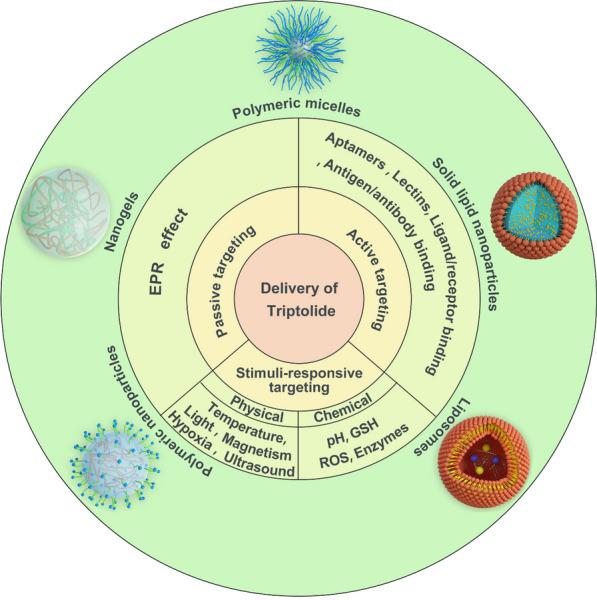
As a natural product with various biological activities, triptolide (TP) has been reported in anti-inflammatory, anti-tumor and anti-autoimmune studies. However, the narrow therapeutic window, poor water solubility, and fast metabolism limit its wide clinical application. To reduce its adverse effects and enhance its efficacy, research and design of targeted drug delivery systems (TDDS) based on nanomaterials is one of the most viable strategies at present. This review summarizes the reports and studies of TDDS combined with TP in recent years, including passive and active targeting of drug delivery systems, and specific delivery system strategies such as polymeric micelles, solid lipid nanoparticles, liposomes, and stimulus-responsive polymer nanoparticles. The reviewed literature presented herein indicates that TDDS is a multifunctional and efficient method for the delivery of TP. In addition, the advantages and disadvantages of TDDS are sorted out, aiming to provide reference for the combination of traditional Chinese medicine and advanced nano drug delivery systems (NDDS) in the future.
作为一种具有多种生物活性的天然产物,雷公藤红素(TP)在抗炎、抗肿瘤和抗自身免疫研究中已有报道。然而,其治疗窗较窄、水溶性差、代谢快,限制了其广泛的临床应用。为了降低其不良反应并提高疗效,基于纳米材料的靶向药物传递系统(TDDS)的研究和设计是目前最可行的策略之一。本综述总结了近年来 TP 与 TDDS 联合的报道和研究,包括药物传递系统的被动和主动靶向,以及聚合物胶束、固体脂质纳米粒、脂质体和刺激响应聚合物纳米粒等特定的传递系统策略。本文综述的文献表明,TDDS 是一种多功能、高效的 TP 传递方法。此外,还对 TDDS 的优缺点进行了梳理,以期为未来中药与先进的纳米药物传递系统(NDDS)的结合提供参考。

 Zotero 插件