
新型GII.2[P16]和GII.4悉尼[P16]诺如病毒的进化分析
Evolutionary analyses of emerging GII.2[P16] and GII.4 Sydney [P16] noroviruses.
作者信息
Zheng Guo-Li, Zhu Zheng-Xi, Cui Jia-le, Yu Jie-Mei
机构信息
College of Life Sciences and Bioengineering, Beijing Jiaotong University, 3 Shangyuan Residency, Hai-Dian District, Beijing 100044, China.
出版信息
Virus Evol. 2022 Apr 4;8(1):veac030. doi: 10.1093/ve/veac030. eCollection 2022.
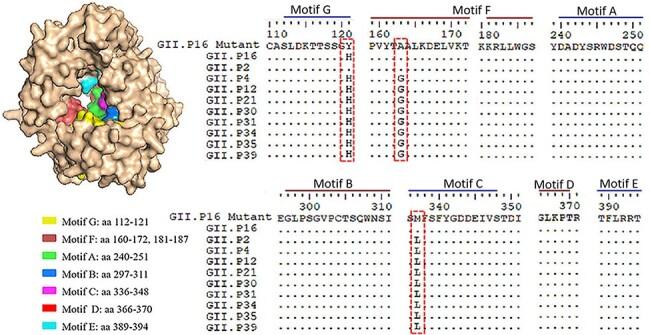
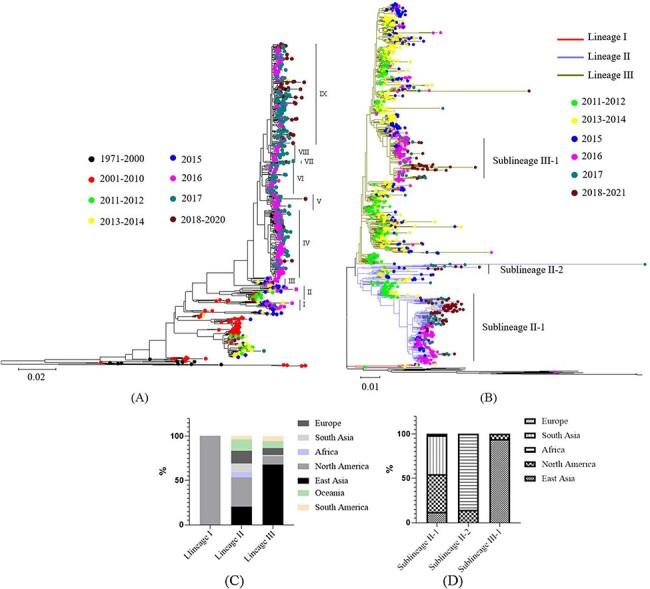
GII.2[P16] and GII.4 Sydney [P16] are currently the two predominant norovirus genotypes. This study sought to clarify their evolutionary patterns by analyzing the major capsid VP1 and RNA-dependent RNA polymerase (RdRp) genes. Sequence diversities were analyzed at both nucleotide and amino acid levels. Selective pressures were evaluated with the Hyphy package in different models. Phylogenetic trees were constructed by the maximum likelihood method from full VP1 sequences, and evolutionary rates were estimated by the Bayesian Markov Chain Monte Carlo approach. The results showed that (1) several groups of tightly linked mutations between the RdRp and VP1 genes were detected in the GII.2[P16] and GII.4[P16] noroviruses, and most of these mutations were synonymous, which may lead to a better viral fitness to the host; (2) although the pattern of having new GII.4 variants every 2-4 years has been broken, both the pre- and the post-2015 Sydney VP1 had comparable evolutionary rates to previously epidemic GII.4 variants, and half of the major antigenic sites on GII.4 Sydney had residue substitutions and several caused obvious changes in the carbohydrate-binding surface that may potentially alter the property of the virus; and (3) GII.4 Sydney variants during 2018-21 showed geographical specificity in East Asia, South Asia, and North America; the antigenic sites of GII.2 are strictly conserved, but the GII.2 VP1 chronologically evolved into nine different sublineages over time, with sublineage IX being the most prevalent one since 2018. This study suggested that both VP1 and RdRp of the GII.2[P16] and GII.4 Sydney [P16] noroviruses exhibited different evolutionary directions. GII.4[P16] is likely to generate potential novel epidemic variants by accumulating mutations in the P2 domain, similar to previously epidemic GII.4 variants, while GII.2[P16] has conserved predicted antigenicity and may evolve by changing the properties of nonstructural proteins, such as polymerase replicational fidelity and efficiency. This study expands the understanding of the evolutionary dynamics of GII.2[P16] and GII.4[P16] noroviruses and may predict the emergence of new variants.
GII.2[P16]和GII.4悉尼株[P16]是目前两种主要的诺如病毒基因型。本研究旨在通过分析主要衣壳蛋白VP1和RNA依赖性RNA聚合酶(RdRp)基因来阐明它们的进化模式。在核苷酸和氨基酸水平上分析序列多样性。使用Hyphy软件包在不同模型中评估选择压力。通过最大似然法从完整的VP1序列构建系统发育树,并通过贝叶斯马尔可夫链蒙特卡罗方法估计进化速率。结果表明:(1)在GII.2[P16]和GII.4[P16]诺如病毒中检测到RdRp和VP1基因之间几组紧密连锁的突变,其中大多数突变为同义突变,这可能导致病毒对宿主具有更好的适应性;(2)尽管每2 - 4年出现新型GII.4变异株的模式已被打破,但2015年前后的悉尼株VP1与之前流行的GII.4变异株具有相当的进化速率,并且GII.4悉尼株上一半的主要抗原位点存在残基替换,其中一些导致碳水化合物结合表面发生明显变化,这可能会改变病毒的特性;(3)2018 - 2021年期间的GII.4悉尼株变异株在东亚、南亚和北美表现出地理特异性;GII.2的抗原位点严格保守,但GII.2 VP1随时间推移按时间顺序演变为九个不同的亚谱系,亚谱系IX自2018年以来最为普遍。本研究表明,GII.2[P16]和GII.4悉尼株[P16]诺如病毒的VP1和RdRp均表现出不同的进化方向。GII.4[P16]可能通过在P2结构域积累突变产生潜在的新型流行变异株,类似于之前流行的GII.4变异株,而GII.2[P16]具有保守的预测抗原性,可能通过改变非结构蛋白的特性(如聚合酶复制保真度和效率)来进化。本研究扩展了对GII.2[P16]和GII.4[P16]诺如病毒进化动态的理解,并可能预测新变异株的出现。




 Zotero 插件