
丙泊酚,一种麻醉剂,通过 cAMP 依赖性门控机制的变构调节抑制 HCN 通道。
Propofol, an Anesthetic Agent, Inhibits HCN Channels through the Allosteric Modulation of the cAMP-Dependent Gating Mechanism.
机构信息
Department of Anesthesiology, Shiga University of Medical Science, Otsu 520-2192, Japan.
Department of Physiology, Shiga University of Medical Science, Otsu 520-2192, Japan.
出版信息
Biomolecules. 2022 Apr 12;12(4):570. doi: 10.3390/biom12040570.
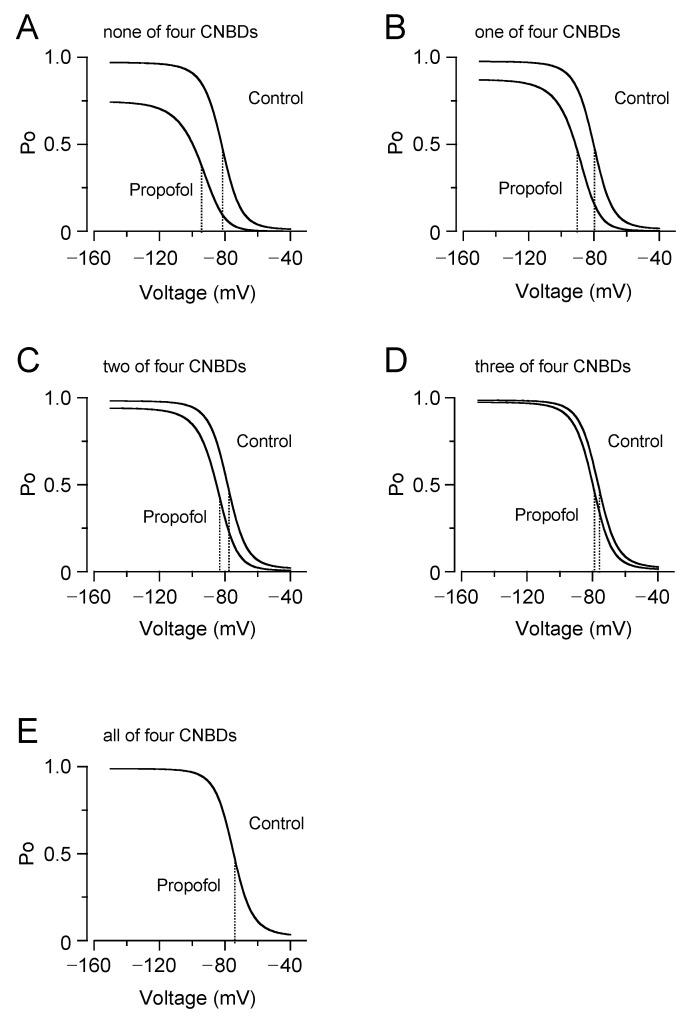
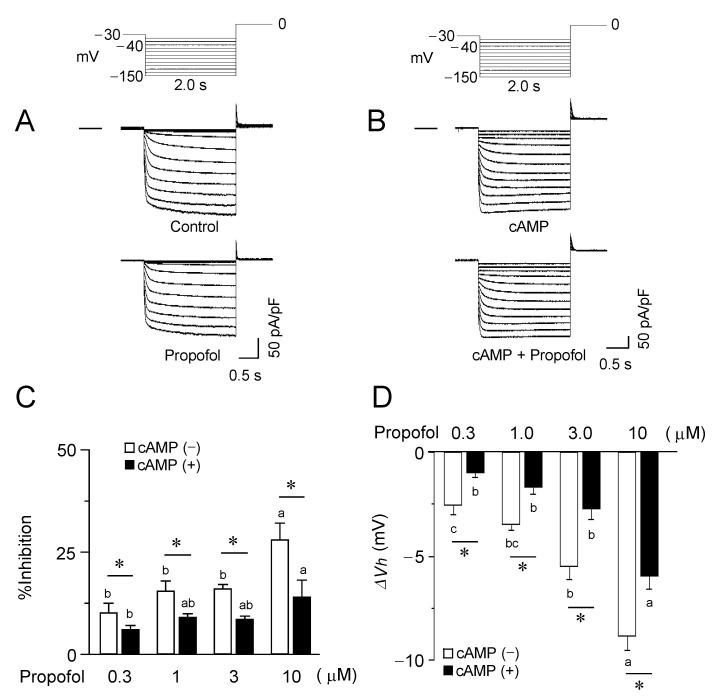
Propofol is a broadly used intravenous anesthetic agent that can cause cardiovascular effects, including bradycardia and asystole. A possible mechanism for these effects is slowing cardiac pacemaker activity due to inhibition of the hyperpolarization-activated, cyclic nucleotide-gated (HCN) channels. However, it remains unclear how propofol affects the allosteric nature of the voltage- and cAMP-dependent gating mechanism in HCN channels. To address this aim, we investigated the effect of propofol on HCN channels (HCN4 and HCN2) in heterologous expression systems using a whole-cell patch clamp technique. The extracellular application of propofol substantially suppressed the maximum current at clinical concentrations. This was accompanied by a hyperpolarizing shift in the voltage dependence of channel opening. These effects were significantly attenuated by intracellular loading of cAMP, even after considering the current modification by cAMP in opposite directions. The differential degree of propofol effects in the presence and absence of cAMP was rationalized by an allosteric gating model for HCN channels, where we assumed that propofol affects allosteric couplings between the pore, voltage-sensor, and cyclic nucleotide-binding domain (CNBD). The model predicted that propofol enhanced autoinhibition of pore opening by unliganded CNBD, which was relieved by the activation of CNBD by cAMP. Taken together, these findings reveal that propofol acts as an allosteric modulator of cAMP-dependent gating in HCN channels, which may help us to better understand the clinical action of this anesthetic drug.
异丙酚是一种广泛应用的静脉麻醉剂,可引起心血管效应,包括心动过缓和停搏。这些效应的可能机制是由于抑制超极化激活的环核苷酸门控 (HCN) 通道而减缓心脏起搏器的活动。然而,异丙酚如何影响 HCN 通道的电压和 cAMP 依赖性门控机制的变构性质仍不清楚。为了解决这一目标,我们使用全细胞膜片钳技术在异源表达系统中研究了异丙酚对 HCN 通道 (HCN4 和 HCN2) 的影响。在临床浓度下,异丙酚的细胞外应用显著抑制了最大电流。这伴随着通道开放的电压依赖性的超极化移位。即使考虑到 cAMP 对电流的相反方向的修饰,cAMP 的细胞内加载也显著减弱了这些效应。在存在和不存在 cAMP 的情况下,异丙酚效应的差异程度可以通过 HCN 通道的变构门控模型来合理化,我们假设异丙酚影响孔、电压传感器和环核苷酸结合域 (CNBD) 之间的变构偶联。该模型预测异丙酚增强了未结合的 CNBD 对孔开放的自动抑制,而 cAMP 激活 CNBD 则缓解了这种抑制。总之,这些发现表明,异丙酚作为 HCN 通道中 cAMP 依赖性门控的变构调节剂起作用,这可能有助于我们更好地理解这种麻醉药物的临床作用。



 Zotero 插件