
中国西南部云南省奶牛和奶水牛中[物种名称未给出]的发生情况及分子特征
Occurrence and Molecular Characterization of spp. in Dairy Cattle and Dairy Buffalo in Yunnan Province, Southwest China.
作者信息
Meng Ying-Wen, Shu Fan-Fan, Pu Li-Hua, Zou Yang, Yang Jian-Fa, Zou Feng-Cai, Zhu Xing-Quan, Li Zhao, He Jun-Jun
机构信息
Key Laboratory of Veterinary Public Health of Yunnan Province, College of Veterinary Medicine, Yunnan Agricultural University, Kunming 650201, China.
State Key Laboratory of Veterinary Etiological Biology, Key Laboratory of Veterinary Parasitology of Gansu Province, Lanzhou Veterinary Research Institute, Chinese Academy of Agricultural Sciences, Lanzhou 730046, China.
出版信息
Animals (Basel). 2022 Apr 15;12(8):1031. doi: 10.3390/ani12081031.
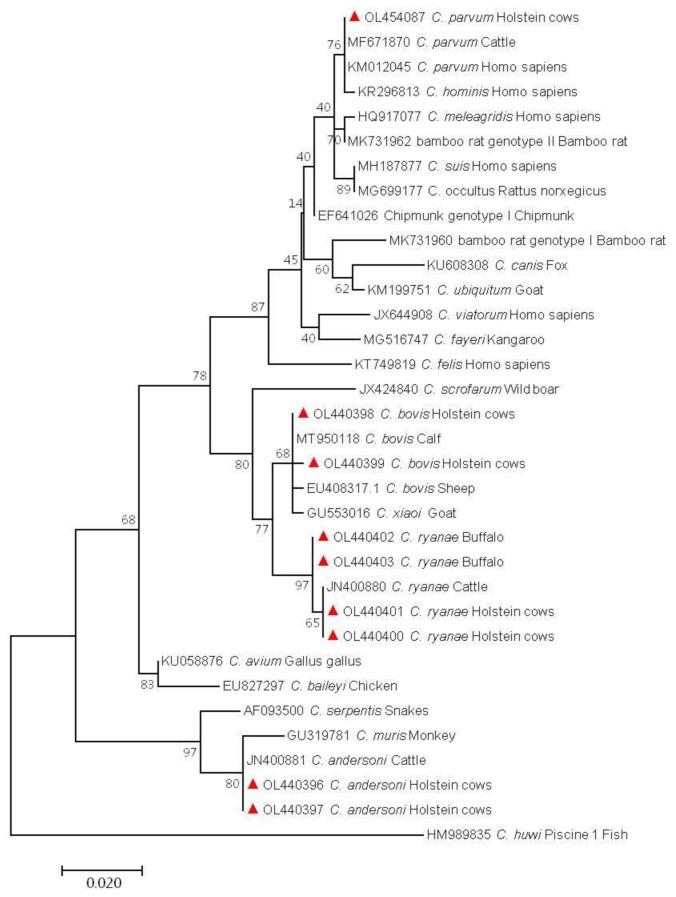
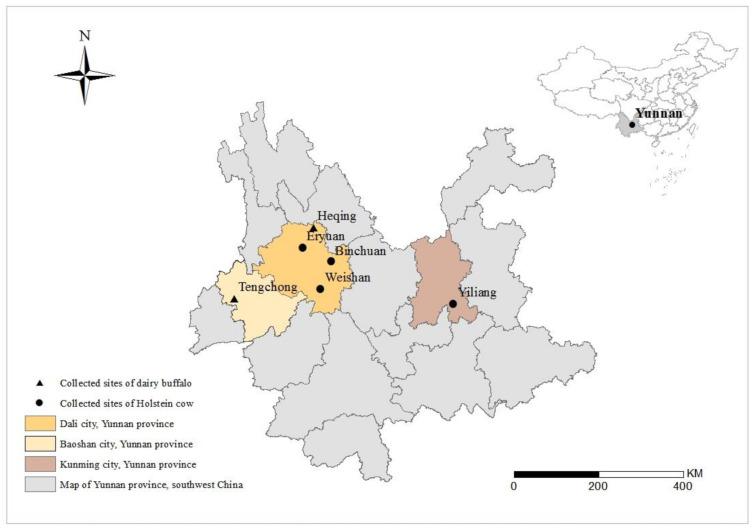
spp. are important foodborne and waterborne pathogens in humans and animals, causing diarrheal diseases. Cattle are one of the reservoirs of infection in humans. However, data on the occurrence of spp. in cattle in Yunnan Province remains limited. A total of 700 fecal samples were collected from Holstein cows ( = 442) and dairy buffaloes ( = 258) in six counties of Yunnan Province. The occurrence and genotypes of spp. were analyzed using nested PCR and DNA sequencing. Furthermore, the isolates were further analyzed using multilocus sequence typing (MLST) at four gene loci (MS1, MS2, MS3, and MS16), and the isolate was subtyped by 60-kDa glycoprotein (60) loci. The occurrence of spp. in Holstein cows and dairy buffaloes was 14.7% (65/442) and 1.1% (3/258), respectively. Of these positive samples, 56 Holstein cow samples represented , four Holstein cow samples represented , three Holstein cow samples represented , and one represented . Meanwhile, only three dairy buffalo samples represented . MLST analysis of subtypes of detected four subtypes, including A5A4A2A1 ( = 7), A4A4A4A1 ( = 7), A1A4A4A1 ( = 2), and A4A4A2A1 ( = 1). One isolate was identified as the IIdA18G1 subtype. These results revealed the high occurrence and high genetic diversity of spp. in Holstein cows in Yunnan Province, enriching the knowledge of the population genetic structure of spp. in Yunnan Province.
[具体菌名]属细菌是人和动物中重要的食源性病原体和水源性病原体,可引发腹泻疾病。牛是人类感染的储存宿主之一。然而,关于云南省牛群中[具体菌名]属细菌的发生情况的数据仍然有限。从云南省六个县的荷斯坦奶牛(n = 442)和奶水牛(n = 258)中总共采集了700份粪便样本。使用巢式PCR和DNA测序分析了[具体菌名]属细菌的发生情况和基因型。此外,对[具体菌名]属分离株在四个基因位点(MS1、MS2、MS3和MS16)进行多位点序列分型(MLST)进一步分析,并通过60 kDa糖蛋白(60)位点对[具体菌名]属分离株进行亚型分型。荷斯坦奶牛和奶水牛中[具体菌名]属细菌的发生率分别为14.7%(65/442)和1.1%(3/258)。在这些阳性样本中,56份荷斯坦奶牛样本代表[具体亚型1],4份荷斯坦奶牛样本代表[具体亚型2],3份荷斯坦奶牛样本代表[具体亚型3],1份代表[具体亚型4]。同时,只有3份奶水牛样本代表[具体亚型]。对[具体菌名]属亚型的MLST分析检测到四种亚型,包括A5A4A2A1(n = 7)、A4A4A4A1(n = 7)、A1A4A4A1(n = 2)和A4A4A2A1(n = 1)。一株[具体菌名]属分离株被鉴定为IIdA18G1亚型。这些结果揭示了云南省荷斯坦奶牛中[具体菌名]属细菌的高发生率和高遗传多样性,丰富了云南省[具体菌名]属细菌群体遗传结构的知识。
 Zotero 插件