
1 型糖尿病的发病机制:既有事实和新见解。
Pathogenesis of Type 1 Diabetes: Established Facts and New Insights.
机构信息
Division of Paediatrics, University Medical Centre Ljubljana, 1000 Ljubljana, Slovenia.
Department of Paediatrics, Faculty of Medicine, University of Ljubljana, 1000 Ljubljana, Slovenia.
出版信息
Genes (Basel). 2022 Apr 16;13(4):706. doi: 10.3390/genes13040706.
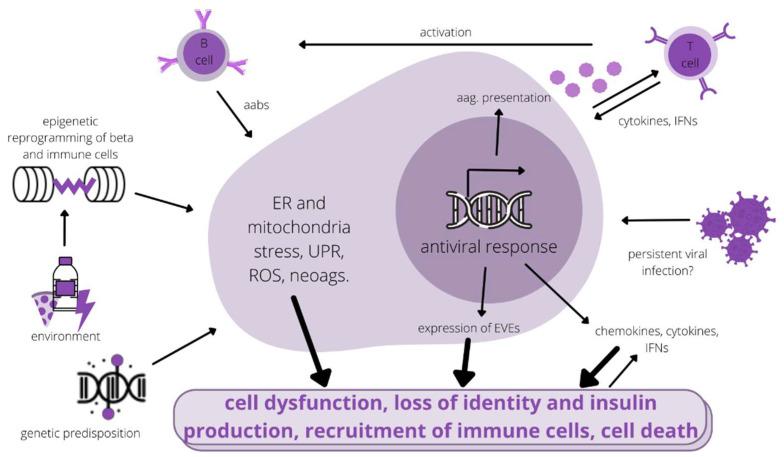
Type 1 diabetes (T1D) is an autoimmune disease characterized by the T-cell-mediated destruction of insulin-producing β-cells in pancreatic islets. It generally occurs in genetically susceptible individuals, and genetics plays a major role in the development of islet autoimmunity. Furthermore, these processes are heterogeneous among individuals; hence, different endotypes have been proposed. In this review, we highlight the interplay between genetic predisposition and other non-genetic factors, such as viral infections, diet, and gut biome, which all potentially contribute to the aetiology of T1D. We also discuss a possible active role for β-cells in initiating the pathological processes. Another component in T1D predisposition is epigenetic influences, which represent a link between genetic susceptibility and environmental factors and may account for some of the disease heterogeneity. Accordingly, a shift towards personalized therapies may improve the treatment results and, therefore, result in better outcomes for individuals in the long-run. There is also a clear need for a better understanding of the preclinical phases of T1D and finding new predictive biomarkers for earlier diagnosis and therapy, with the final goal of reverting or even preventing the development of the disease.
1 型糖尿病(T1D)是一种自身免疫性疾病,其特征是 T 细胞介导的胰岛中胰岛素产生β细胞的破坏。它通常发生在遗传易感个体中,遗传在胰岛自身免疫的发展中起主要作用。此外,这些过程在个体之间存在异质性;因此,已经提出了不同的表型。在这篇综述中,我们强调了遗传易感性与其他非遗传因素(如病毒感染、饮食和肠道微生物群)之间的相互作用,这些因素都可能导致 T1D 的发病机制。我们还讨论了β细胞在启动病理过程中可能发挥的积极作用。T1D 易感性的另一个组成部分是表观遗传影响,它是遗传易感性和环境因素之间的联系,可能解释了部分疾病的异质性。因此,向个体化治疗的转变可能会改善治疗结果,从而从长远来看为个体带来更好的结果。此外,还需要更好地了解 T1D 的临床前阶段,并寻找新的预测性生物标志物以进行早期诊断和治疗,最终目标是逆转甚至预防疾病的发展。
 Zotero 插件