
通过渗透压诱导脂质体收缩调节类旁细胞药物跨人工仿生屏障的转运
Modulation of Paracellular-like Drug Transport across an Artificial Biomimetic Barrier by Osmotic Stress-Induced Liposome Shrinking.
作者信息
Eriksen Jonas Borregaard, Barakat Hesham, Luppi Barbara, Brandl Martin, Bauer-Brandl Annette
机构信息
Department of Physics Chemistry and Pharmacy, University of Southern Denmark, Campusvej 55, DK-5230 Odense, Denmark.
Department of Pharmacy and Biotechnology, Alma Mater Studiorum-University of Bologna, Via San Donato 19/2, 40127 Bologna, Italy.
出版信息
Pharmaceutics. 2022 Mar 28;14(4):721. doi: 10.3390/pharmaceutics14040721.
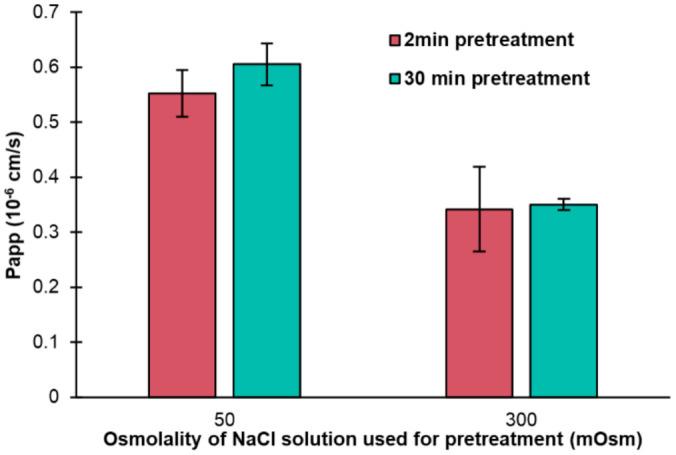
Various types of artificial biomimetic barriers are widely utilized as in vitro tools to predict the passive "transcellular" transport of drug compounds. The current study investigated if the sandwich barrier PermeaPad, which is composed of tightly packed phospholipid vesicles enclosed between two support sheets, contributes to a transport mechanism that is paracellular-like, representing one of the alternative pathways of passive transport in vivo, primarily of relevance for hydrophilic drug compounds. To this end, we pretreated the commercial PermeaPad barrier with NaCl solutions of either high or low osmolality prior to permeation experiments on reversed Franz cell setups with hydrophilic model compounds calcein and acyclovir and hydrophobic model compounds hydrocortisone and celecoxib. Our starting hypothesis was that the liposomes formed in the barrier during the hydration step should either shrink or swell upon contact with test media (drug solutions) due to osmotic pressure difference as compared to the pretreatment solutions. Apparent permeabilities for calcein and acyclovir across the PermeaPad barrier were found to increase approximately 2.0 and 1.7 fold, respectively, upon hypo-osmotic pretreatment (soaking in hypotonic medium, while the permeation of hydrocortisone and celecoxib remained unchanged. A control experiment with lipid-free barriers (support sheets) indicated that the permeation of all the compounds was virtually unchanged upon hypo-osmotic pretreatment. In conclusion, soaking PermeaPad in a medium of lower osmotic pressure than that used during the permeation study appears to induce the osmotic shrinking of the lipid vesicles in the barrier, leaving wider water channels between the vesicles and, thus, allowing hydrophilic compounds to pass the barrier in a paracellular-like manner.
各种类型的人工仿生屏障被广泛用作体外工具,以预测药物化合物的被动“跨细胞”转运。本研究调查了由紧密堆积的磷脂囊泡夹在两个支撑片之间组成的三明治屏障PermeaPad是否有助于一种类似细胞旁途径的转运机制,这是体内被动转运的替代途径之一,主要与亲水性药物化合物相关。为此,在使用亲水性模型化合物钙黄绿素和阿昔洛韦以及疏水性模型化合物氢化可的松和塞来昔布进行反向弗兰兹细胞装置渗透实验之前,我们用高渗或低渗的NaCl溶液对市售的PermeaPad屏障进行了预处理。我们最初的假设是,在水合步骤中屏障中形成的脂质体在与测试介质(药物溶液)接触时,由于与预处理溶液相比的渗透压差异,应该会收缩或膨胀。发现经低渗预处理(浸泡在低渗介质中)后,钙黄绿素和阿昔洛韦通过PermeaPad屏障的表观渗透率分别增加了约2.0倍和1.7倍,而氢化可的松和塞来昔布的渗透率保持不变。使用无脂质屏障(支撑片)的对照实验表明,经低渗预处理后所有化合物的渗透率实际上没有变化。总之,将PermeaPad浸泡在渗透压低于渗透研究中所用渗透压的介质中,似乎会诱导屏障中脂质体的渗透收缩,在脂质体之间留下更宽的水通道,从而使亲水性化合物以类似细胞旁的方式通过屏障。


 Zotero 插件