
多粘菌素B与大麻二酚联合协同杀菌的潜在机制:一项代谢组学研究
Mechanisms Underlying Synergistic Killing of Polymyxin B in Combination with Cannabidiol against : A Metabolomic Study.
作者信息
Hussein Maytham, Allobawi Rafah, Levou Irini, Blaskovich Mark A T, Rao Gauri G, Li Jian, Velkov Tony
机构信息
Department of Biochemistry and Pharmacology, School of Biomedical Sciences, Faculty of Medicine, Dentistry and Health Sciences, The University of Melbourne, Parkville, VIC 3010, Australia.
Institute for Molecular Bioscience, The University of Queensland, Brisbane, QLD 4072, Australia.
出版信息
Pharmaceutics. 2022 Apr 3;14(4):786. doi: 10.3390/pharmaceutics14040786.
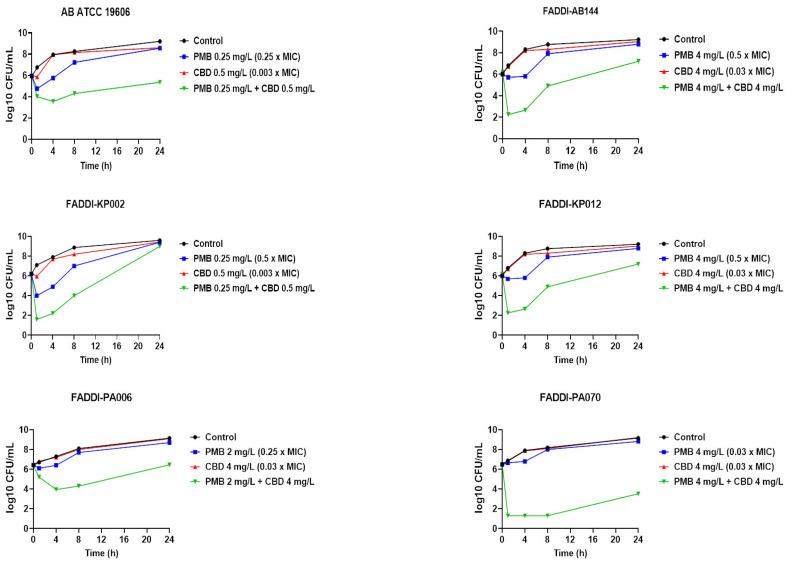
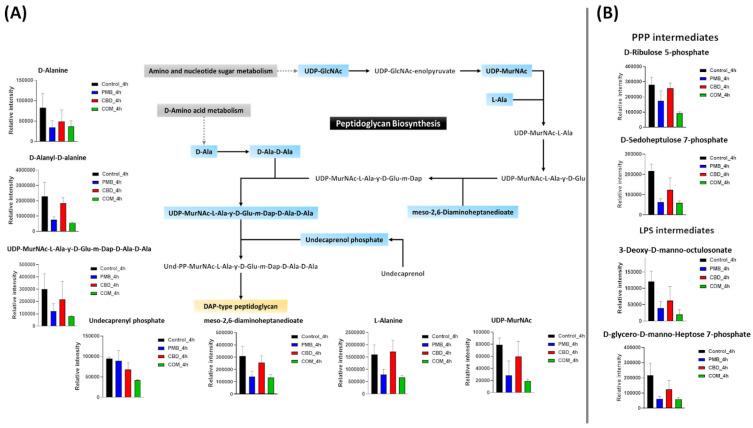
Polymyxins have resurged as the last-resort antibiotics against multidrug-resistant . As reports of polymyxin resistance in with monotherapy have become increasingly common, combination therapy is usually the only remaining treatment option. A novel and effective strategy is to combine polymyxins with non-antibiotic drugs. This study aimed to investigate, using untargeted metabolomics, the mechanisms of antibacterial killing synergy of the combination of polymyxin B with a synthetic cannabidiol against ATCC 19606. The antibacterial synergy of the combination against a panel of Gram-negative pathogens (, and ) was also explored using checkerboard and static time-kill assays. The polymyxin B-cannabidiol combination showed synergistic antibacterial activity in checkerboard and static time-kill assays against both polymyxin-susceptible and polymyxin-resistant isolates. The metabolomics study at 1 h demonstrated that polymyxin B monotherapy and the combination (to the greatest extent) significantly perturbed the complex interrelated metabolic pathways involved in the bacterial cell envelope biogenesis (amino sugar and nucleotide sugar metabolism, peptidoglycan, and lipopolysaccharide (LPS) biosynthesis), nucleotides (purine and pyrimidine metabolism) and peptide metabolism; notably, these pathways are key regulators of bacterial DNA and RNA biosynthesis. Intriguingly, the combination caused a major perturbation in bacterial membrane lipids (glycerophospholipids and fatty acids) compared to very minimal changes induced by monotherapies. At 4 h, polymyxin B-cannabidiol induced more pronounced effects on the abovementioned pathways compared to the minimal impact of monotherapies. This metabolomics study for the first time showed that in disorganization of the bacterial envelope formation, the DNA and RNA biosynthetic pathways were the most likely molecular mechanisms for the synergy of the combination. The study suggests the possibility of cannabidiol repositioning, in combination with polymyxins, for treatment of MDR polymyxin-resistant Gram-negative infections.
多粘菌素已重新成为对抗多重耐药菌的最后一道抗生素防线。随着单药治疗中多粘菌素耐药报告日益常见,联合治疗通常是唯一剩下的治疗选择。一种新颖且有效的策略是将多粘菌素与非抗生素药物联合使用。本研究旨在通过非靶向代谢组学研究多粘菌素B与合成大麻二酚联合使用对嗜麦芽窄食单胞菌ATCC 19606的抗菌协同杀伤机制。还使用棋盘法和静态杀菌试验探究了该联合用药对一组革兰氏阴性病原体(嗜麦芽窄食单胞菌、铜绿假单胞菌和鲍曼不动杆菌)的抗菌协同作用。多粘菌素B - 大麻二酚联合用药在棋盘法和静态杀菌试验中对多粘菌素敏感和耐药菌株均表现出协同抗菌活性。1小时时的代谢组学研究表明,多粘菌素B单药治疗以及联合用药(在最大程度上)显著扰乱了参与细菌细胞壁生物合成(氨基糖和核苷酸糖代谢、肽聚糖和脂多糖(LPS)生物合成)、核苷酸(嘌呤和嘧啶代谢)以及肽代谢的复杂相互关联的代谢途径;值得注意的是,这些途径是细菌DNA和RNA生物合成的关键调节因子。有趣的是,与单药治疗引起的极小变化相比,联合用药导致细菌膜脂(甘油磷脂和脂肪酸)出现重大扰动。4小时时,与单药治疗的微小影响相比,多粘菌素B - 大麻二酚对上述途径产生了更明显的影响。这项代谢组学研究首次表明,在细菌包膜形成紊乱过程中,DNA和RNA生物合成途径最有可能是联合用药协同作用的分子机制。该研究表明大麻二酚与多粘菌素联合用于治疗多重耐药的多粘菌素耐药革兰氏阴性菌感染具有重新定位的可能性。


 Zotero 插件