
癌症中的铁失衡:缺乏与过载的交集。
Iron imbalance in cancer: Intersection of deficiency and overload.
机构信息
Institute for Innovation in Mental and Physical Health and Clinical Translation (IMPACT), School of Medicine, Faculty of Health, Deakin University, Geelong, Victoria, Australia.
Department of Translational Medicine Centre, All India Institute of Medical Sciences (AIIMS) Bhopal, Bhopal, India.
出版信息
Cancer Med. 2022 Oct;11(20):3837-3853. doi: 10.1002/cam4.4761. Epub 2022 Apr 22.
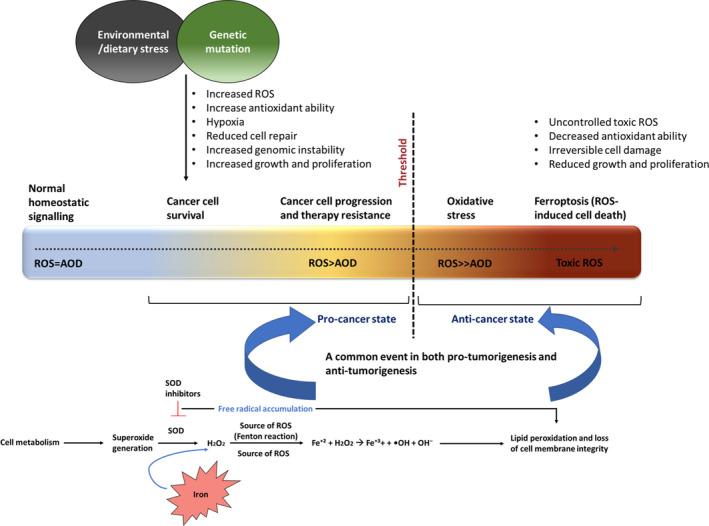
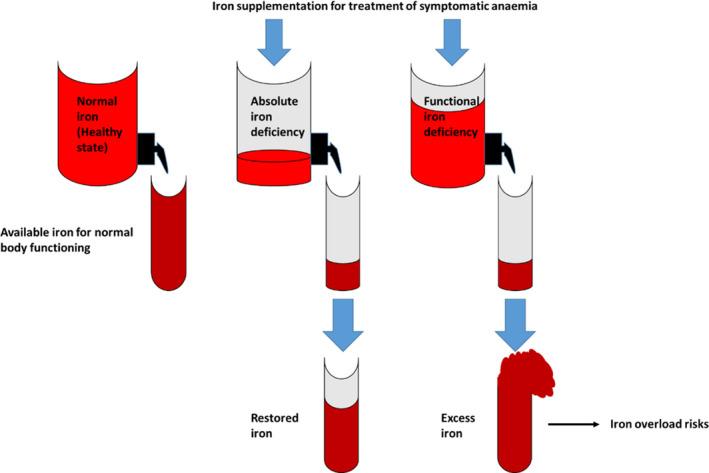
Iron, an essential trace element, plays a complex role in tumour biology. While iron causes cancer clearance through toxic free radical generation, iron-induced free radical flux also acts as a cancer promoter. These fates majorly guided through cellular response towards pro-oxidant and antioxidant settings in a tumour microenvironment, designate iron-induced oxidative stress as a common yet paradoxical factor in pro-tumorigenesis as well as anti-tumorigenesis, posing a challenge to laying down iron thresholds favouring tumour clearance. Additionally, complexity of iron's association with carcinogenesis has been extended to iron-induced ROS's involvement in states of both iron deficiency and overload, conditions identified as comparable, inevitable and significant coexisting contributors as well as outcomes in chronic infections and tumorigenesis. Besides, iron overload may also develop as an unwanted outcome in certain cancer patients, as a result of symptomatic anaemia treatment owed to irrational iron-restoration therapies without a prior knowledge of body's iron status with both conditions synergistically acting towards tumour aggravation. The co-play of iron deficiency and overload along with iron's pro-tumour and antitumour roles with intersecting mechanisms, thus presents an unpredictable regulatory response loop in a state of malignancy. The relevance of iron's thresholds beyond which it proves to be beneficial against tumorigenesis hence becomes questionable. These factors pose a challenge, over establishing if iron chelation or iron flooding acts as a better approach towards antitumour therapies. This review presents a critical picture of multiple contrasting features of iron's behaviour in cancer, leading towards two conditions lying at opposite ends of a spectrum: iron deficiency and overload in chronic disease conditions including cancer, hence, validating the critical significance of diagnosis of patients' iron status prior to opting for subsequent therapies.
铁是一种必需的微量元素,在肿瘤生物学中发挥着复杂的作用。虽然铁通过产生有毒的自由基来清除癌症,但铁诱导的自由基流也可以作为癌症促进剂。这些命运主要通过细胞对肿瘤微环境中促氧化剂和抗氧化剂环境的反应来引导,将铁诱导的氧化应激指定为促肿瘤发生和抗肿瘤发生的常见但矛盾的因素,这给确定有利于肿瘤清除的铁阈值带来了挑战。此外,铁与致癌作用的关系的复杂性已经扩展到铁诱导的 ROS 参与缺铁和铁过载的状态,这些状态被认为是相似的、不可避免的和重要的共同存在的贡献者,也是慢性感染和肿瘤发生的结果。此外,由于不合理的铁恢复治疗,某些癌症患者可能会因贫血症状而出现铁过载,而在不知道体内铁状况的情况下进行治疗,这两种情况协同作用,导致肿瘤恶化。缺铁和铁过载的共同作用以及铁的促肿瘤和抗肿瘤作用及其相互交织的机制,因此在恶性肿瘤状态下呈现出不可预测的调节反应循环。因此,超过一定阈值的铁对肿瘤发生有益的相关性就变得值得怀疑。这些因素对确定铁螯合或铁淹没作为抗肿瘤治疗的更好方法提出了挑战。这篇综述呈现了铁在癌症中行为的多个对比特征的关键图片,导致两种情况处于慢性疾病状态(包括癌症)的光谱两端:缺铁和铁过载,从而验证了在选择后续治疗之前对患者铁状况进行诊断的重要性。
 Zotero 插件