
社会性蜜蜂肠道局限细菌的物种分化。
Species divergence in gut-restricted bacteria of social bees.
机构信息
Department of Integrative Biology, The University of Texas at Austin, Austin, TX 78712.
出版信息
Proc Natl Acad Sci U S A. 2022 May 3;119(18):e2115013119. doi: 10.1073/pnas.2115013119. Epub 2022 Apr 25.
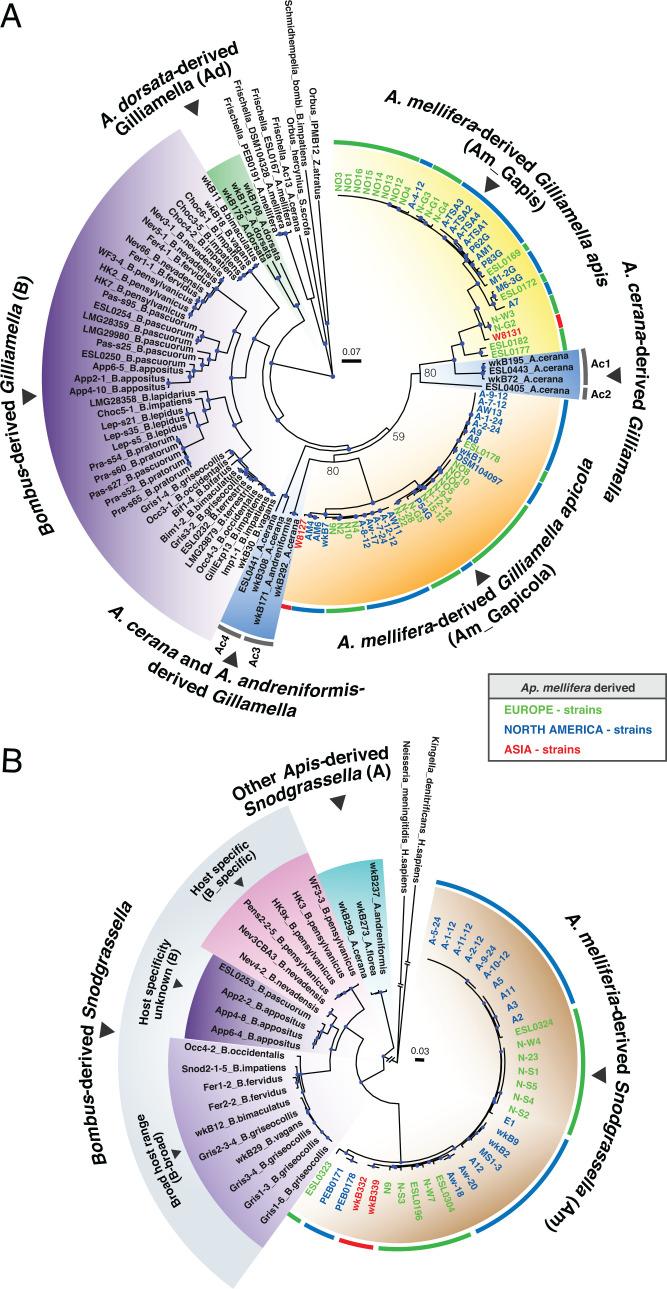
Host-associated microbiomes, particularly gut microbiomes, often harbor related but distinct microbial lineages, but how this diversity arises and is maintained is not well understood. A prerequisite for lineage diversification is reproductive isolation imposed by barriers to gene flow. In host-associated microbes, genetic recombination can be disrupted by confinement to different hosts, for example following host speciation, or by niche partitioning within the same host. Taking advantage of the simple gut microbiome of social bees, we explore the diversification of two groups of gut-associated bacteria, Gilliamella and Snodgrassella, which have evolved for 80 million y with honey bees and bumble bees. Our analyses of sequenced genomes show that these lineages have diversified into discrete populations with limited gene flow. Divergence has occurred between symbionts of different host species and, in some cases, between symbiont lineages within a single host individual. Populations have acquired genes to adapt to specific hosts and ecological niches; for example, Gilliamella lineages differ markedly in abilities to degrade dietary polysaccharides and to use the resulting sugar components. Using engineered fluorescent bacteria in vivo, we show that Gilliamella lineages localize to different hindgut regions, corresponding to differences in their abilities to use spatially concentrated nitrogenous wastes of hosts. Our findings show that bee gut bacteria can diversify due to isolation in different host species and also due to spatial niche partitioning within individual hosts, leading to barriers to gene flow.
宿主相关的微生物组,特别是肠道微生物组,通常包含相关但不同的微生物谱系,但这种多样性是如何产生和维持的还不是很清楚。谱系多样化的一个前提是由基因流动障碍引起的生殖隔离。在宿主相关的微生物中,遗传重组可以通过限制在不同的宿主中而被破坏,例如在宿主物种形成之后,或者通过在同一宿主内的生态位分隔。利用社会性蜜蜂简单的肠道微生物组,我们探索了两种肠道相关细菌 Gilliamella 和 Snodgrassella 的多样化,这两种细菌已经与蜜蜂和大黄蜂进化了 8000 万年。我们对测序基因组的分析表明,这些谱系已经多样化成具有有限基因流动的离散种群。在不同宿主物种的共生体之间,以及在某些情况下,在单个宿主个体内的共生体谱系之间,已经发生了分歧。种群获得了适应特定宿主和生态位的基因;例如,Gilliamella 谱系在降解饮食多糖和利用产生的糖成分的能力上有显著差异。我们使用体内工程化的荧光细菌表明,Gilliamella 谱系定位于不同的后肠区域,这与它们利用宿主空间集中的含氮废物的能力的差异相对应。我们的研究结果表明,蜜蜂肠道细菌可以通过在不同宿主物种中的隔离以及在单个宿主内的空间生态位分隔而多样化,从而导致基因流动的障碍。



 Zotero 插件