
家族史、遗传和非遗传乳腺癌风险预测模型预测的高危人群重叠:对风险分层的影响。
Overlap of high-risk individuals predicted by family history, and genetic and non-genetic breast cancer risk prediction models: implications for risk stratification.
机构信息
Genome Institute of Singapore, Human Genetics, Singapore, Singapore.
Saw Swee Hock School of Public Health, National University of Singapore and National University Health System, Singapore, Singapore.
出版信息
BMC Med. 2022 Apr 26;20(1):150. doi: 10.1186/s12916-022-02334-z.
BACKGROUND
Family history, and genetic and non-genetic risk factors can stratify women according to their individual risk of developing breast cancer. The extent of overlap between these risk predictors is not clear.
METHODS
In this case-only analysis involving 7600 Asian breast cancer patients diagnosed between age 30 and 75 years, we examined identification of high-risk patients based on positive family history, the Gail model 5-year absolute risk [5yAR] above 1.3%, breast cancer predisposition genes (protein-truncating variants [PTV] in ATM, BRCA1, BRCA2, CHEK2, PALB2, BARD1, RAD51C, RAD51D, or TP53), and polygenic risk score (PRS) 5yAR above 1.3%.
RESULTS
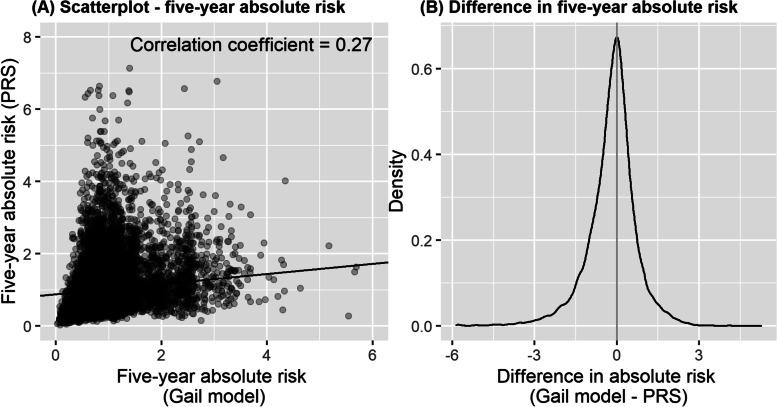
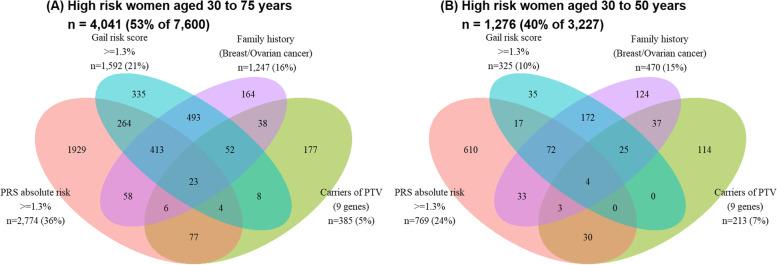
Correlation between 5yAR (at age of diagnosis) predicted by PRS and the Gail model was low (r=0.27). Fifty-three percent of breast cancer patients (n=4041) were considered high risk by one or more classification criteria. Positive family history, PTV carriership, PRS, or the Gail model identified 1247 (16%), 385 (5%), 2774 (36%), and 1592 (21%) patients who were considered at high risk, respectively. In a subset of 3227 women aged below 50 years, the four models studied identified 470 (15%), 213 (7%), 769 (24%), and 325 (10%) unique patients who were considered at high risk, respectively. For younger women, PRS and PTVs together identified 745 (59% of 1276) high-risk individuals who were not identified by the Gail model or family history.
CONCLUSIONS
Family history and genetic and non-genetic risk stratification tools have the potential to complement one another to identify women at high risk.
背景
家族史、遗传和非遗传风险因素可以根据女性个体罹患乳腺癌的风险对其进行分层。这些风险预测因素之间的重叠程度尚不清楚。
方法
在这项涉及 7600 名年龄在 30 至 75 岁之间被诊断患有乳腺癌的亚洲患者的病例对照分析中,我们检查了基于阳性家族史、Gail 模型 5 年绝对风险(5yAR)超过 1.3%、乳腺癌易感性基因(ATM、BRCA1、BRCA2、CHEK2、PALB2、BARD1、RAD51C、RAD51D 或 TP53 中的蛋白截断变异)和多基因风险评分(PRS)5yAR 超过 1.3%来识别高危患者的情况。
结果
PRS 预测的(诊断时的)5yAR 与 Gail 模型之间的相关性较低(r=0.27)。53%的乳腺癌患者(n=4041)通过一种或多种分类标准被认为是高危患者。阳性家族史、PTV 携带、PRS 或 Gail 模型分别识别出 1247(16%)、385(5%)、2774(36%)和 1592(21%)被认为是高危的患者。在年龄低于 50 岁的 3227 名女性亚组中,所研究的四个模型分别识别出 470(15%)、213(7%)、769(24%)和 325(10%)的独特高危患者。对于年轻女性,PRS 和 PTV 共同识别出 1276 名高危个体中的 745 名(59%),这些个体未被 Gail 模型或家族史识别。
结论
家族史和遗传及非遗传风险分层工具有可能相互补充,以识别高危女性。
 Zotero 插件