
60岁及以上老年人饮食炎症指数与认知表现之间的关联
The Association Between Dietary Inflammatory Index and Cognitive Performance in Older Adults Aged 60 Years and Older.
作者信息
Song Wenlei, Feng Yijun, Gong Zonglin, Tian Changwei
机构信息
Department of Disease Control, Kunshan Centers for Disease Control and Prevention, Kunshan, China.
Department of Nursing, Zhouzhuang People's Hospital, Kunshan, China.
出版信息
Front Nutr. 2022 Apr 12;9:748000. doi: 10.3389/fnut.2022.748000. eCollection 2022.
BACKGROUND
Neuroinflammation has been linked to the development of cognitive performance. Epidemiological evidence on dietary inflammatory potential and cognitive performance is scarce. We evaluated the association between dietary inflammatory index (DII) and cognitive performance in older adults.
METHODS
This study included adults aged 60 years or older from the 2011-2014 National Health and Nutrition Examination Survey. The DII scores were calculated based on 27 nutritional parameters. Cognitive performance was assessed with four cognitive tests: the Digit Symbol Substitution Test (DSST, = 2,780), the Consortium to Establish a Registry for Alzheimer's Disease Word Learning (CERAD-WL, = 2,859) and Delayed Recall (CERAD-DR, = 2,857), and the Animal Fluency (AF, = 2,844) tests. Restricted cubic splines and logistic regression were adopted to assess the associations.
RESULTS
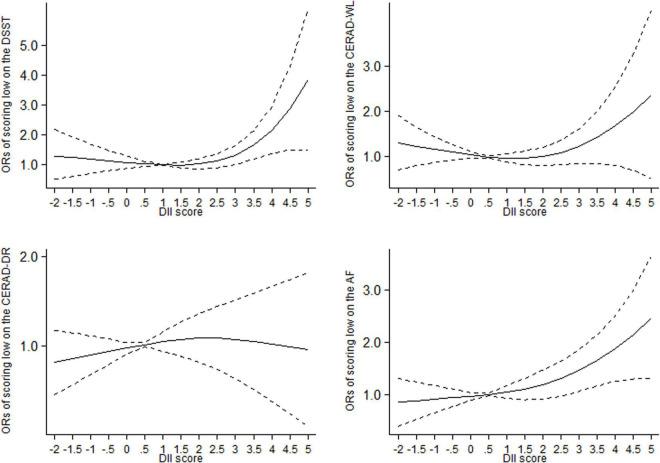
Comparing the highest to lowest tertile of DII scores, the odds ratio (95% CI) of lower cognitive functioning was 1.97 (1.08-3.58) [-trend = 0.02, per 1 unit increment: 1.17 (1.01-1.38)] on DSST, 1.24 (0.87-1.76) [-trend = 0.24, per 1 unit increment: 1.09 (0.96-1.23)] on CERAD-WL, 0.93 (0.57-1.51) [-trend = 0.74, per 1 unit increment: 1.02 (0.87-1.20)] on CERAD-DR, and 1.76 (1.30-2.37) [-trend < 0.01, per 1 unit increment: 1.17 (1.05-1.29)] on AF. The above-mentioned associations were observed in both men and women. In non-linear dose-response analysis, the association between DII and lower cognitive functioning was not significant at lower DII scores up to 3.0, after which the association was significant and the curve rose steeply.
CONCLUSION
Higher DII is associated with lower scores on DSST and AF tests in older adults.
背景
神经炎症与认知能力的发展有关。关于饮食炎症潜能与认知能力的流行病学证据很少。我们评估了老年人饮食炎症指数(DII)与认知能力之间的关联。
方法
本研究纳入了2011 - 2014年美国国家健康与营养检查调查中60岁及以上的成年人。DII分数基于27种营养参数计算得出。认知能力通过四项认知测试进行评估:数字符号替换测试(DSST,n = 2,780)、阿尔茨海默病注册协会词汇学习(CERAD - WL,n = 2,859)和延迟回忆(CERAD - DR,n = 2,857)测试,以及动物流畅性(AF,n = 2,844)测试。采用受限立方样条和逻辑回归来评估关联。
结果
比较DII分数的最高三分位数与最低三分位数,在DSST测试中,认知功能较低的比值比(95%置信区间)为1.97(1.08 - 3.58)[-趋势 = 0.02,每增加1个单位:1.17(1.01 - 1.38)];在CERAD - WL测试中为1.24(0.87 - 1.76)[-趋势 = 0.24,每增加1个单位:1.09(0.96 - 1.23)];在CERAD - DR测试中为0.93(0.57 - 1.51)[-趋势 = 0.74,每增加1个单位:1.02(0.87 - 1.20)];在AF测试中为1.76(1.30 - 2.37)[-趋势 < 0.01,每增加1个单位:1.17(1.05 - 1.29)]。上述关联在男性和女性中均有观察到。在非线性剂量反应分析中,DII与较低认知功能之间的关联在DII分数低于3.0时不显著,之后该关联显著且曲线急剧上升。
结论
较高的DII与老年人DSST和AF测试的较低分数相关。
 Zotero 插件