
随机临床试验:个体与团体催眠治疗肠易激综合征。
Randomised clinical trial: individual versus group hypnotherapy for irritable bowel syndrome.
机构信息
Department of Molecular and Clinical Medicine, Sahlgrenska Academy, Gothenburg, Sweden.
Division of Gastroenterology and Hepatology, University of North Carolina at Chapel Hill, Chapel Hill, North Carolina, USA.
出版信息
Aliment Pharmacol Ther. 2022 Jun;55(12):1501-1511. doi: 10.1111/apt.16934. Epub 2022 May 3.
BACKGROUND
Gut-directed hypnotherapy improves symptoms for patients with irritable bowel syndrome (IBS). Group hypnotherapy, as well as hypnotherapy administered by nurses, can increase treatment availability, but there are few comparisons between individual and group-based hypnotherapy.
AIM
We aimed to evaluate and compare the effectiveness of nurse-administered hypnotherapy for IBS delivered individually or in groups.
METHODS
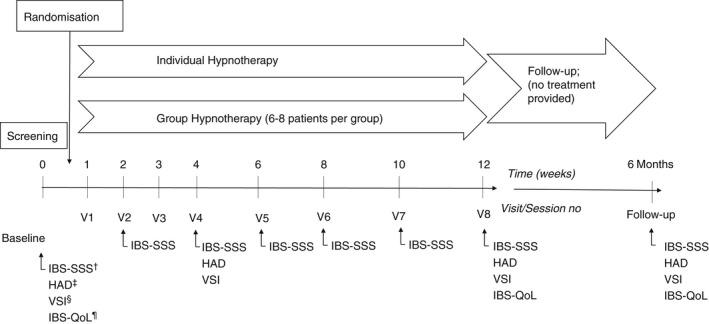
IBS patients were randomised to individual or group hypnotherapy (8 sessions, 12 weeks). The primary endpoint was changes in severity of IBS symptoms. A responder was defined as reduction of IBS severity scoring system (IBS-SSS) ≥50 points at the end of treatment compared to baseline. The effects on extracolonic and psychological symptoms, and quality of life were also assessed. Symptoms were also followed up 6 months after treatment start.
RESULTS
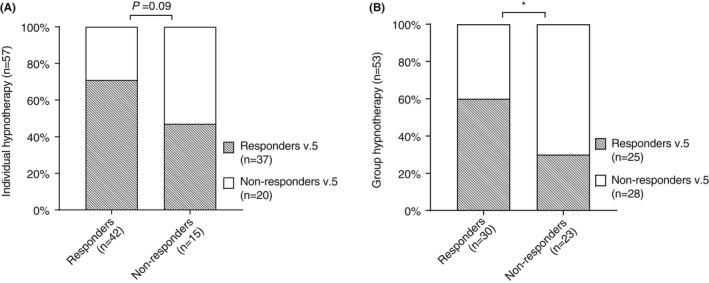
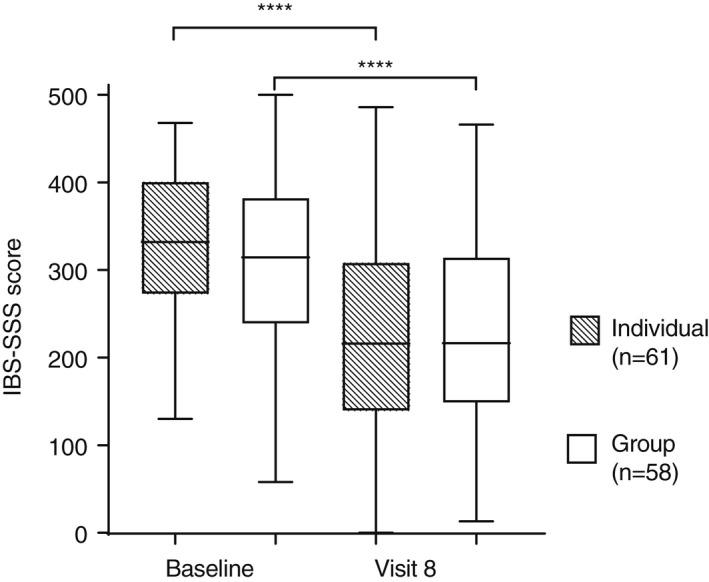
A total of 119 patients were randomised (61 individual, 58 group hypnotherapy). Patients reported improvements in IBS symptoms (IBS-SSS) (individual: 332 (273-401) (median, IQR), versus 216 (140-308), (p < 0.0001), group: 315 (239-382), versus 217 (149-314), (p < 0.0001)), with no differences between the groups (p = 0.16). Extracolonic symptoms, psychological symptoms and quality of life also improved, without clear differences between the groups. Sixty-nine percent of the individual hypnotherapy patients were responders after treatment versus 57% of the group hypnotherapy patients (p = 0.25). Symptom improvements were also seen at follow-up.
CONCLUSIONS
Nurse-administered gut-directed hypnotherapy, delivered individually or in groups, relieves IBS symptoms, improves psychological symptoms and quality of life. Group hypnotherapy can be an efficacious alternative, enabling more patients to benefit from the treatment (ClinicalTrials.gov ID no of study: NCT03432078).
背景
肠道导向催眠疗法可改善肠易激综合征(IBS)患者的症状。小组催眠疗法以及由护士进行的催眠疗法可以增加治疗的可及性,但个体催眠疗法与基于小组的催眠疗法之间的比较很少。
目的
我们旨在评估和比较个体和小组肠道导向催眠疗法治疗 IBS 的有效性。
方法
将 IBS 患者随机分为个体或小组催眠疗法(8 次,12 周)。主要终点是 IBS 症状严重程度的变化。定义应答者为与基线相比,治疗结束时 IBS 严重程度评分系统(IBS-SSS)降低≥50 分。还评估了对结肠外和心理症状以及生活质量的影响。治疗开始后 6 个月也进行了随访。
结果
共有 119 名患者被随机分组(61 名个体,58 名小组催眠疗法)。患者报告 IBS 症状(IBS-SSS)有所改善(个体:332(273-401)(中位数,IQR),与 216(140-308)相比,(p<0.0001),组:315(239-382),与 217(149-314)相比,(p<0.0001)),两组之间无差异(p=0.16)。结肠外症状、心理症状和生活质量也有所改善,两组之间无明显差异。个体催眠疗法治疗后的应答者占 69%,而小组催眠疗法组的应答者占 57%(p=0.25)。在随访时也观察到症状改善。
结论
由护士管理的肠道导向催眠疗法,无论是个体还是小组形式,都能缓解 IBS 症状,改善心理症状和生活质量。小组催眠疗法可以作为一种有效的替代方法,使更多的患者受益于治疗(研究的 ClinicalTrials.gov ID 号:NCT03432078)。



 Zotero 插件