
高级别宫颈上皮内瘤变的临床消退与 DNA 甲基化缺失相关(CONCERVE 研究)。
Clinical Regression of High-Grade Cervical Intraepithelial Neoplasia Is Associated With Absence of DNA Methylation (CONCERVE Study).
机构信息
Amsterdam UMC, Vrije Universiteit Amsterdam, Pathology, Cancer Center Amsterdam, Amsterdam, the Netherlands.
OLVG, Obstetrics and Gynaecology, Amsterdam, the Netherlands.
出版信息
J Clin Oncol. 2022 Sep 10;40(26):3037-3046. doi: 10.1200/JCO.21.02433. Epub 2022 May 5.
PURPOSE
Cervical screening can prevent cancer by detection and treatment of cervical intraepithelial neoplasia grade 2 or 3 (CIN2/3). Screening also results in considerable overtreatment because many CIN2/3 lesions show spontaneous regression when left untreated. In this multicenter longitudinal cohort study of women with untreated CIN2/3, the prognostic value of methylation was evaluated for clinical regression.
PATIENTS AND METHODS
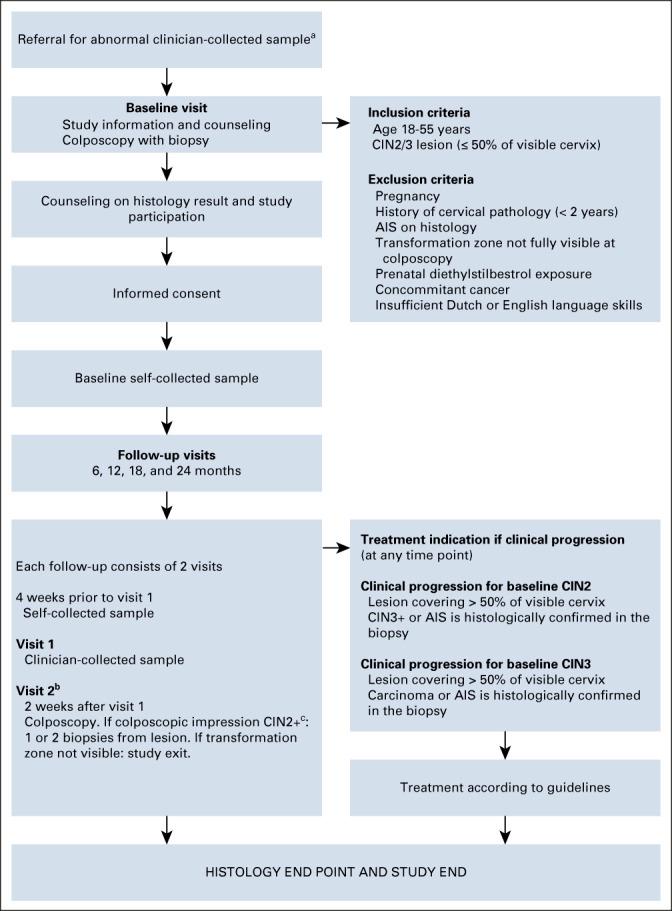
Women with CIN2/3 were prospectively followed for 24 months. Surgical excision was replaced by a wait-and-see policy. methylation was evaluated on all clinician-collected samples and self-collected samples collected at baseline. Every 6 months, human papillomavirus (HPV) testing and cytology were conducted on a clinician-collected sample, and a colposcopic examination was performed by a gynecologist to exclude progression. At the final study visit, two biopsies were taken. Clinical regression was defined as histologically confirmed absence of CIN2+ or an HPV-negative clinician-collected sample with normal cytology. Regression incidences were estimated using the Kaplan-Meier method.
RESULTS
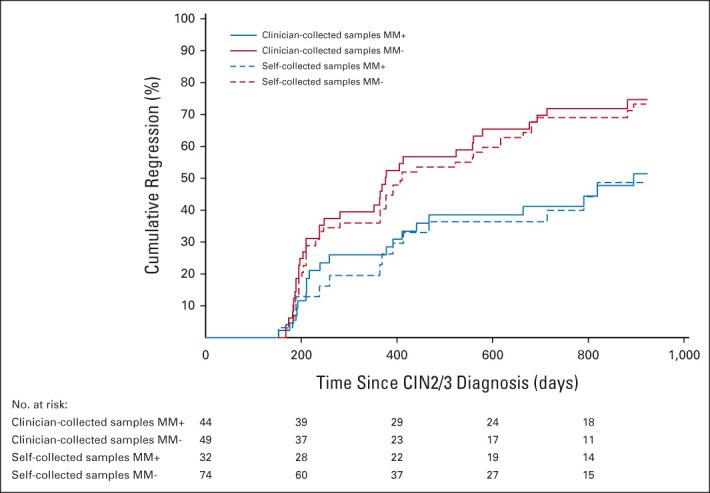
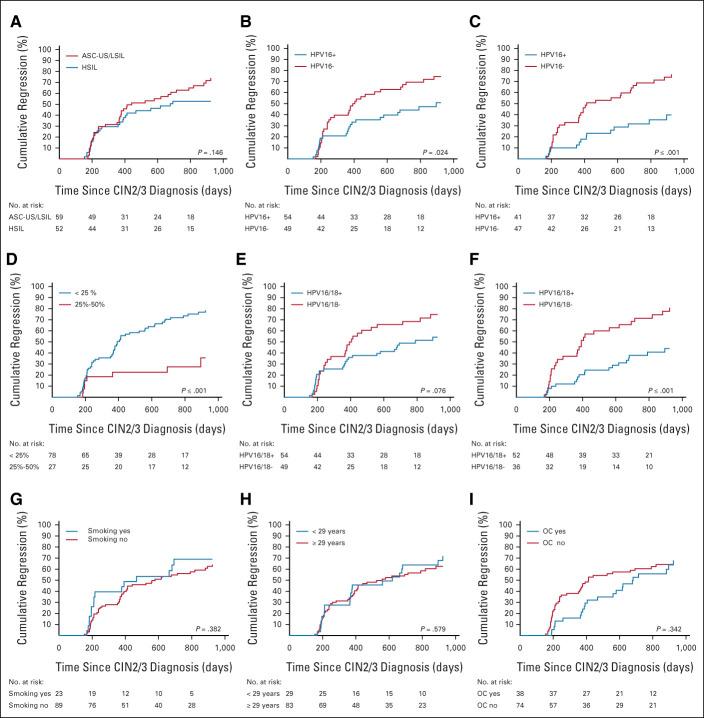
One hundred fourteen women (median age, 30 years; range, 20-53 years) were included, 80 of whom were diagnosed with CIN2 and 34 with CIN3. During the study, 65.8% of women (75/114) did not receive surgical treatment. Women with a result on the baseline clinician-collected sample showed more clinical regression (74.7%) than women with a methylation result (51.4%, = .013). Regression in women with a negative methylation test was highest when cytology was atypical squamous cells of undetermined significance/low-grade squamous intraepithelial lesion (88.4%) or HPV16 was negative (85.1%).
CONCLUSION
Most women with untreated CIN2/3 and a negative baseline methylation test showed clinical regression. Methylation, in combination with cytology or HPV genotyping, can be used to support a wait-and-see policy in women with CIN2/3.
目的
通过检测和治疗宫颈上皮内瘤变 2 级或 3 级(CIN2/3),宫颈筛查可以预防癌症。筛查也会导致过度治疗,因为许多 CIN2/3 病变在未经治疗的情况下会自发消退。在这项针对未经治疗的 CIN2/3 女性的多中心纵向队列研究中,评估了 甲基化对临床消退的预后价值。
患者和方法
前瞻性随访 CIN2/3 女性 24 个月。手术切除被观望政策取代。对所有临床医生收集的样本和基线时自我收集的样本进行 甲基化评估。每 6 个月,对临床医生收集的样本进行人乳头瘤病毒(HPV)检测和细胞学检查,并由妇科医生进行阴道镜检查以排除进展。在最后一次研究访问时,取两个活检。临床消退定义为组织学证实无 CIN2+或 HPV 阴性、细胞学正常的临床医生收集的样本。使用 Kaplan-Meier 方法估计消退发生率。
结果
共纳入 114 名女性(中位年龄 30 岁;范围 20-53 岁),其中 80 名诊断为 CIN2,34 名诊断为 CIN3。在研究期间,65.8%的女性(75/114)未接受手术治疗。基线时临床医生收集的样本中 结果为阳性的女性(74.7%)比 甲基化结果为阳性的女性(51.4%,.013)更有可能出现临床消退。细胞学为不典型鳞状细胞不能明确意义/低级别鳞状上皮内病变(88.4%)或 HPV16 阴性(85.1%)时,阴性 甲基化检测的女性消退率最高。
结论
大多数未经治疗的 CIN2/3 且基线 甲基化检测阴性的女性出现临床消退。甲基化与细胞学或 HPV 基因分型相结合,可用于支持 CIN2/3 女性的观望政策。


 Zotero 插件