
土壤水分可利用性条件下根和地上部之间的双向、长距离激素信号传递。
Bi-directional, long-distance hormonal signalling between roots and shoots of soil water availability.
机构信息
Lancaster Environment Centre, Lancaster University, Lancaster, UK.
NIAB Agronomy, NIAB, Cambridge, UK.
出版信息
Physiol Plant. 2022 May;174(3):e13697. doi: 10.1111/ppl.13697.
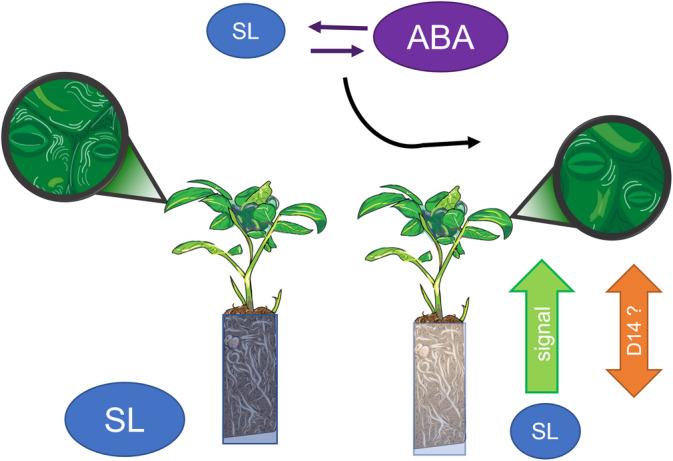
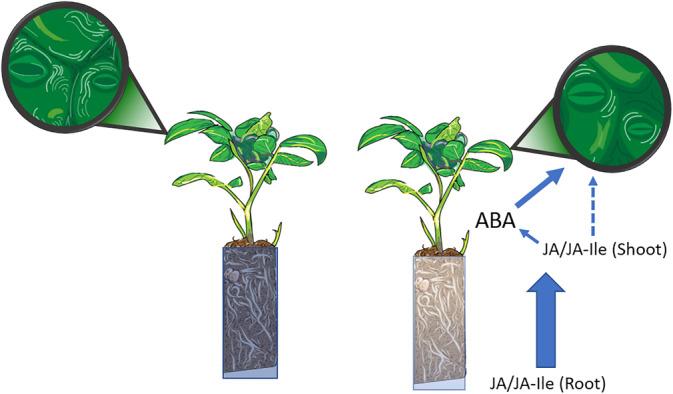
While the importance of plant water relations in determining crop response to soil water availability is difficult to over-emphasise, under many circumstances, plants maintain their leaf water status as the soil dries yet shoot gas exchange and growth is restricted. Such observations lead to development of a paradigm that root-to-shoot signals regulate shoot physiology, and a conceptual framework to test the importance of different signals such as plant hormones in these physiological processes. Nevertheless, shoot-to-root (hormonal) signalling also plays an important role in regulating root growth and function and may dominate when larger quantities of a hormone are produced in the shoots than the roots. Here, we review the evidence for acropetal and basipetal transport of three different plant hormones (abscisic acid, jasmonates, strigolactones) that have antitranspirant effects, to indicate the origin and action of these signalling systems. The physiological importance of each transport pathway likely depends on the specific environmental conditions the plant is exposed to, specifically whether the roots or shoots are the first to lose turgor when exposed to drying soil or elevated atmospheric demand, respectively. All three hormones can interact to influence each other's synthesis, degradation and intracellular signalling to augment or attenuate their physiological impacts, highlighting the complexity of unravelling these signalling systems. Nevertheless, such complexity suggests crop improvement opportunities to select for allelic variation in the genes affecting hormonal regulation, and (in selected crops) to augment root-shoot communication by judicious selection of rootstock-scion combinations to ameliorate abiotic stresses.
虽然植物水分关系在确定作物对土壤水分供应的响应方面的重要性再怎么强调也不为过,但在许多情况下,植物在土壤变干时仍能维持其叶片水分状态,但 Shoot 气体交换和生长受到限制。这些观察结果导致了一个范式的发展,即根到 Shoot 的信号调节 Shoot 生理学,以及一个概念框架来测试不同信号(如植物激素)在这些生理过程中的重要性。然而, Shoot 到根(激素)信号也在调节根生长和功能方面发挥着重要作用,并且当 Shoot 中产生的激素量大于根中产生的激素量时,可能会占主导地位。在这里,我们回顾了三种具有蒸腾作用的不同植物激素(脱落酸、茉莉酸、独脚金内酯)的向顶和向基运输的证据,以表明这些信号系统的起源和作用。每种运输途径的生理重要性可能取决于植物所暴露的具体环境条件,特别是当植物暴露在干燥的土壤或升高的大气需求中时,是根还是 Shoot 首先失去膨压。这三种激素都可以相互作用,影响彼此的合成、降解和细胞内信号转导,以增强或减弱它们的生理影响,突出了揭示这些信号系统的复杂性。然而,这种复杂性表明,有机会通过选择影响激素调节的基因的等位变异来改善作物,并且(在选定的作物中)通过明智地选择砧木-接穗组合来增强根- Shoot 通讯,以减轻非生物胁迫。

 Zotero 插件