
大尺寸(>100-μm)微塑料在加拿大不列颠哥伦比亚省的沿海海洋食物网中不会生物放大。
Large size (>100-μm) microplastics are not biomagnifying in coastal marine food webs of British Columbia, Canada.
机构信息
Department of Biology, University of Victoria, Victoria, British Columbia, Canada.
Hakai Institute, Calvert Island, British Columbia, Canada.
出版信息
Ecol Appl. 2022 Oct;32(7):e2654. doi: 10.1002/eap.2654. Epub 2022 Jul 4.
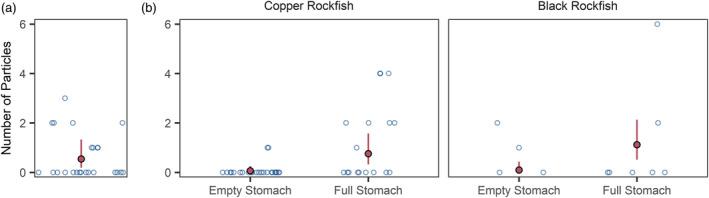
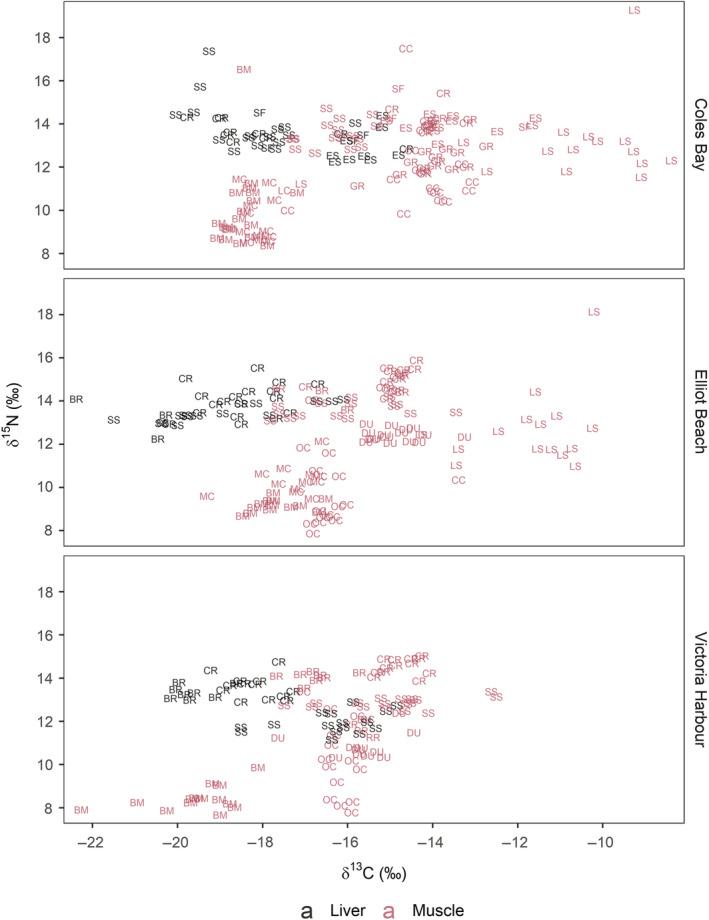
Microplastics (MPs) contamination in marine environments is of increasing concern, as plastic particles are globally ubiquitous across ecosystems. A large variety of aquatic taxa ingest MPs, but the extent to which animals accumulate and transfer MPs through food webs is largely unknown. In this study, we quantified MP uptake in bivalves, crabs, echinoderms, and fish feeding at different trophic levels at three sites on southern Vancouver Island. We paired stable-isotope food web analysis with MP concentrations in digestive tracts across all trophic levels and in fish livers. We then used Bayesian generalized linear mixed models to explore whether bioaccumulation and biomagnification were occurring. Our results showed that MPs (100-5000 μm along their longest dimension) are not biomagnifying in marine coastal food webs, with no correlation between the digestive tract or fish liver MP concentrations and trophic position of the various species. Ecological traits did, however, affect microplastic accumulation in digestive tracts, with suspension feeder and smaller-bodied planktivorous fish ingesting more MPs by body weight. Trophic transfer occurred between prey and predator for rockfish, but higher concentrations in full stomachs compared with empty ones suggested rapid excretion of ingested MPs. Collectively, our findings suggested the movement of MP through marine food webs is facilitated by species-specific mechanisms, with contamination susceptibility a function of species biology, not trophic position. Furthermore, the statistical methods we employ, including machine learning for classifying unknown particles and a probabilistic way to account for background contamination, are universally applicable to the study of microplastics. Our findings advance understanding of how MPs enter and move through aquatic food webs, suggesting that lower-trophic-level animals are more at risk of ingesting >100-μm MPs, relative to higher-trophic-level animals. Our work also highlights the need to advance the study of <100-μm MPs, which are still poorly understood and may need to be considered separately in ecological risk assessments.
海洋环境中的微塑料(MPs)污染越来越受到关注,因为塑料颗粒在全球各个生态系统中无处不在。大量水生分类群摄入 MPs,但动物通过食物网积累和转移 MPs 的程度在很大程度上尚不清楚。在这项研究中,我们量化了南温哥华岛三个地点不同营养级别的双壳类动物、螃蟹、棘皮动物和鱼类摄入 MPs 的情况。我们将稳定同位素食物网分析与所有营养级别的消化道 MPs 浓度以及鱼类肝脏中的 MPs 浓度进行配对。然后,我们使用贝叶斯广义线性混合模型来探索生物积累和生物放大是否在发生。我们的研究结果表明,在海洋沿海食物网中, MPs(最长尺寸为 100-5000μm)没有生物放大作用,各种物种的消化道或鱼肝脏中的 MPs 浓度与营养位置之间没有相关性。然而,生态特征确实会影响消化道中微塑料的积累,滤食者和较小体型的浮游食性鱼类通过体重摄入更多的 MPs。在石斑鱼中,猎物和捕食者之间存在营养转移,但与空胃相比,满胃中的 MPs 浓度更高,这表明摄入的 MPs 被迅速排泄。总的来说,我们的研究结果表明,MP 通过海洋食物网的移动是由特定物种的机制促成的,污染易感性是物种生物学的一个功能,而不是营养位置。此外,我们采用的统计方法,包括用于分类未知颗粒的机器学习方法和用于解释背景污染的概率方法,普遍适用于微塑料的研究。我们的研究结果提高了对 MPs 如何进入和通过水生食物网的理解,表明与较高营养级别的动物相比,较低营养级别的动物更有可能摄入>100μm 的 MPs。我们的工作还强调了需要推进对<100μm MPs 的研究,因为这些 MPs 仍未得到充分了解,在生态风险评估中可能需要单独考虑。



 Zotero 插件