
评估西班牙 2020 年 8 月 30 日至 2021 年 1 月 31 日期间非药物干预措施对 COVID-19 传播的影响。
Assessing the effect of non-pharmaceutical interventions on COVID-19 transmission in Spain, 30 August 2020 to 31 January 2021.
机构信息
Consorcio de Investigación Biomédica en Red de Epidemiología y Salud Pública, CIBERESP, Madrid, Spain.
Centro Nacional de Epidemiología, Instituto de Salud Carlos IIII, Madrid, Spain.
出版信息
Euro Surveill. 2022 May;27(19). doi: 10.2807/1560-7917.ES.2022.27.19.2100869.
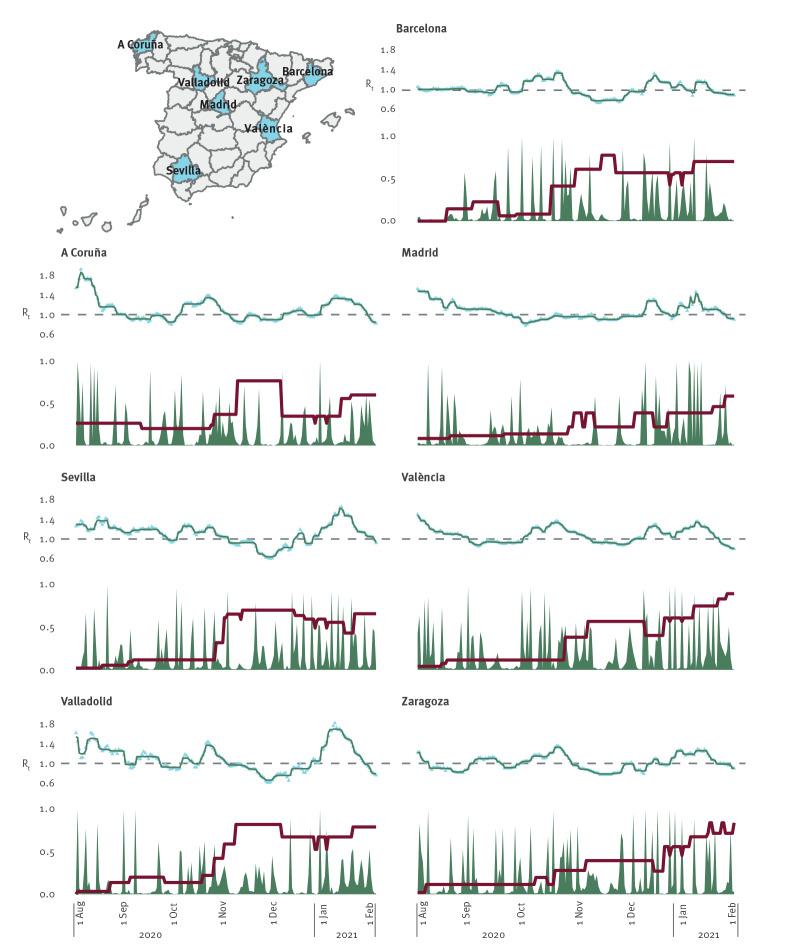
BackgroundAfter a national lockdown during the first wave of the COVID-19 pandemic in Spain, regional governments implemented different non-pharmaceutical interventions (NPIs) during the second wave.AimTo analyse which implemented NPIs significantly impacted effective reproduction number (R) in seven Spanish provinces during 30 August 2020-31 January 2021.MethodsWe coded each NPI and levels of stringency with a 'severity index' (SI) and computed a global SI (mean of SIs per six included interventions). We performed a Bayesian change point analysis on the R curve of each province to identify possible associations with global SI variations. We fitted and compared several generalised additive models using multimodel inference, to quantify the statistical effect on R of the global SI (stringency) and the individual SIs (separate effect of NPIs).ResultsThe global SI had a significant lowering effect on the R (mean: 0.16 ± 0.05 units for full stringency). Mandatory closing times for non-essential businesses, limited gatherings, and restricted outdoors seating capacities (negative) as well as curfews (positive) were the only NPIs with a significant effect. Regional mobility restrictions and limited indoors seating capacity showed no effect. Our results were consistent with a 1- to 3-week-delayed R as a response variable.ConclusionWhile response measures implemented during the second COVID-19 wave contributed substantially to a decreased reproduction number, the effectiveness of measures varied considerably. Our findings should be considered for future interventions, as social and economic consequences could be minimised by considering only measures proven effective.
背景
在西班牙 COVID-19 大流行的第一波期间实行全国封锁后,各地区政府在第二波期间实施了不同的非药物干预措施(NPIs)。
目的
分析在 2020 年 8 月 30 日至 2021 年 1 月 31 日期间,西班牙七个省份实施的哪些非药物干预措施对有效繁殖数(R)产生了显著影响。
方法
我们对每个 NPI 和严格程度进行编码,使用“严重程度指数(SI)”,并计算出全球 SI(每六个包含的干预措施的平均值)。我们对每个省份的 R 曲线进行贝叶斯变点分析,以确定与全球 SI 变化的可能关联。我们使用多模型推断拟合并比较了几种广义加性模型,以量化全球 SI(严格程度)和个别 SI(NPI 的单独影响)对 R 的统计影响。
结果
全球 SI 对 R 有显著的降低作用(全严格程度时的平均值:0.16±0.05 单位)。非必要企业的强制关闭时间、限制聚会和限制户外座位容量(负向)以及宵禁(正向)是唯一具有显著影响的 NPI。区域流动性限制和有限的室内座位容量没有效果。我们的结果与 R 作为因变量的 1 至 3 周延迟一致。
结论
尽管第二波 COVID-19 期间实施的应对措施对降低繁殖数做出了重大贡献,但措施的有效性差异很大。我们的研究结果应在未来的干预措施中加以考虑,因为通过仅考虑被证明有效的措施,可以将社会和经济后果降到最低。
 Zotero 插件