
SARS-CoV-2 感染扰乱了仓鼠呼吸道上皮的纤毛和基底细胞稳态。
SARS-CoV-2 Infection Dysregulates Cilia and Basal Cell Homeostasis in the Respiratory Epithelium of Hamsters.
机构信息
Department of Pathology, University of Veterinary Medicine Hanover Foundation, 30559 Hanover, Germany.
Center for Systems Neuroscience (ZSN), University of Veterinary Medicine Hanover Foundation, 30559 Hanover, Germany.
出版信息
Int J Mol Sci. 2022 May 4;23(9):5124. doi: 10.3390/ijms23095124.
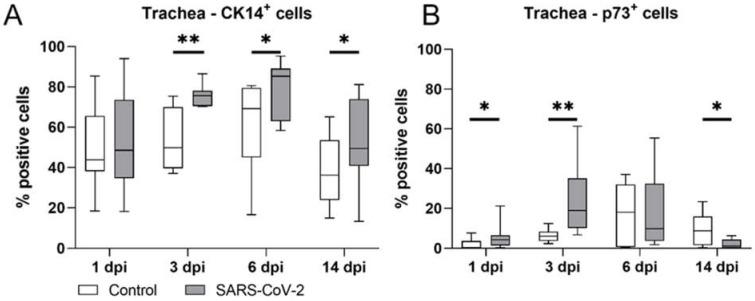
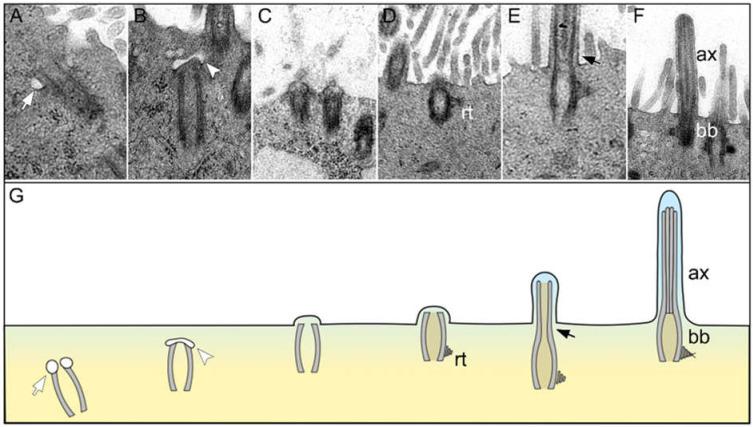
Similar to many other respiratory viruses, SARS-CoV-2 targets the ciliated cells of the respiratory epithelium and compromises mucociliary clearance, thereby facilitating spread to the lungs and paving the way for secondary infections. A detailed understanding of mechanism involved in ciliary loss and subsequent regeneration is crucial to assess the possible long-term consequences of COVID-19. The aim of this study was to characterize the sequence of histological and ultrastructural changes observed in the ciliated epithelium during and after SARS-CoV-2 infection in the golden Syrian hamster model. We show that acute infection induces a severe, transient loss of cilia, which is, at least in part, caused by cilia internalization. Internalized cilia colocalize with membrane invaginations, facilitating virus entry into the cell. Infection also results in a progressive decline in cells expressing the regulator of ciliogenesis FOXJ1, which persists beyond virus clearance and the termination of inflammatory changes. Ciliary loss triggers the mobilization of p73 and CK14 basal cells, which ceases after regeneration of the cilia. Although ciliation is restored after two weeks despite the lack of FOXJ1, an increased frequency of cilia with ultrastructural alterations indicative of secondary ciliary dyskinesia is observed. In summary, the work provides new insights into SARS-CoV-2 pathogenesis and expands our understanding of virally induced damage to defense mechanisms in the conducting airways.
类似于许多其他呼吸道病毒,SARS-CoV-2 靶向呼吸道上皮的纤毛细胞,并损害黏液纤毛清除功能,从而促进向肺部的传播,并为继发感染铺平道路。详细了解纤毛丧失和随后再生所涉及的机制对于评估 COVID-19 的可能长期后果至关重要。本研究的目的是描述在金黄地鼠 SARS-CoV-2 感染模型中,纤毛上皮在感染期间和之后观察到的组织学和超微结构变化的序列。我们表明,急性感染会导致严重的、短暂的纤毛丧失,至少部分是由纤毛内化引起的。内化的纤毛与膜内陷共定位,促进病毒进入细胞。感染还导致调节纤毛发生的 FOXJ1 表达细胞的渐进性下降,这种下降持续到病毒清除和炎症变化终止之后。纤毛丧失引发 p73 和 CK14 基底细胞的动员,尽管纤毛再生,但在纤毛再生后,这种动员会停止。尽管两周后尽管 FOXJ1 缺乏,但纤毛仍能恢复,观察到具有表明继发性纤毛运动障碍的超微结构改变的纤毛频率增加。总之,这项工作提供了 SARS-CoV-2 发病机制的新见解,并扩展了我们对病毒引起的传导气道防御机制损伤的理解。



 Zotero 插件