
探究 2009-2019 年美国与召回相关的食源性疾病暴发的危险因素。
Exploring Risk Factors of Recall-Associated Foodborne Disease Outbreaks in the United States, 2009-2019.
机构信息
Friedman School of Nutrition Science and Policy, Tufts University, Boston, MA 02111, USA.
Army Medical Department Student Detachment, U.S. Army Medical Center of Excellence, Fort Sam Houston, San Antonio, TX 78234, USA.
出版信息
Int J Environ Res Public Health. 2022 Apr 19;19(9):4947. doi: 10.3390/ijerph19094947.
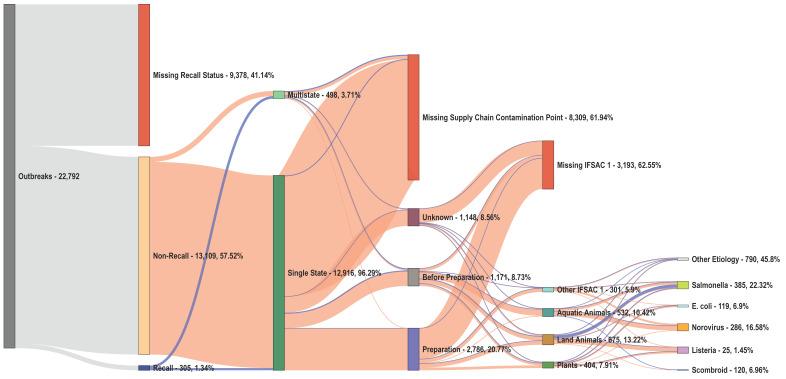
Earlier identification and removal of contaminated food products is crucial in reducing economic burdens of foodborne outbreaks. Recalls are a safety measure that is deployed to prevent foodborne illnesses. However, few studies have examined temporal trends in recalls or compared risk factors between non-recall and recall outbreaks in the United States, due to disparate and often incomplete surveillance records in publicly reported data. We demonstrated the usability of the electronic Foodborne Outbreak Reporting System (eFORS) and National Outbreak Reporting System (NORS) for describing temporal trends and outbreak risk factors of food recalls in 1998−2019. We examined monthly trends between surveillance systems by using segmented time-series analyses. We compared the risk factors (e.g., multistate outbreak, contamination supply chain stage, pathogen etiology, and food products) of recalls and non-recalls by using logistic regression models. Out of 22,972 outbreaks, 305 (1.3%) resulted in recalls and 9378 (41%) had missing recall information. However, outbreaks with missing recall information decreased at an accelerating rate of ~25%/month in 2004−2009 and at a decelerating rate of ~13%/month after the transition from eFORS to NORS in 2009−2019. Irrespective of the contaminant etiology, multistate outbreaks according to the residence of ill persons had odds 11.00−13.50 times (7.00, 21.60) that of single-state outbreaks resulting in a recall (p < 0.001) when controlling for all risk factors. Electronic reporting has improved the availability of food recall data, yet retrospective investigations of historical records are needed. The investigation of recalls enhances public health professionals’ understanding of their annual financial burden and improves outbreak prediction analytics to reduce the likelihood and severity of recalls.
早期识别和清除受污染的食品对于减轻食源性疾病爆发造成的经济负担至关重要。召回是一种安全措施,旨在预防食源性疾病。然而,由于公开报告数据中的监测记录存在差异且往往不完整,很少有研究调查召回的时间趋势或比较美国非召回和召回爆发的风险因素。我们展示了电子食源性疾病报告系统 (eFORS) 和国家爆发报告系统 (NORS) 在描述 1998-2019 年食品召回的时间趋势和爆发风险因素方面的可用性。我们使用分段时间序列分析检查了监测系统之间的月度趋势。我们使用逻辑回归模型比较了召回和非召回的风险因素(例如,多州爆发、污染供应链阶段、病原体病因和食品)。在 22972 次爆发中,有 305 次(1.3%)导致召回,9378 次(41%)缺少召回信息。然而,在 2004-2009 年期间,缺少召回信息的爆发以每月约 25%的加速率减少,而在 2009-2019 年从 eFORS 过渡到 NORS 后,减少率以每月约 13%的减速率减少。无论污染物病因如何,根据患者居住地确定的多州爆发导致召回的可能性是单州爆发的 11.00-13.50 倍(7.00,21.60)(p<0.001),在控制所有风险因素的情况下。电子报告提高了食品召回数据的可用性,但仍需要对历史记录进行回顾性调查。对召回的调查增强了公共卫生专业人员对其年度经济负担的理解,并改进了爆发预测分析,以降低召回的可能性和严重程度。


 Zotero 插件