
危重症患者拔管结局的预测模型:一项多中心前瞻性队列研究。
Prediction Model of Extubation Outcomes in Critically Ill Patients: A Multicenter Prospective Cohort Study.
作者信息
Tanaka Aiko, Kabata Daijiro, Hirao Osamu, Kosaka Junko, Furushima Nana, Maki Yuichi, Uchiyama Akinori, Egi Moritoki, Shintani Ayumi, Morimatsu Hiroshi, Mizobuchi Satoshi, Kotake Yoshifumi, Fujino Yuji
机构信息
Department of Anesthesiology and Intensive Care Medicine, Osaka University Graduate School of Medicine, 2-15 Yamadaoka, Suita 565-0871, Japan.
Department of Medical Statistics, Graduate School of Medicine, Osaka Metropolitan University, 1-4-3 Asahimachi, Abeno-ku, Osaka 545-8585, Japan.
出版信息
J Clin Med. 2022 Apr 29;11(9):2520. doi: 10.3390/jcm11092520.
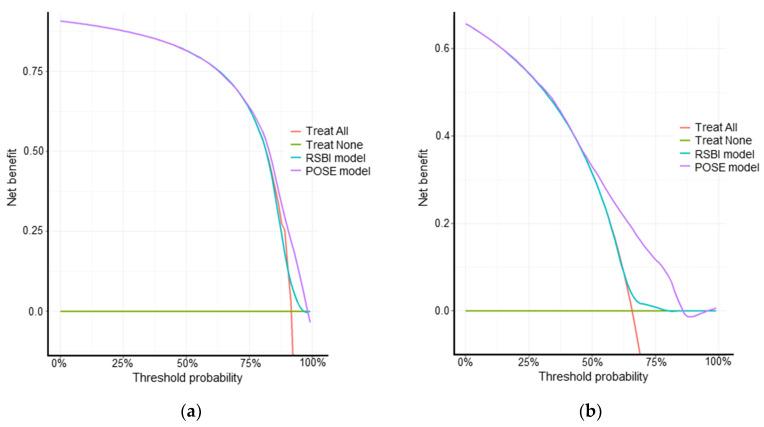
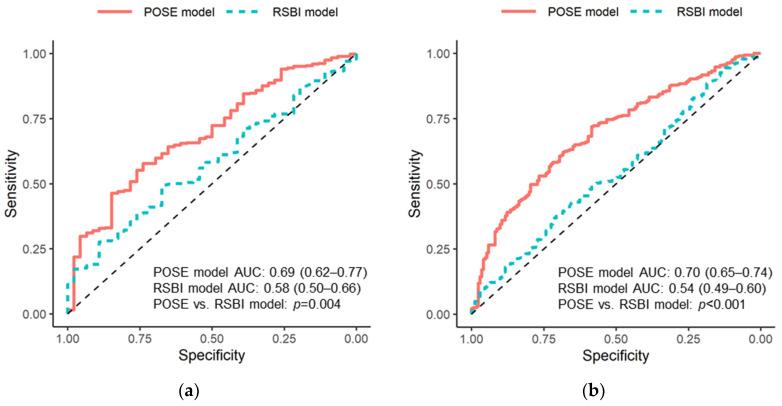
Liberation from mechanical ventilation is of great importance owing to related complications from extended ventilation time. In this prospective multicenter study, we aimed to construct a versatile model for predicting extubation outcomes in critical care settings using obtainable physiological predictors. The study included patients who had been extubated after a successful 30 min spontaneous breathing trial (SBT). A multivariable logistic regression model was constructed to predict extubation outcomes (successful extubation without reintubation and uneventful extubation without reintubation or noninvasive respiratory support) using eight parameters: age, heart failure, respiratory disease, rapid shallow breathing index (RSBI), PaO2/FIO2, Glasgow Coma Scale score, fluid balance, and endotracheal suctioning episodes. Of 499 patients, 453 (90.8%) and 328 (65.7%) achieved successful and uneventful extubation, respectively. The areas under the curve for successful and uneventful extubation in the novel prediction model were 0.69 (95% confidence interval (CI), 0.62−0.77) and 0.70 (95% CI, 0.65−0.74), respectively, which were significantly higher than those in the conventional model solely using RSBI (0.58 (95% CI, 0.50−0.66) and 0.54 (95% CI, 0.49−0.60), p = 0.004 and <0.001, respectively). The model was validated using a bootstrap method, and an online application was developed for automatic calculation. Our model, which is based on a combination of generally obtainable parameters, established an accessible method for predicting extubation outcomes after a successful SBT.
由于机械通气时间延长会引发相关并发症,因此脱离机械通气至关重要。在这项前瞻性多中心研究中,我们旨在利用可获取的生理预测指标构建一个通用模型,以预测重症监护环境中的拔管结果。该研究纳入了在成功进行30分钟自主呼吸试验(SBT)后拔管的患者。构建了一个多变量逻辑回归模型,使用八个参数预测拔管结果(成功拔管且无需重新插管以及顺利拔管且无需重新插管或无创呼吸支持):年龄、心力衰竭、呼吸系统疾病、快速浅呼吸指数(RSBI)、动脉血氧分压/吸入氧分数值(PaO2/FIO2)、格拉斯哥昏迷量表评分、液体平衡和气管内吸痰次数。499例患者中,分别有453例(90.8%)和328例(65.7%)成功拔管且过程顺利。新预测模型中成功拔管和顺利拔管的曲线下面积分别为0.69(95%置信区间(CI),0.62 - 0.77)和0.70(95%CI,0.65 - 0.74),显著高于仅使用RSBI的传统模型(0.58(95%CI,0.50 - 0.66)和0.54(95%CI,0.49 - 0.60),p分别为0.004和<0.001)。使用自助法对该模型进行了验证,并开发了一个在线应用程序用于自动计算。我们的模型基于通常可获取的参数组合,建立了一种预测成功SBT后拔管结果的可及方法。



 Zotero 插件