
解析 AXL 在癌症免疫逃逸和免疫检查点抑制耐药中的作用。
Dissecting the Role of AXL in Cancer Immune Escape and Resistance to Immune Checkpoint Inhibition.
机构信息
Centre for Cancer Biomarkers and Department of Biomedicine, University of Bergen, Bergen, Norway.
Thumbay Research Institute for Precision Medicine, Gulf Medical University, Ajman, United Arab Emirates.
出版信息
Front Immunol. 2022 Apr 27;13:869676. doi: 10.3389/fimmu.2022.869676. eCollection 2022.
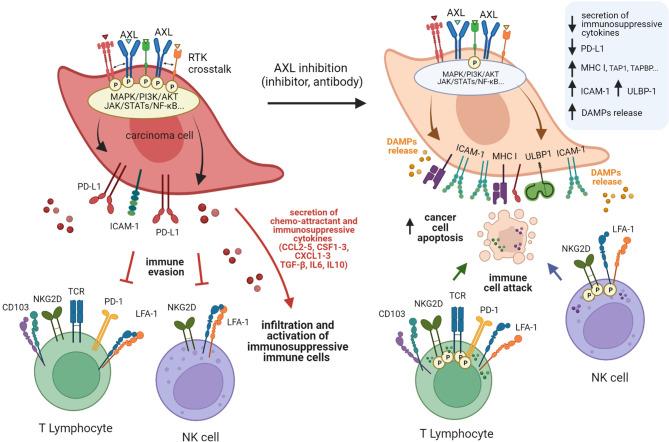
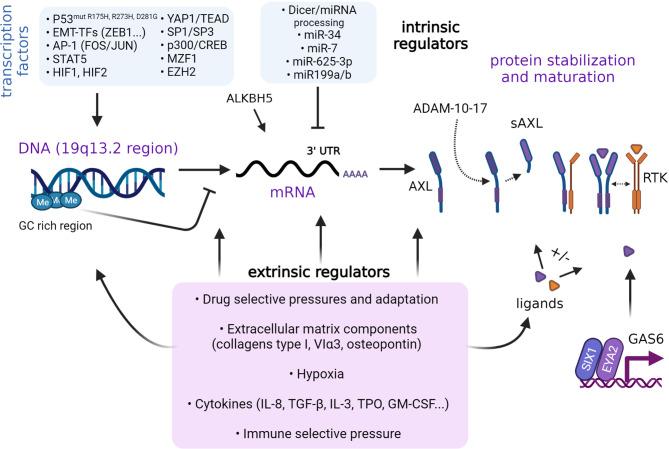
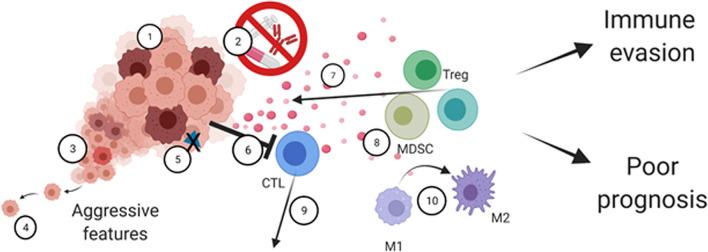
The development and implementation of Immune Checkpoint Inhibitors (ICI) in clinical oncology have significantly improved the survival of a subset of cancer patients with metastatic disease previously considered uniformly lethal. However, the low response rates and the low number of patients with durable clinical responses remain major concerns and underscore the limited understanding of mechanisms regulating anti-tumor immunity and tumor immune resistance. There is an urgent unmet need for novel approaches to enhance the efficacy of ICI in the clinic, and for predictive tools that can accurately predict ICI responders based on the composition of their tumor microenvironment. The receptor tyrosine kinase (RTK) AXL has been associated with poor prognosis in numerous malignancies and the emergence of therapy resistance. AXL is a member of the TYRO3-AXL-MERTK (TAM) kinase family. Upon binding to its ligand GAS6, AXL regulates cell signaling cascades and cellular communication between various components of the tumor microenvironment, including cancer cells, endothelial cells, and immune cells. Converging evidence points to AXL as an attractive molecular target to overcome therapy resistance and immunosuppression, supported by the potential of AXL inhibitors to improve ICI efficacy. Here, we review the current literature on the prominent role of AXL in regulating cancer progression, with particular attention to its effects on anti-tumor immune response and resistance to ICI. We discuss future directions with the aim to understand better the complex role of AXL and TAM receptors in cancer and the potential value of this knowledge and targeted inhibition for the benefit of cancer patients.
免疫检查点抑制剂(ICI)在临床肿瘤学中的发展和应用显著改善了先前被认为普遍致命的转移性疾病的一部分癌症患者的生存。然而,低反应率和持久临床反应的患者数量仍然是主要关注点,并突显了对调节抗肿瘤免疫和肿瘤免疫抵抗的机制的理解有限。迫切需要新的方法来提高 ICI 在临床上的疗效,并需要预测工具,根据肿瘤微环境的组成来准确预测 ICI 反应者。受体酪氨酸激酶(RTK)AXL 与多种恶性肿瘤的预后不良和治疗耐药性的出现有关。AXL 是 TYRO3-AXL-MERTK(TAM)激酶家族的成员。在与配体 GAS6 结合后,AXL 调节细胞信号级联和肿瘤微环境中各种成分之间的细胞通讯,包括癌细胞、内皮细胞和免疫细胞。越来越多的证据表明 AXL 是克服治疗耐药性和免疫抑制的有吸引力的分子靶点,AXL 抑制剂有可能提高 ICI 的疗效。在这里,我们回顾了关于 AXL 在调节癌症进展中的突出作用的现有文献,特别关注其对抗肿瘤免疫反应和对 ICI 耐药性的影响。我们讨论了未来的方向,旨在更好地了解 AXL 和 TAM 受体在癌症中的复杂作用,以及这方面的知识和靶向抑制的潜在价值,以造福癌症患者。

 Zotero 插件