
核输出蛋白 XPO1 抑制剂增强 KRAS G12C 抑制剂在 KRAS G12C 突变癌症的临床前模型中的抗癌疗效。
Inhibitor of the Nuclear Transport Protein XPO1 Enhances the Anticancer Efficacy of KRAS G12C Inhibitors in Preclinical Models of KRAS G12C-Mutant Cancers.
机构信息
Barbara Ann Karmanos Cancer Institute, Department of Oncology, Wayne State University School of Medicine, Detroit MI 48201, USA.
University of California Irvine School of Medicine, Orange CA 92868, USA; Chao Family Comprehensive Cancer Center, Orange, CA 92868, USA.
出版信息
Cancer Res Commun. 2022 May;2(5):342-352. doi: 10.1158/2767-9764.crc-21-0176. Epub 2022 May 10.
UNLABELLED
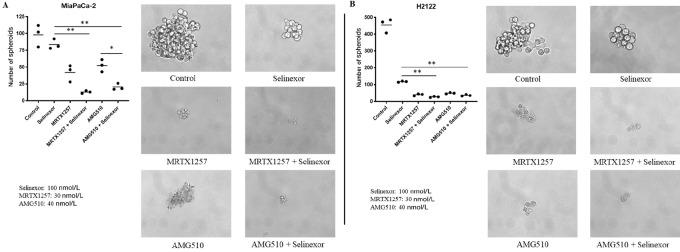
The identification of molecules that can bind covalently to KRAS G12C and lock it in an inactive GDP-bound conformation has opened the door to targeting KRAS G12C selectively. These agents have shown promise in preclinical tumor models and clinical trials. FDA has recently granted approval to sotorasib for KRAS G12C mutated non-small cell lung cancer (NSCLC). However, patients receiving these agents as monotherapy generally develop drug resistance over time. This necessitates the development of multi-targeted approaches that can potentially sensitize tumors to KRAS inhibitors. We generated KRAS G12C inhibitor-resistant cell lines and observed that they exhibit sensitivity toward selinexor, a selective inhibitor of nuclear export protein exportin1 (XPO1), as a single agent. KRAS G12C inhibitors in combination with selinexor suppressed the proliferation of KRAS G12C mutant cancer cell lines in a synergistic manner. Moreover, combined treatment of selinexor with KRAS G12C inhibitors resulted in enhanced spheroid disintegration, reduction in the number and size of colonies formed by G12C mutant cancer cells. Mechanistically, the combination of selinexor with KRAS G12C inhibitors suppressed cell growth signaling and downregulated the expression of cell cycle markers, KRAS and NF-kB as well as increased nuclear accumulation of tumor suppressor protein Rb. In an KRAS G12C cell-derived xenograft model, oral administration of a combination of selinexor and sotorasib was demonstrated to reduce tumor burden and enhance survival. In conclusion, we have shown that the nuclear transport protein XPO1 inhibitor can enhance the anticancer activity of KRAS G12C inhibitors in preclinical cancer models.
SIGNIFICANCE
In this study, combining nuclear transport inhibitor selinexor with KRAS G12C inhibitors has resulted in potent antitumor effects in preclinical cancer models. This can be an effective combination therapy for cancer patients that do not respond or develop resistance to KRAS G12C inhibitor treatment.
目的
鉴定能够与 KRAS G12C 共价结合并将其锁定在非活性 GDP 结合构象中的分子,为 KRAS G12C 的选择性靶向治疗打开了大门。这些药物在临床前肿瘤模型和临床试验中显示出了良好的疗效。美国食品药品监督管理局(FDA)最近批准了 sotorasib 用于治疗 KRAS G12C 突变型非小细胞肺癌(NSCLC)。然而,接受这些药物单药治疗的患者通常会随着时间的推移产生耐药性。这就需要开发多靶点的方法,使肿瘤对 KRAS 抑制剂敏感。我们生成了 KRAS G12C 抑制剂耐药细胞系,并观察到它们对 selinexor(一种选择性核输出蛋白 exportin1 [XPO1] 抑制剂)作为单一药物表现出敏感性。KRAS G12C 抑制剂与 selinexor 联合抑制 KRAS G12C 突变型癌细胞系的增殖呈协同作用。此外,sinexel 与 KRAS G12C 抑制剂联合治疗可增强球体的崩解,减少由 G12C 突变癌细胞形成的菌落的数量和大小。从机制上讲,sinexel 与 KRAS G12C 抑制剂的联合抑制了细胞生长信号,并下调了细胞周期标志物、KRAS 和 NF-kB 的表达,同时增加了肿瘤抑制蛋白 Rb 的核积累。在 KRAS G12C 细胞衍生的异种移植模型中,口服给予 selinexor 和 sotorasib 的联合治疗可降低肿瘤负担并提高存活率。总之,我们表明,核转运蛋白 XPO1 抑制剂可以增强 KRAS G12C 抑制剂在临床前癌症模型中的抗癌活性。
意义
在这项研究中,将核转运抑制剂 selinexor 与 KRAS G12C 抑制剂联合使用,在临床前癌症模型中产生了强大的抗肿瘤作用。对于那些对 KRAS G12C 抑制剂治疗无反应或产生耐药性的癌症患者,这可能是一种有效的联合治疗方法。




 Zotero 插件