
NOTCH1 信号在 CD4+T 细胞激活过程中改变转录因子网络并增强抗原反应性。
NOTCH1 signaling during CD4+ T-cell activation alters transcription factor networks and enhances antigen responsiveness.
机构信息
Clinical Research Division, Fred Hutchinson Cancer Research Center, Seattle, WA.
Molecular and Cellular Biology, University of Washington, Seattle, WA.
出版信息
Blood. 2022 Nov 24;140(21):2261-2275. doi: 10.1182/blood.2021015144.
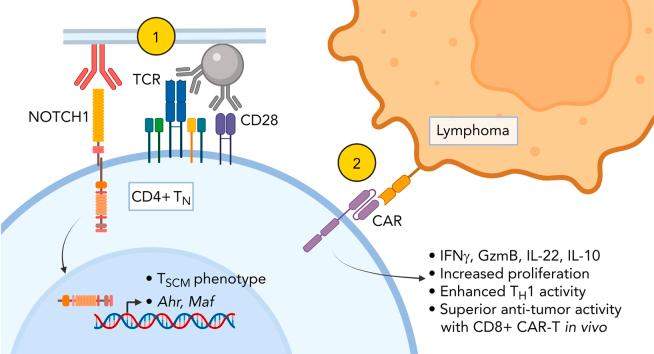
Adoptive transfer of T cells expressing chimeric antigen receptors (CAR-T) effectively treats refractory hematologic malignancies in a subset of patients but can be limited by poor T-cell expansion and persistence in vivo. Less differentiated T-cell states correlate with the capacity of CAR-T to proliferate and mediate antitumor responses, and interventions that limit tumor-specific T-cell differentiation during ex vivo manufacturing enhance efficacy. NOTCH signaling is involved in fate decisions across diverse cell lineages and in memory CD8+ T cells was reported to upregulate the transcription factor FOXM1, attenuate differentiation, and enhance proliferation and antitumor efficacy in vivo. Here, we used a cell-free culture system to provide an agonistic NOTCH1 signal during naïve CD4+ T-cell activation and CAR-T production and studied the effects on differentiation, transcription factor expression, cytokine production, and responses to tumor. NOTCH1 agonism efficiently induced a stem cell memory phenotype in CAR-T derived from naïve but not memory CD4+ T cells and upregulated expression of AhR and c-MAF, driving heightened production of interleukin-22, interleukin-10, and granzyme B. NOTCH1-agonized CD4+ CAR-T demonstrated enhanced antigen responsiveness and proliferated to strikingly higher frequencies in mice bearing human lymphoma xenografts. NOTCH1-agonized CD4+ CAR-T also provided superior help to cotransferred CD8+ CAR-T, driving improved expansion and curative antitumor responses in vivo at low CAR-T doses. Our data expand the mechanisms by which NOTCH can shape CD4+ T-cell behavior and demonstrate that activating NOTCH1 signaling during genetic modification ex vivo is a potential strategy for enhancing the function of T cells engineered with tumor-targeting receptors.
嵌合抗原受体 (CAR-T) 表达的 T 细胞过继转移可有效治疗部分难治性血液系统恶性肿瘤,但在体内 T 细胞扩增和持续存在受限。分化程度较低的 T 细胞状态与 CAR-T 增殖和介导抗肿瘤反应的能力相关,在体外制造过程中限制肿瘤特异性 T 细胞分化的干预措施可增强疗效。NOTCH 信号参与多种细胞谱系的命运决定,在记忆 CD8+T 细胞中,据报道 NOTCH 信号上调转录因子 FOXM1,减弱分化,并增强体内增殖和抗肿瘤疗效。在这里,我们使用无细胞培养系统在幼稚 CD4+T 细胞激活和 CAR-T 生产过程中提供激动性 NOTCH1 信号,并研究其对分化、转录因子表达、细胞因子产生和对肿瘤的反应的影响。NOTCH1 激动剂有效地诱导源自幼稚而非记忆 CD4+T 细胞的 CAR-T 产生干细胞记忆表型,并上调 AhR 和 c-MAF 的表达,从而驱动白细胞介素-22、白细胞介素-10 和颗粒酶 B 的产生增加。NOTCH1 激动的 CD4+CAR-T 表现出增强的抗原反应性,并在携带人淋巴瘤异种移植物的小鼠中以惊人的更高频率增殖。NOTCH1 激动的 CD4+CAR-T 还为共转导的 CD8+CAR-T 提供了更好的帮助,在低 CAR-T 剂量下驱动体内扩展和治愈抗肿瘤反应的改善。我们的数据扩展了 NOTCH 可以塑造 CD4+T 细胞行为的机制,并证明在体外遗传修饰过程中激活 NOTCH1 信号是增强携带肿瘤靶向受体的 T 细胞工程功能的潜在策略。
 Zotero 插件