
CAR T 细胞耗竭:潜在原因及解决方案。
Exhaustion of CAR T cells: potential causes and solutions.
机构信息
Division of Cancer Immunotherapy, Kanagawa Cancer Center Research Institute, Yokohama, Japan.
Cancer Vaccine and Immunotherapy Center, Kanagawa Cancer Center, Yokohama, Japan.
出版信息
J Transl Med. 2022 May 23;20(1):239. doi: 10.1186/s12967-022-03442-3.
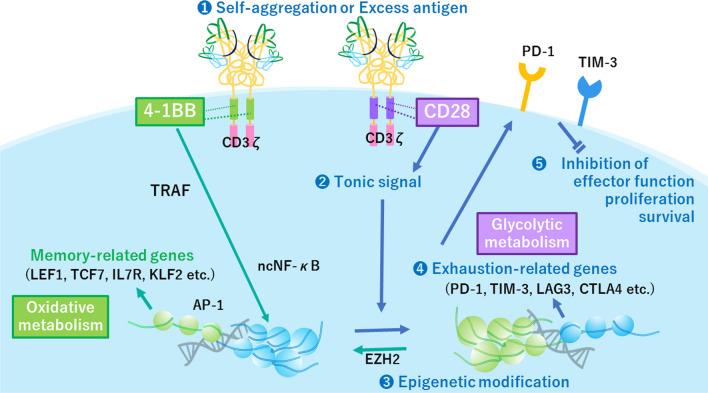
Chimeric antigen receptor (CAR) T cell therapy has attracted attention for its promising therapeutic effects on hematological malignancies. However, there are problems such as relapse during long-term follow-up and limited effect on solid tumors with this therapy. Exhaustion, which impairs in vivo persistence and killing activity of CAR T cells, is one of the causes of these issues. Depending on their structure of extracellular portion, some CARs induce tonic signals in the absence of ligand stimulation and induce exhaustion phenotype in CAR T cells. Analysis of these self-activating CARs is expected to provide key information for understanding and resolving CAR T cell exhaustion. In this review, we introduced examples of self-activating CARs and summarized their phenotypes to figure out how CAR T cell exhaustion occurs. Further, we aimed to review promising solutions to the CAR T cell exhaustion that hampers generalized application of CAR T cell therapy.
嵌合抗原受体 (CAR) T 细胞疗法因其在血液恶性肿瘤方面有良好的治疗效果而备受关注。然而,这种疗法在长期随访过程中存在复发等问题,对实体瘤的效果有限。衰竭会损害 CAR T 细胞在体内的持久性和杀伤活性,是导致这些问题的原因之一。根据其细胞外部分的结构,一些 CAR 在没有配体刺激的情况下诱导持续信号,并在 CAR T 细胞中诱导衰竭表型。分析这些自我激活的 CAR 有望为理解和解决 CAR T 细胞衰竭提供关键信息。在这篇综述中,我们介绍了自我激活的 CAR 的例子,并总结了它们的表型,以了解 CAR T 细胞衰竭是如何发生的。此外,我们旨在综述克服 CAR T 细胞衰竭以推动 CAR T 细胞疗法广泛应用的有前途的解决方案。

 Zotero 插件