
对芬太尼及其类似物在μ-阿片受体上潜在结合构象的全面评估。
A comprehensive evaluation of the potential binding poses of fentanyl and its analogs at the µ-opioid receptor.
作者信息
Xie Bing, Goldberg Alexander, Shi Lei
机构信息
Computational Chemistry and Molecular Biophysics Section, Molecular Targets and Medications Discovery Branch, National Institute on Drug Abuse - Intramural Research Program, National Institutes of Health, Baltimore, MD 21224, USA.
出版信息
Comput Struct Biotechnol J. 2022 May 14;20:2309-2321. doi: 10.1016/j.csbj.2022.05.013. eCollection 2022.
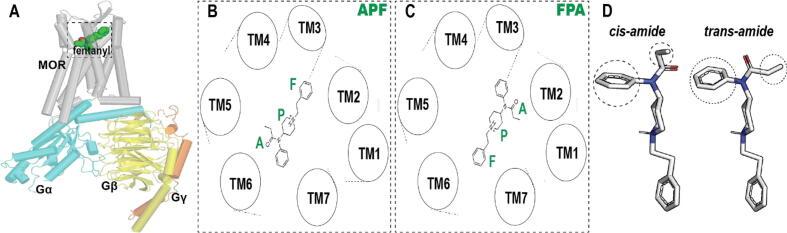
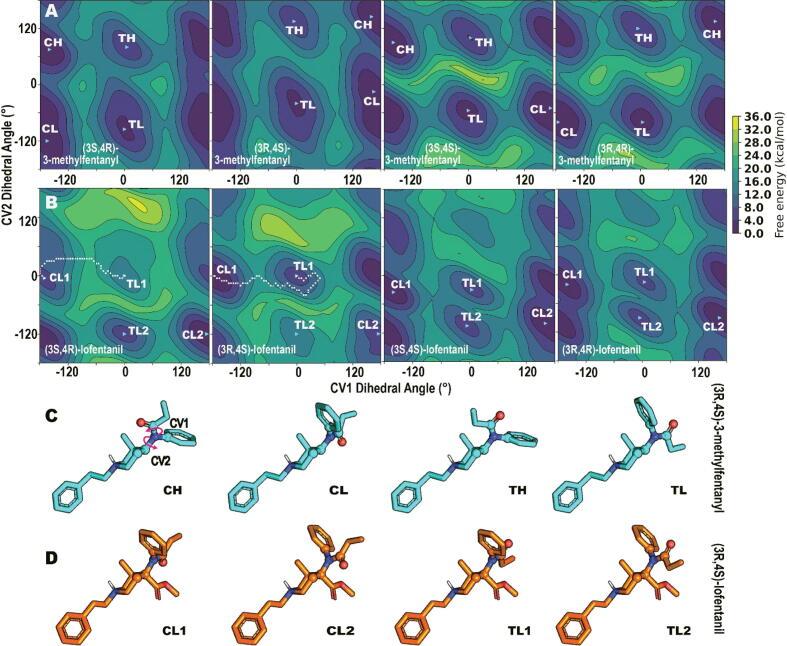
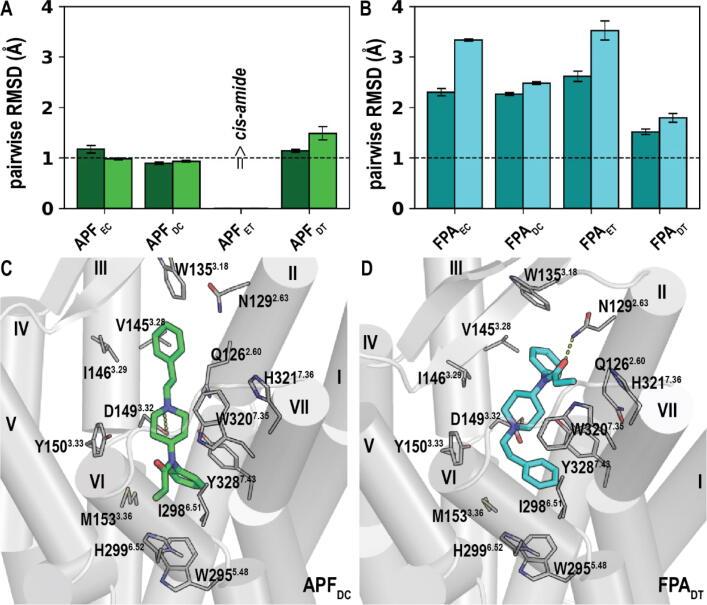
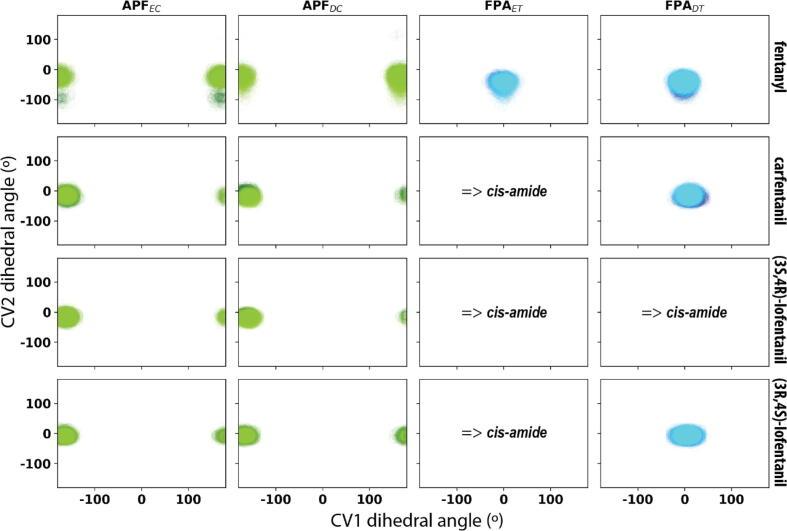
Fentanyl and its analogs are selective agonists of the µ-opioid receptor (MOR). Among novel synthetic opioids (NSOs), they dominate the recreational drug market and are the main culprits for the opioid crisis, which has been exacerbated by the COVID-19 pandemic. By taking advantage of the crystal structures of the MOR, several groups have investigated the binding mechanism of fentanyl, but have not reached a consensus, in terms of both the binding orientation and the fentanyl conformation. Thus, the binding mechanism of fentanyl at the MOR remains an unsolved and challenging question. Here, we carried out a systematic computational study to investigate the preferred fentanyl conformations, and how these conformations are being accommodated in the MOR binding pocket. We characterized the free energy landscape of fentanyl conformations with metadynamics simulations, and compared and evaluated several possible fentanyl binding conditions in the MOR with long-timescale molecular dynamics simulations. Our results indicate that the most preferred binding pose in the MOR binding pocket corresponds well with the global minimum on the energy landscape of fentanyl in the absence of the receptor, while the energy landscape can be reconfigured by modifying the fentanyl scaffold. The interactions with the receptor may stabilize a slightly unfavored fentanyl conformation in an alternative binding pose. By extending similar investigations to fentanyl analogs, our findings establish a structure-activity relationship of fentanyl binding at the MOR. In addition to providing a structural basis to understand the potential toxicity of the emerging NSOs, such insights will contribute to developing new, safer analgesics.
芬太尼及其类似物是μ-阿片受体(MOR)的选择性激动剂。在新型合成阿片类药物(NSO)中,它们主导着娱乐性毒品市场,是阿片类药物危机的主要罪魁祸首,而新冠疫情加剧了这一危机。利用MOR的晶体结构,多个研究团队对芬太尼的结合机制进行了研究,但在结合方向和芬太尼构象方面尚未达成共识。因此,芬太尼在MOR上的结合机制仍然是一个未解决的挑战性问题。在此,我们进行了一项系统的计算研究,以探究芬太尼的优选构象,以及这些构象如何在MOR结合口袋中被容纳。我们用元动力学模拟表征了芬太尼构象的自由能景观,并通过长时间尺度的分子动力学模拟比较和评估了MOR中几种可能的芬太尼结合条件。我们的结果表明,MOR结合口袋中最优选的结合姿势与在没有受体时芬太尼能量景观上的全局最小值非常吻合,而通过修饰芬太尼支架可以重新配置能量景观。与受体的相互作用可能会在另一种结合姿势中稳定一种略微不利的芬太尼构象。通过将类似的研究扩展到芬太尼类似物,我们的发现建立了芬太尼在MOR上结合的构效关系。除了为理解新兴NSO的潜在毒性提供结构基础外,这些见解将有助于开发新的、更安全的镇痛药。




 Zotero 插件