
隐藏议程——内质网应激和未折叠蛋白反应在炎症诱导的肌肉减少症中的作用。
Hidden Agenda - The Involvement of Endoplasmic Reticulum Stress and Unfolded Protein Response in Inflammation-Induced Muscle Wasting.
机构信息
Experimental and Clinical Research Center (ECRC), Charité-Universitätsmedizin Berlin, Max Delbrück Center (MDC) for Molecular Medicine in the Helmholtz Association, Berlin, Germany.
Department of Molecular Cardiology, DZHK (German Center for Cardiovascular Research), Partner Site, Greifswald, Germany.
出版信息
Front Immunol. 2022 May 9;13:878755. doi: 10.3389/fimmu.2022.878755. eCollection 2022.
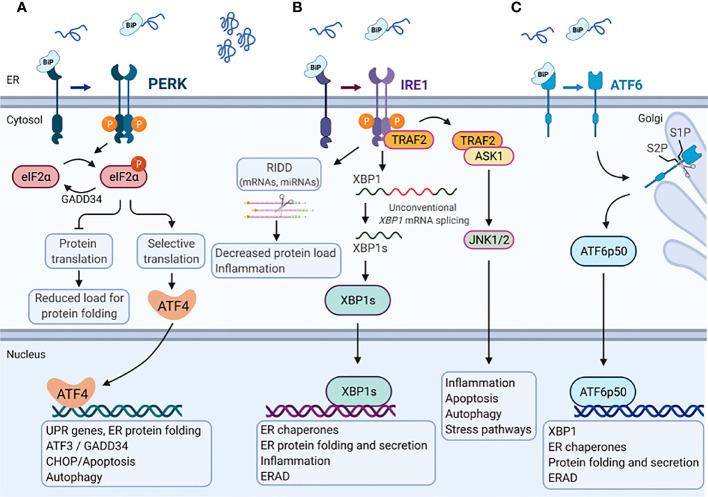
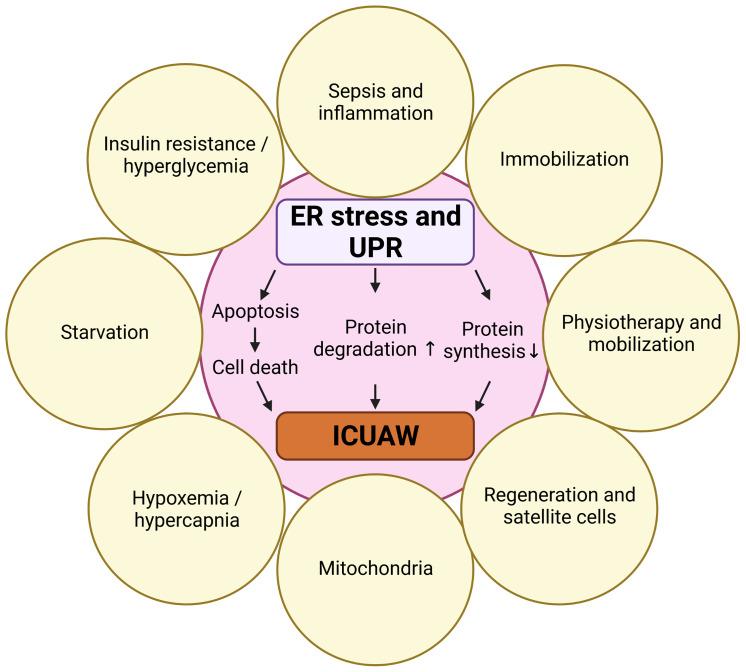
Critically ill patients at the intensive care unit (ICU) often develop a generalized weakness, called ICU-acquired weakness (ICUAW). A major contributor to ICUAW is muscle atrophy, a loss of skeletal muscle mass and function. Skeletal muscle assures almost all of the vital functions of our body. It adapts rapidly in response to physiological as well as pathological stress, such as inactivity, immobilization, and inflammation. In response to a reduced workload or inflammation muscle atrophy develops. Recent work suggests that adaptive or maladaptive processes in the endoplasmic reticulum (ER), also known as sarcoplasmic reticulum, contributes to this process. In muscle cells, the ER is a highly specialized cellular organelle that assures calcium homeostasis and therefore muscle contraction. The ER also assures correct folding of proteins that are secreted or localized to the cell membrane. Protein folding is a highly error prone process and accumulation of misfolded or unfolded proteins can cause ER stress, which is counteracted by the activation of a signaling network known as the unfolded protein response (UPR). Three ER membrane residing molecules, protein kinase R-like endoplasmic reticulum kinase (PERK), inositol requiring protein 1a (IRE1a), and activating transcription factor 6 (ATF6) initiate the UPR. The UPR aims to restore ER homeostasis by reducing overall protein synthesis and increasing gene expression of various ER chaperone proteins. If ER stress persists or cannot be resolved cell death pathways are activated. Although, ER stress-induced UPR pathways are known to be important for regulation of skeletal muscle mass and function as well as for inflammation and immune response its function in ICUAW is still elusive. Given recent advances in the development of ER stress modifying molecules for neurodegenerative diseases and cancer, it is important to know whether or not therapeutic interventions in ER stress pathways have favorable effects and these compounds can be used to prevent or treat ICUAW. In this review, we focus on the role of ER stress-induced UPR in skeletal muscle during critical illness and in response to predisposing risk factors such as immobilization, starvation and inflammation as well as ICUAW treatment to foster research for this devastating clinical problem.
重症监护病房(ICU)的危重症患者常出现全身无力,称为 ICU 获得性肌无力(ICUAW)。导致 ICUAW 的一个主要因素是肌肉萎缩,即骨骼肌质量和功能的丧失。骨骼肌确保了我们身体的几乎所有重要功能。它会迅速适应生理和病理应激,如不活动、固定和炎症。当工作量减少或出现炎症时,肌肉会萎缩。最近的研究表明,内质网(ER),又称肌浆网,中的适应性或失代偿性过程有助于这一过程。在内质网中,内质网是一种高度专业化的细胞器,可确保钙稳态,从而确保肌肉收缩。内质网还确保分泌或定位于细胞膜的蛋白质正确折叠。蛋白质折叠是一个高度易错的过程,错误折叠或未折叠的蛋白质堆积会导致内质网应激,这会被一种称为未折叠蛋白反应(UPR)的信号网络激活所抵消。三种内质网膜驻留分子,蛋白激酶 R 样内质网激酶(PERK)、肌醇需求蛋白 1a(IRE1a)和激活转录因子 6(ATF6)启动 UPR。UPR 通过减少整体蛋白质合成和增加各种内质网伴侣蛋白的基因表达来恢复内质网的稳态。如果内质网应激持续存在或无法解决,则会激活细胞死亡途径。尽管内质网应激诱导的 UPR 途径对于调节骨骼肌质量和功能以及炎症和免疫反应是重要的,但它在 ICUAW 中的作用仍然难以捉摸。鉴于最近在神经退行性疾病和癌症的内质网应激修饰分子的发展方面取得了进展,了解内质网应激途径的治疗干预是否有有利影响以及这些化合物是否可用于预防或治疗 ICUAW 非常重要。在这篇综述中,我们专注于内质网应激诱导的 UPR 在危重病期间和对固定、饥饿和炎症等易患风险因素以及 ICUAW 治疗的反应中在骨骼肌中的作用,以促进对这一毁灭性临床问题的研究。
 Zotero 插件