
绝经后药物巴多昔芬具有抗疟作用,并能抑制血卟啉的形成。
Bazedoxifene, a Postmenopausal Drug, Acts as an Antimalarial and Inhibits Hemozoin Formation.
机构信息
CSIR-Centre for Cellular and Molecular Biology, Hyderabad, Telangana, India.
International Centre for Genetic Engineering and Biotechnologygrid.425195.e, New Delhi, Delhi, India.
出版信息
Microbiol Spectr. 2022 Jun 29;10(3):e0278121. doi: 10.1128/spectrum.02781-21. Epub 2022 May 26.
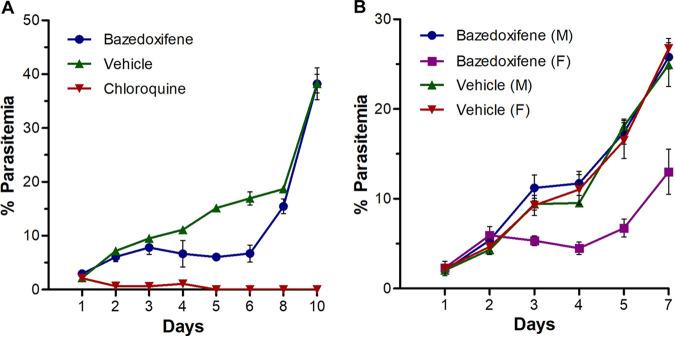
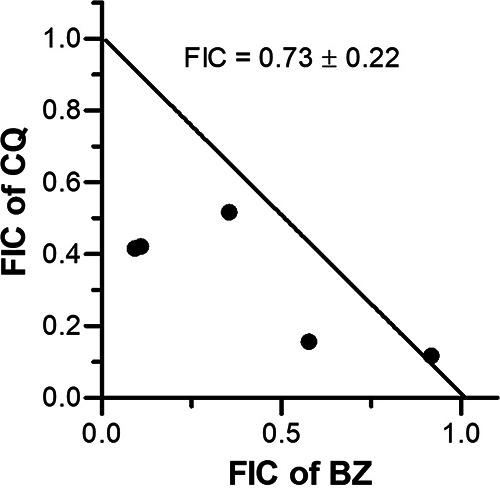
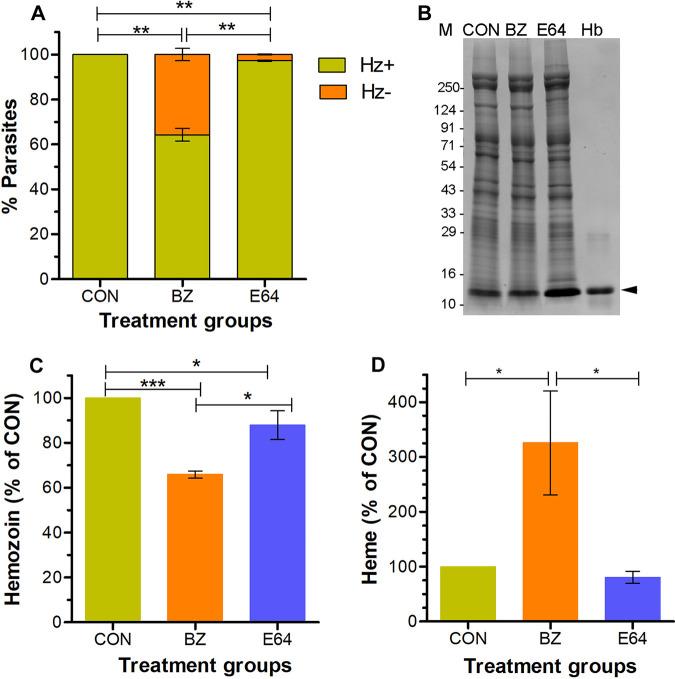
Despite a remarkable improvement in health care and continued drug discovery efforts, malaria control efforts are continuously challenged by the emergence of drug-resistant parasite strains. Given a long and risky development path of new drugs, repurposing existing drugs for the treatment of malaria is an attractive and shorter path. Tamoxifen, a selective estrogen receptor modulator (SERM) for the treatment and prevention of estrogen receptor-positive breast cancer, possesses antibacterial, antifungal, and antiparasitic activities. Hence, we assessed tamoxifen, raloxifene, and bazedoxifene, which represent the first-, second-, and third-generation SERMs, respectively, for antimalarial activity. Raloxifene and bazedoxifene inhibited the erythrocytic development of Plasmodium falciparum with submicromolar 50% inhibitory concentration (IC) values. Among the three, bazedoxifene was the most potent and also decreased P. berghei infection in female mice but not in male mice. However, bazedoxifene similarly inhibited P. falciparum growth in erythrocytes of male and female origin, which highlights the importance of sex-specific host physiology in drug efficacy. Bazedoxifene was most potent on early ring-stage parasites, and about 35% of the treated parasites did not contain hemozoin in the food vacuole. Bazedoxifene-treated parasites had almost 34% less hemozoin content than the control parasites. However, both control and bazedoxifene-treated parasites had similar hemoglobin levels, suggesting that bazedoxifene inhibits hemozoin formation and that toxicity due to accumulation of free heme could be a mechanism of its antimalarial activity. Because bazedoxifene is in clinical use and bazedoxifene-chloroquine combination shows an additive antiparasitic effect, bazedoxifene could be an adjunctive partner of currently used antimalarial regimens. The emergence and spread of drug-resistant strains of the human malaria parasite Plasmodium falciparum has necessitated new drugs. Selective estrogen receptor modulators are in clinical use for the prevention and treatment of breast cancer and postmenopausal osteoporosis. We demonstrate that bazedoxifene, a third-generation selective estrogen receptor modulator, has potent inhibitory activity against both susceptible and drug-resistant strains of Plasmodium falciparum. It also blocked the development of Plasmodium berghei in mice. The inhibitory effect was strongest on the ring stage and resulted in the inhibition of hemozoin formation, which could be the major mechanism of bazedoxifene action. Hemozoin is a nontoxic polymer of heme, which is a by-product of hemoglobin degradation by the malaria parasite during its development within the erythrocyte. Because bazedoxifene is already in clinical use for the treatment of postmenopausal osteoporosis, our findings support repurposing of bazedoxifene as an antimalarial.
尽管医疗保健水平显著提高,药物研发工作也在持续进行,但抗疟努力仍不断受到耐药寄生虫株出现的挑战。鉴于新药的研发路径漫长且风险大,将现有药物重新用于治疗疟疾是一条具有吸引力且耗时较短的途径。他莫昔芬是一种用于治疗和预防雌激素受体阳性乳腺癌的选择性雌激素受体调节剂(SERM),具有抗菌、抗真菌和抗寄生虫活性。因此,我们评估了他莫昔芬、雷洛昔芬和巴多昔芬,它们分别代表第一代、第二代和第三代 SERM,用于抗疟活性。雷洛昔芬和巴多昔芬以亚微摩尔 50%抑制浓度(IC)值抑制恶性疟原虫的红细胞发育。在这三种药物中,巴多昔芬的活性最强,也能降低雌性小鼠中的疟原虫感染,但对雄性小鼠无效。然而,巴多昔芬同样抑制了来自雄性和雌性来源的红细胞中的恶性疟原虫生长,这凸显了性别特异性宿主生理学在药物疗效中的重要性。巴多昔芬对早期环早期寄生虫最有效,约 35%的处理寄生虫在食物泡中没有含铁血黄素。与对照寄生虫相比,用巴多昔芬处理的寄生虫中的含铁血黄素含量少约 34%。然而,对照和巴多昔芬处理的寄生虫的血红蛋白水平相似,这表明巴多昔芬抑制含铁血黄素的形成,并且由于游离血红素的积累而产生的毒性可能是其抗疟活性的机制。由于巴多昔芬已在临床使用,并且巴多昔芬-氯喹联合使用具有相加的抗寄生虫作用,因此巴多昔芬可能成为目前使用的抗疟方案的辅助药物。人类疟原虫恶性疟原虫耐药株的出现和传播,需要新的药物。选择性雌激素受体调节剂已用于预防和治疗乳腺癌和绝经后骨质疏松症。我们证明第三代选择性雌激素受体调节剂巴多昔芬对敏感和耐药的恶性疟原虫株均具有强效抑制活性。它还阻止了疟原虫伯氏疟原虫在小鼠中的发育。在环早期阶段抑制作用最强,并导致含铁血黄素形成的抑制,这可能是巴多昔芬作用的主要机制。含铁血黄素是血红素的无毒聚合物,是疟原虫在红细胞内发育过程中降解血红蛋白的副产物。由于巴多昔芬已用于治疗绝经后骨质疏松症,我们的研究结果支持将巴多昔芬重新用作抗疟药物。


 Zotero 插件