
脱落酸:在果实发育和成熟中的作用
Abscisic Acid: Role in Fruit Development and Ripening.
作者信息
Gupta Kapil, Wani Shabir H, Razzaq Ali, Skalicky Milan, Samantara Kajal, Gupta Shubhra, Pandita Deepu, Goel Sonia, Grewal Sapna, Hejnak Vaclav, Shiv Aalok, El-Sabrout Ahmed M, Elansary Hosam O, Alaklabi Abdullah, Brestic Marian
机构信息
Department of Biotechnology, Siddharth University, Kapilvastu, India.
Mountain Research Centre for Field Crops, Sher-e-Kashmir University of Agricultural Sciences and Technology of Jammu, Khudwani, India.
出版信息
Front Plant Sci. 2022 May 10;13:817500. doi: 10.3389/fpls.2022.817500. eCollection 2022.
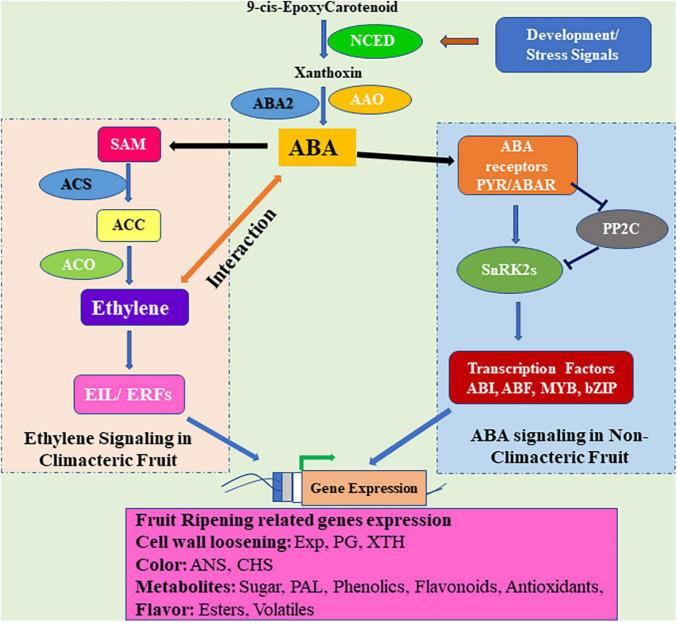
Abscisic acid (ABA) is a plant growth regulator known for its functions, especially in seed maturation, seed dormancy, adaptive responses to biotic and abiotic stresses, and leaf and bud abscission. ABA activity is governed by multiple regulatory pathways that control ABA biosynthesis, signal transduction, and transport. The transport of the ABA signaling molecule occurs from the shoot (site of synthesis) to the fruit (site of action), where ABA receptors decode information as fruit maturation begins and is significantly promoted. The maximum amount of ABA is exported by the phloem from developing fruits during seed formation and initiation of fruit expansion. In the later stages of fruit ripening, ABA export from the phloem decreases significantly, leading to an accumulation of ABA in ripening fruit. Fruit growth, ripening, and senescence are under the control of ABA, and the mechanisms governing these processes are still unfolding. During the fruit ripening phase, interactions between ABA and ethylene are found in both climacteric and non-climacteric fruits. It is clear that ABA regulates ethylene biosynthesis and signaling during fruit ripening, but the molecular mechanism controlling the interaction between ABA and ethylene has not yet been discovered. The effects of ABA and ethylene on fruit ripening are synergistic, and the interaction of ABA with other plant hormones is an essential determinant of fruit growth and ripening. Reaction and biosynthetic mechanisms, signal transduction, and recognition of ABA receptors in fruits need to be elucidated by a more thorough study to understand the role of ABA in fruit ripening. Genetic modifications of ABA signaling can be used in commercial applications to increase fruit yield and quality. This review discusses the mechanism of ABA biosynthesis, its translocation, and signaling pathways, as well as the recent findings on ABA function in fruit development and ripening.
脱落酸(ABA)是一种植物生长调节剂,以其功能而闻名,特别是在种子成熟、种子休眠、对生物和非生物胁迫的适应性反应以及叶片和芽的脱落方面。ABA的活性受多种调控途径控制,这些途径控制着ABA的生物合成、信号转导和运输。ABA信号分子从地上部(合成部位)运输到果实(作用部位),在果实成熟开始时,ABA受体在此解码信息,且果实成熟显著加速。在种子形成和果实开始膨大期间,发育中的果实通过韧皮部输出的ABA量达到最大值。在果实成熟后期,韧皮部的ABA输出显著减少,导致成熟果实中ABA积累。果实的生长、成熟和衰老受ABA控制,而调控这些过程的机制仍在不断揭示中。在果实成熟阶段,在跃变型和非跃变型果实中均发现了ABA与乙烯之间的相互作用。显然,ABA在果实成熟过程中调节乙烯的生物合成和信号转导,但控制ABA与乙烯相互作用的分子机制尚未发现。ABA和乙烯对果实成熟的作用是协同的,ABA与其他植物激素的相互作用是果实生长和成熟的重要决定因素。需要通过更深入的研究来阐明果实中ABA的反应和生物合成机制、信号转导以及ABA受体的识别,以了解ABA在果实成熟中的作用。ABA信号转导的基因修饰可用于商业应用,以提高果实产量和品质。本文综述了ABA的生物合成机制、转运及其信号通路,以及ABA在果实发育和成熟方面功能的最新研究结果。


 Zotero 插件