
环境空气污染与儿科呼吸道疾病急诊就诊之间的关联:COVID-19大流行的影响
Association between Ambient Air Pollution and Emergency Room Visits for Pediatric Respiratory Diseases: The Impact of COVID-19 Pandemic.
作者信息
Cheng Chi-Yung, Tseng Yu-Lun, Huang Kuo-Chen, Chiu I-Min, Pan Hsiu-Yung, Cheng Fu-Jen
机构信息
Department of Emergency Medicine, Kaohsiung Chang Gung Memorial Hospital, College of Medicine, Chang Gung University, Kaohsiung 833, Taiwan.
College of Medicine, Chang Gung University, Taoyuan 333, Taiwan.
出版信息
Toxics. 2022 May 14;10(5):247. doi: 10.3390/toxics10050247.
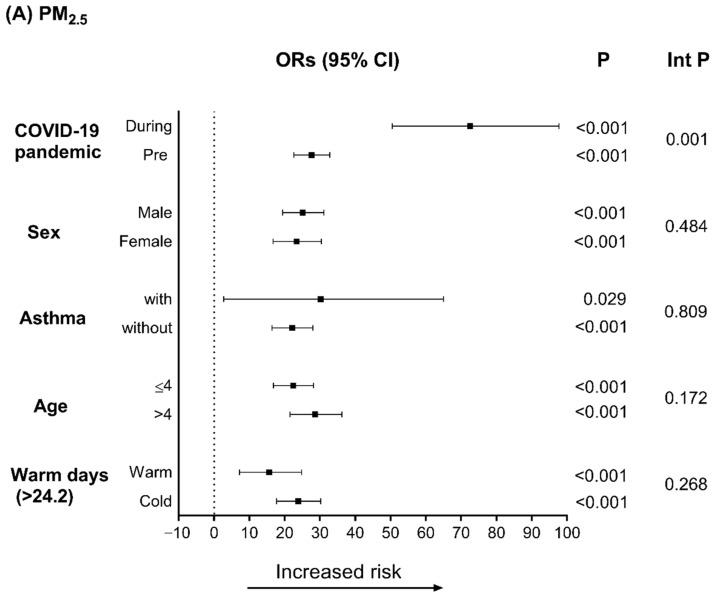
The level and composition of air pollution have changed during the coronavirus disease 2019 (COVID-19) pandemic. However, the association between air pollution and pediatric respiratory disease emergency department (ED) visits during the COVID-19 pandemic remains unclear. The study was retrospectively conducted between 2017 and 2020 in Kaohsiung, Taiwan, from 1 January 2020 to 1 May 2020, defined as the period of the COVID-19 pandemic, and 1 January 2017 to 31 May 2019, defined as the pre-COVID-19 pandemic period. We enrolled patients under 17 years old who visited the ED in a medical center and were diagnosed with respiratory diseases such as pneumonia, asthma, bronchitis, and acute pharyngitis. Measurements of particulate matter (PM) with aerodynamic diameters of <10 μm (PM10) and < 2.5 μm (PM2.5), nitrogen dioxide (NO2), and Ozone (O3) were collected. During the COVID-19 pandemic, an increase in the interquartile range of PM2.5, PM10, and NO2 levels was associated with increases of 72.5% (95% confidence interval [CI], 50.5−97.7%), 98.0% (95% CI, 70.7−129.6%), and 54.7% (95% CI, 38.7−72.6%), respectively, in the risk of pediatric respiratory disease ED visits on lag 1, which were greater than those in the pre-COVID-19 pandemic period. After adjusting for temperature and humidity, the risk of pediatric respiratory diseases after exposure to PM2.5 (inter p = 0.001) and PM10 (inter p < 0.001) was higher during the COVID-19 pandemic. PM2.5, PM10, and NO2 may play important roles in pediatric respiratory events in Kaohsiung, Taiwan. Compared with the pre-COVID-19 pandemic period, the levels of PM2.5 and PM10 were lower; however, the levels were related to a greater increase in ED during the COVID-19 pandemic.
在2019冠状病毒病(COVID-19)大流行期间,空气污染的水平和构成发生了变化。然而,COVID-19大流行期间空气污染与儿科呼吸道疾病急诊就诊之间的关联仍不明确。该研究于2017年至2020年在台湾高雄进行,回顾性分析了2020年1月1日至2020年5月1日(定义为COVID-19大流行期)以及2017年1月1日至2019年5月31日(定义为COVID-19大流行前时期)的数据。我们纳入了在一家医疗中心急诊科就诊且被诊断患有肺炎、哮喘、支气管炎和急性咽炎等呼吸道疾病的17岁以下患者。收集了空气动力学直径<10μm(PM10)和<2.5μm(PM2.5)的颗粒物、二氧化氮(NO2)和臭氧(O3)的测量数据。在COVID-19大流行期间,PM2.5、PM10和NO2水平的四分位间距增加与滞后1天的儿科呼吸道疾病急诊就诊风险分别增加72.5%(95%置信区间[CI],50.5−97.7%)、98.0%(95%CI,70.7−129.6%)和54.7%(95%CI,38.7−72.6%)相关,这些增幅大于COVID-19大流行前时期。在调整温度和湿度后,COVID-19大流行期间暴露于PM2.5(交互p = 0.001)和PM10(交互p < 0.001)后儿科呼吸道疾病的风险更高。PM2.5、PM10和NO2可能在台湾高雄的儿科呼吸道事件中起重要作用。与COVID-19大流行前时期相比,PM2.5和PM10的水平较低;然而,在COVID-19大流行期间,这些水平与急诊就诊的更大增幅相关。


 Zotero 插件