
超氧化物歧化酶3(SOD3)抑制基质金属蛋白酶-1(MMP-1)的表达并增强成纤维细胞中细胞外基质的完整性。
SOD3 Suppresses the Expression of MMP-1 and Increases the Integrity of Extracellular Matrix in Fibroblasts.
作者信息
Kim Jin Hyung, Jeong Hae Dong, Song Min Ji, Lee Dong Hun, Chung Jin Ho, Lee Seung-Taek
机构信息
Department of Biochemistry, College of Life Science and Biotechnology, Yonsei University, Seoul 03722, Korea.
Department of Dermatology, Seoul National University College of Medicine, Seoul 03080, Korea.
出版信息
Antioxidants (Basel). 2022 May 9;11(5):928. doi: 10.3390/antiox11050928.
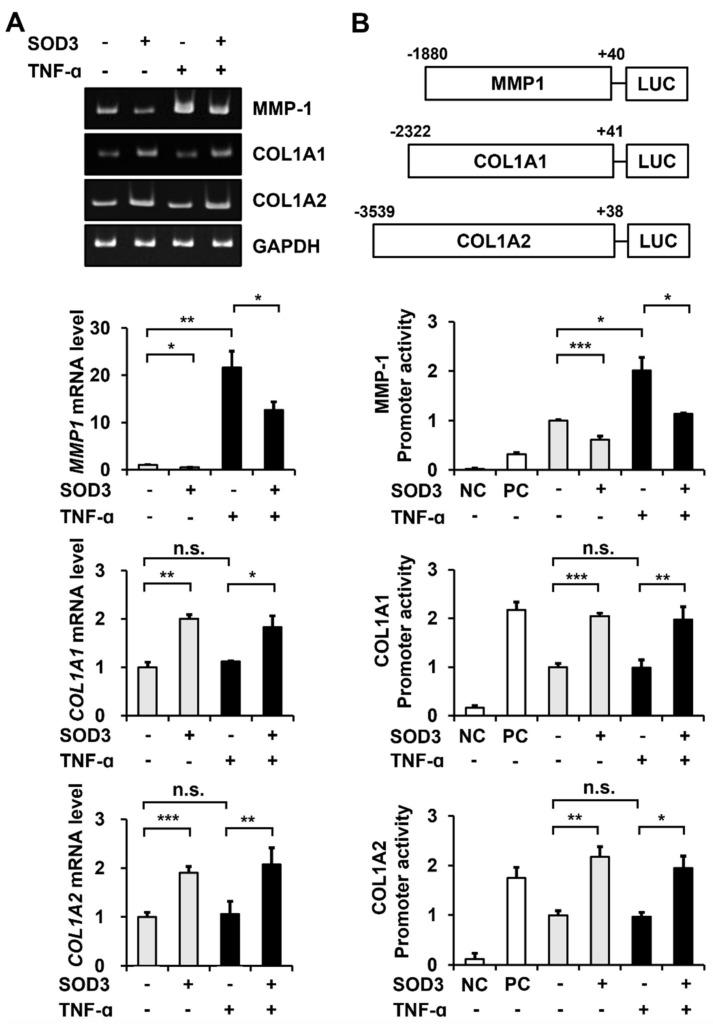
The superoxide dismutase (SOD) family functions as a reactive oxygen species (ROS)-scavenging system by converting superoxide anions into hydrogen peroxide in the cytosol (SOD1), mitochondria (SOD2), and extracellular matrix (SOD3). In this study, we examined the potential roles of SOD family members in skin aging. We found that SOD3 expression levels were significantly more reduced in the skin tissues of old mice and humans than in young counterparts, but SOD1 and SOD2 expression levels remained unchanged with aging. Accordingly, we analyzed the effects of SOD3 on intracellular ROS levels and the integrity of the extracellular matrix in fibroblasts. The treatment of foreskin fibroblasts with recombinant SOD3 reduced the intracellular ROS levels and secretion of MMP-1 while increasing the secretion of type I collagen. The effects of SOD3 were greater in fibroblasts treated with the TNF-α. SOD3 treatment also decreased the mRNA levels and promoter activity of while increasing the mRNA levels and promoter activities of and . SOD3 treatment reduced the phosphorylation of NF-κB, p38 MAPK, ERK, and JNK, which are essential for transactivation. In a three-dimensional culture of fibroblasts, SOD3 decreased the amount of type I collagen fragments produced by MMP-1 and increased the amount of nascent type I procollagen. These results demonstrate that SOD3 reduces intracellular ROS levels, suppresses MMP-1 expression, and induces type I collagen expression in fibroblasts. Therefore, SOD3 may play a role in delaying or preventing skin aging.
超氧化物歧化酶(SOD)家族通过在细胞质(SOD1)、线粒体(SOD2)和细胞外基质(SOD3)中将超氧阴离子转化为过氧化氢,发挥活性氧(ROS)清除系统的作用。在本研究中,我们检测了SOD家族成员在皮肤衰老中的潜在作用。我们发现,老年小鼠和人类皮肤组织中SOD3的表达水平显著低于年轻对照,但SOD1和SOD2的表达水平不会随衰老而改变。因此,我们分析了SOD3对成纤维细胞内ROS水平和细胞外基质完整性的影响。用重组SOD3处理包皮成纤维细胞可降低细胞内ROS水平和MMP-1的分泌,同时增加I型胶原蛋白的分泌。在TNF-α处理的成纤维细胞中,SOD3的作用更大。SOD3处理还降低了 的mRNA水平和启动子活性,同时增加了 和 的mRNA水平和启动子活性。SOD3处理降低了NF-κB、p38 MAPK、ERK和JNK的磷酸化,这些蛋白对于 的反式激活至关重要。在成纤维细胞的三维培养中,SOD3减少了MMP-1产生的I型胶原蛋白片段的量,并增加了新生I型前胶原蛋白的量。这些结果表明,SOD3降低了成纤维细胞内的ROS水平,抑制了MMP-1的表达,并诱导了I型胶原蛋白的表达。因此,SOD3可能在延缓或预防皮肤衰老中发挥作用。



 Zotero 插件