
新型细胞色素 P450 () 在 Tribenuron-Methyl-Resistant L. 中的代谢及其对不同作用模式除草剂的抗性。
The Metabolism of a Novel Cytochrome P450 () in Tribenuron-Methyl-Resistant L. to Herbicides with Different Mode of Actions.
机构信息
Department of Applied Chemistry, College of Science, China Agricultural University, Beijing 100193, China.
出版信息
Int J Mol Sci. 2022 May 22;23(10):5812. doi: 10.3390/ijms23105812.
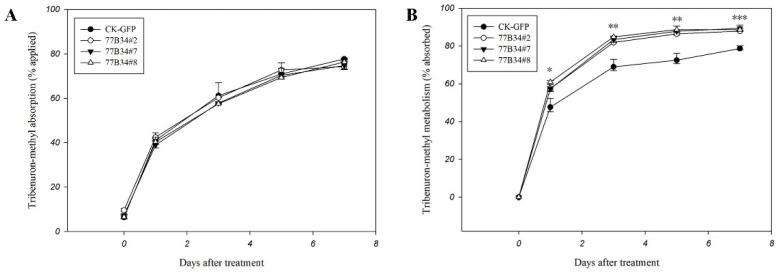
L. (flixweeds) is a noxious broad-leaf weed infesting winter wheat fields in China that has evolved high resistance to tribenuron-methyl. In this work, a brand new gene was cloned from tribenuron-methyl-resistant (TR) and transferred into , and the sensitivities of with or without the transgene to herbicides with a different mode of actions (MoAs) were tested. Compared to expressing pCAMBIA1302-GFP (empty plasmid), transferring pCAMBIA1302-CYP77B34 (recombinant plasmid) became resistant to acetolactate synthase (ALS)-inhibiting herbicide tribenuron-methyl, protoporphyrinogen oxidase (PPO)-inhibiting herbicides carfentrazone-ethyl and oxyfluorfen. Cytochrome P450 inhibitor malathion could reverse the resistance to tribenuron-methyl, carfentrazone-ethyl and oxyfluorfen in transgenic plants. In addition, the metabolic rates of tribenuron-methyl in expressing were significantly higher than those in expressing pCAMBIA1302-GFP. Other than that, the transgenic plants showed some tolerance to very-long-chain fatty acid synthesis (VLCFAs)-inhibiting herbicide pretilachlor and photosystem (PS) II-inhibiting herbicide bromoxynil. Subcellular localization revealed that the CYP77B34 protein was located in the endoplasmic reticulum (ER). These results clearly indicated that mediated resistance to tribenuron-methyl and may have been involved in cross-resistance to carfentrazone-ethyl, oxyfluorfen, pretilachlor and bromoxynil.
节节麦是一种在中国冬小麦田中为害的有毒阔叶杂草,已对啶磺草胺产生了高度抗性。本工作从啶磺草胺抗性(TR)节节麦中克隆了一个全新的基因,并将其转入 ,并测试了含有或不含有该基因的 对具有不同作用模式(MoA)的除草剂的敏感性。与表达 pCAMBIA1302-GFP(空质粒)的 相比,表达 pCAMBIA1302-CYP77B34(重组质粒)的 对乙酰乳酸合酶(ALS)抑制剂除草剂啶磺草胺、原卟啉原氧化酶(PPO)抑制剂除草剂唑草酮和三氟羧草醚变得具有抗性。细胞色素 P450 抑制剂马拉硫磷可以逆转转基因 植株对啶磺草胺、唑草酮和三氟羧草醚的抗性。此外,表达 的 代谢啶磺草胺的速率明显高于表达 pCAMBIA1302-GFP 的 。除此之外,转基因植株对非常长链脂肪酸合成(VLCFAs)抑制剂丙草胺和 PS II 抑制剂溴苯腈表现出一定的耐受性。亚细胞定位表明 CYP77B34 蛋白位于内质网(ER)中。这些结果清楚地表明, 介导了对啶磺草胺的抗性,并且可能参与了对唑草酮、三氟羧草醚、丙草胺和溴苯腈的交叉抗性。


 Zotero 插件