
S-腺苷甲硫氨酸和S-腺苷同型半胱氨酸的分析:短期饮食干预对健康成年人的方法优化与分析
Analysis of S-Adenosylmethionine and S-Adenosylhomocysteine: Method Optimisation and Profiling in Healthy Adults upon Short-Term Dietary Intervention.
作者信息
Bravo Aida Corrillero, Aguilera Maria Nieves Ligero, Marziali Nahuel R, Moritz Lennart, Wingert Victoria, Klotz Katharina, Schumann Anke, Grünert Sarah C, Spiekerkoetter Ute, Berger Urs, Lederer Ann-Kathrin, Huber Roman, Hannibal Luciana
机构信息
Laboratory of Clinical Biochemistry and Metabolism, Department of General Pediatrics, Adolescent Medicine and Neonatology, Medical Center-University of Freiburg, Faculty of Medicine, University of Freiburg, 79106 Freiburg, Germany.
Department of General Pediatrics, Adolescent Medicine and Neonatology, Medical Center-University of Freiburg, Faculty of Medicine, University of Freiburg, 79106 Freiburg, Germany.
出版信息
Metabolites. 2022 Apr 20;12(5):373. doi: 10.3390/metabo12050373.
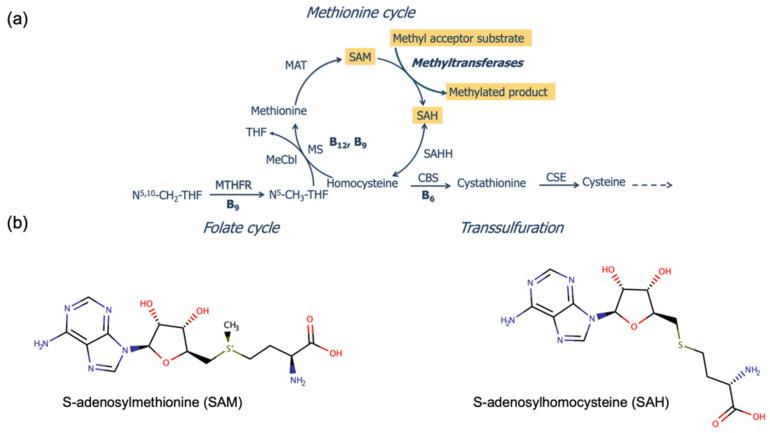
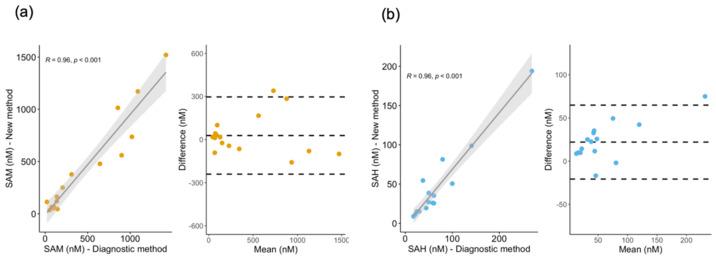
S-adenosylmethionine (SAM) is essential for methyl transfer reactions. All SAM is produced de novo via the methionine cycle. The demethylation of SAM produces S-adenosylhomocysteine (SAH), an inhibitor of methyltransferases and the precursor of homocysteine (Hcy). The measurement of SAM and SAH in plasma has value in the diagnosis of inborn errors of metabolism (IEM) and in research to assess methyl group homeostasis. The determination of SAM and SAH is complicated by the instability of SAM under neutral and alkaline conditions and the naturally low concentration of both SAM and SAH in plasma (nM range). Herein, we describe an optimised LC-MS/MS method for the determination of SAM and SAH in plasma, urine, and cells. The method is based on isotopic dilution and employs 20 µL of plasma or urine, or 500,000 cells, and has an instrumental running time of 5 min. The reference ranges for plasma SAM and SAH in a cohort of 33 healthy individuals (age: 19-60 years old; mean ± 2 SD) were 120 ± 36 nM and 21.5 ± 6.5 nM, respectively, in accordance with independent studies and diagnostic determinations. The method detected abnormal concentrations of SAM and SAH in patients with inborn errors of methyl group metabolism. Plasma and urinary SAM and SAH concentrations were determined for the first time in a randomised controlled trial of 53 healthy adult omnivores (age: 18-60 years old), before and after a 4 week intervention with a vegan or meat-rich diet, and revealed preserved variations of both metabolites and the SAM/SAH index.
S-腺苷甲硫氨酸(SAM)对于甲基转移反应至关重要。所有的SAM都是通过甲硫氨酸循环从头合成的。SAM的去甲基化产生S-腺苷同型半胱氨酸(SAH),它是甲基转移酶的抑制剂,也是同型半胱氨酸(Hcy)的前体。血浆中SAM和SAH的测定在先天性代谢缺陷(IEM)的诊断以及评估甲基稳态的研究中具有重要价值。SAM和SAH的测定因SAM在中性和碱性条件下的不稳定性以及血浆中SAM和SAH的天然低浓度(纳摩尔范围)而变得复杂。在此,我们描述了一种用于测定血浆、尿液和细胞中SAM和SAH的优化液相色谱-串联质谱(LC-MS/MS)方法。该方法基于同位素稀释,使用20μL血浆或尿液,或500,000个细胞,仪器运行时间为5分钟。在一组33名健康个体(年龄:19 - 60岁;平均值±2标准差)中,血浆SAM和SAH的参考范围分别为120±36 nM和21.5±6.5 nM,这与独立研究和诊断测定结果一致。该方法检测出甲基代谢先天性缺陷患者中SAM和SAH的异常浓度。在一项针对53名健康成年杂食者(年龄:18 - 60岁)的随机对照试验中,首次测定了他们在纯素食或富含肉类饮食的4周干预前后血浆和尿液中SAM和SAH的浓度,结果显示这两种代谢物以及SAM/SAH指数的变化均得以保留。





 Zotero 插件