
荷兰新冠疫情大流行第一年侵袭性细菌病流行病学中的病原体和类型特异性变化
Pathogen- and Type-Specific Changes in Invasive Bacterial Disease Epidemiology during the First Year of the COVID-19 Pandemic in The Netherlands.
作者信息
Steens Anneke, Knol Mirjam J, Freudenburg-de Graaf Wieke, de Melker Hester E, van der Ende Arie, van Sorge Nina M
机构信息
Centre for Infectious Disease Control, National Institute for Public Health and the Environment (RIVM), 3721 MA Bilthoven, The Netherlands.
Department of Medical Microbiology and Infection Prevention, Amsterdam UMC, University of Amsterdam, 1105 AZ Amsterdam, The Netherlands.
出版信息
Microorganisms. 2022 May 5;10(5):972. doi: 10.3390/microorganisms10050972.
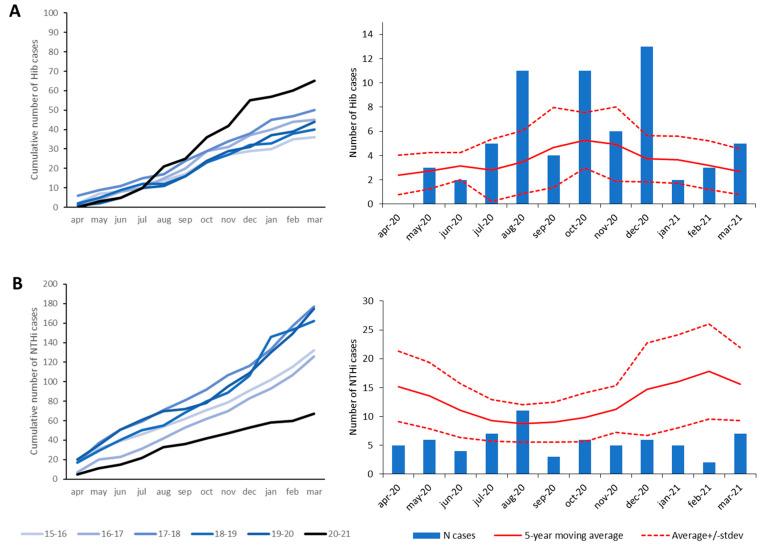
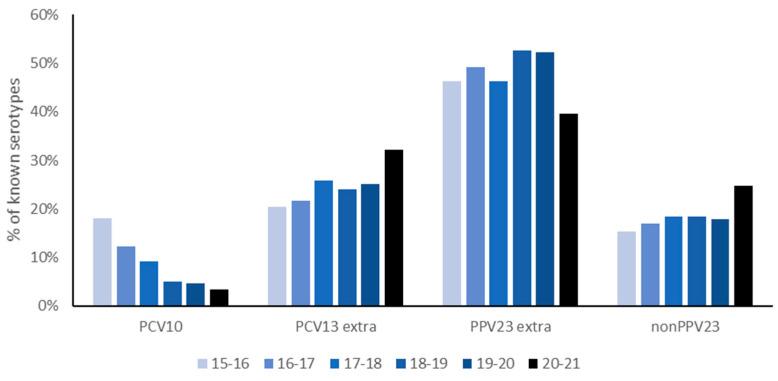
COVID-19 control measures have resulted in a decline in invasive bacterial disease caused by Neisseria meningitidis (IMD), Streptococcus pneumoniae (IPD), and Haemophilus influenzae (Hi-D). These species comprise different serogroups and serotypes that impact transmissibility and virulence. We evaluated type- and pathogen-specific changes in invasive bacterial disease epidemiology in the Netherlands during the first year of the SARS-CoV-2 pandemic. Cases were based on nationwide surveillance for five bacterial species with either respiratory (IMD, IPD, Hi-D) or non-respiratory (controls) transmission routes and were compared from the pre-COVID period (April 2015−March 2020) to the first COVID-19 year (April 2020−March 2021). IMD, IPD, and Hi-D cases decreased by 78%, 67%, and 35%, respectively, in the first COVID-19 year compared to the pre-COVID period, although effects differed per age group. Serogroup B-IMD declined by 61%, while serogroup W and Y-IMD decreased >90%. IPD caused by serotypes 7F, 15A, 12F, 33F, and 8 showed the most pronounced decline (≥76%). In contrast to an overall decrease in Hi-D cases, vaccine-preventable serotype b (Hib) increased by 51%. COVID-19 control measures had pathogen- and type-specific effects related to invasive infections. Continued surveillance is critical to monitor potential rebound effects once restriction measures are lifted and transmission is resumed.
新冠疫情防控措施已导致由脑膜炎奈瑟菌(侵袭性脑膜炎球菌病,IMD)、肺炎链球菌(侵袭性肺炎球菌病,IPD)和流感嗜血杆菌(侵袭性流感嗜血杆菌病,Hi-D)引起的侵袭性细菌病有所减少。这些菌种包含不同的血清群和血清型,会影响传播性和毒力。我们评估了荷兰在新冠疫情大流行第一年侵袭性细菌病流行病学中特定类型和病原体的变化情况。病例基于对五种具有呼吸道(IMD、IPD、Hi-D)或非呼吸道(对照)传播途径的细菌物种进行的全国监测,并将新冠疫情前时期(2015年4月至2020年3月)与首个新冠疫情年(2020年4月至2021年3月)进行了比较。与新冠疫情前时期相比,在首个新冠疫情年,IMD、IPD和Hi-D病例分别减少了78%、67%和35%,不过不同年龄组的影响有所不同。B群IMD下降了61%,而W群和Y群IMD下降超过90%。由7F、15A、12F、33F和8型血清型引起的IPD下降最为显著(≥76%)。与Hi-D病例总体下降形成对比的是,可通过疫苗预防的b型血清型(Hib)增加了51%。新冠疫情防控措施对侵袭性感染具有病原体和类型特异性影响。一旦限制措施解除且传播恢复,持续监测对于监测潜在的反弹效应至关重要。


 Zotero 插件