
静电纺丝参数和后处理方法对壳聚糖纳米纤维的抗菌和抗生物膜活性的影响。
Impact of Electrospinning Parameters and Post-Treatment Method on Antibacterial and Antibiofilm Activity of Chitosan Nanofibers.
机构信息
Biomedical Research Centre, Sumy State University, 2, Rymsky-Korsakov Str., 40007 Sumy, Ukraine.
Faculty of Chemistry, Silesian University of Technology, 44-100 Gliwice, Poland.
出版信息
Molecules. 2022 May 23;27(10):3343. doi: 10.3390/molecules27103343.
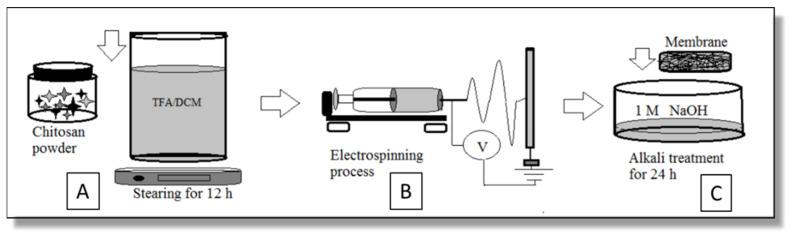
Chitosan, a natural biopolymer, is an ideal candidate to prepare biomaterials capable of preventing microbial infections due to its antibacterial properties. Electrospinning is a versatile method ideally suited to process biopolymers with minimal impact on their physicochemical properties. However, fabrication parameters and post-processing routine can affect biological activity and, therefore, must be well adjusted. In this study, nanofibrous membranes were prepared using trifluoroacetic acid and dichloromethane and evaluated for physiochemical and antimicrobial properties. The use of such biomaterials as potential antibacterial agents was extensively studied in vitro using and as test organisms. The antibacterial assay showed inhibition of bacterial growth and eradication of the planktonic cells of both and in the liquid medium for up to 6 hrs. The quantitative assay showed a significant reduction in bacteria cell viability by nanofibers depending on the method of fabrication. The antibacterial properties of these biomaterials can be attributed to the structural modifications provided by co-solvent formulation and application of post-treatment procedure. Consequently, the proposed antimicrobial surface modification method is a promising technique to prepare biomaterials designed to induce antimicrobial resistance via antiadhesive capability and the biocide-releasing mechanism.
壳聚糖是一种天然的生物聚合物,由于其具有抗菌性能,是制备能够预防微生物感染的生物材料的理想候选物。静电纺丝是一种多功能的方法,非常适合处理生物聚合物,对其物理化学性质的影响最小。然而,制造参数和后处理程序会影响生物活性,因此必须进行适当调整。在这项研究中,使用三氟乙酸和二氯甲烷制备了纳米纤维膜,并对其物理化学和抗菌性能进行了评估。使用 和 作为测试生物,体外广泛研究了这些生物材料作为潜在抗菌剂的用途。抗菌试验表明,纳米纤维在液体培养基中抑制了 和 的细菌生长并消除了浮游细胞,最长可达 6 小时。定量分析表明,纳米纤维的细菌细胞活力显著降低,这取决于制造方法。这些生物材料的抗菌性能可以归因于共溶剂配方提供的结构修饰和后处理程序的应用。因此,所提出的抗菌表面改性方法是一种很有前途的技术,可以通过抗粘附能力和杀生物剂释放机制来制备设计用于诱导抗菌耐药性的生物材料。




 Zotero 插件