
生殖因素与结直肠癌风险:基于人群的病例对照研究。
Reproductive Factors and Colorectal Cancer Risk: A Population-Based Case-Control Study.
机构信息
Division of Clinical Epidemiology and Aging Research, German Cancer Research Center (DKFZ), Heidelberg, Germany.
Division of Cancer Epidemiology, German Cancer Research Center (DKFZ), Heidelberg, Germany.
出版信息
JNCI Cancer Spectr. 2022 Jul 1;6(4). doi: 10.1093/jncics/pkac042.
BACKGROUND
Hormone-replacement therapy (HRT) is associated with lower colorectal cancer (CRC) risk among postmenopausal women. However, little is known about the effects of lifetime exposure of women to varying levels of estrogen and progesterone through reproductive factors such as parity, use of oral contraceptives (OC), breastfeeding, and menstruation on CRC risk.
METHODS
We assessed associations between reproductive factors and CRC risk among 2650 female CRC patients aged 30+ years and 2175 matched controls in a population-based study in Germany, adjusting for potential confounders by multiple logistic regression.
RESULTS
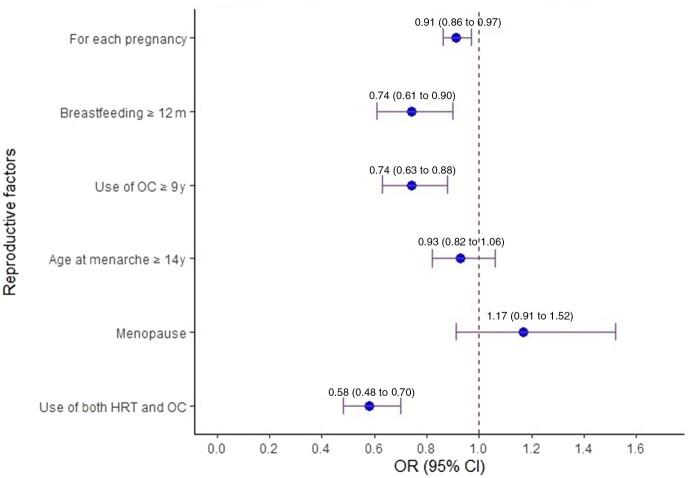
Inverse associations with CRC risk were found for numbers of pregnancies (odds ratio [OR] per pregnancy = 0.91, 95% confidence interval [CI] = 0.86 to 0.97), breastfeeding for 12 months and longer (OR = 0.74, 95% CI = 0.61 to 0.90), and use of either OC or HRT (OR = 0.75, 95% CI = 0.64 to 0.87) or both (OR = 0.58, 95% CI = 0.48 to 0.70). Similar results were found for postmenopausal women only and when adjusting for number of pregnancies and for all reproductive factors analyzed together. Breastfeeding duration of 12 months and longer was associated with lower risk of cancer only in the proximal colon (OR = 0.58, 95% CI = 0.45 to 0.74).
CONCLUSIONS
Several reproductive factors were associated with lower CRC risk in women, including number of pregnancies, breastfeeding duration, and use of OC and HRT. This suggests that women's exposure to female reproductive hormones plays a key role in the difference in CRC risk between women and men and in site-specific CRC risk.
背景
激素替代疗法(HRT)与绝经后女性的结直肠癌(CRC)风险降低有关。然而,对于女性通过生育因素(如生育次数、口服避孕药(OC)的使用、母乳喂养和月经)接触不同水平的雌激素和孕激素对 CRC 风险的影响知之甚少。
方法
我们在德国一项基于人群的研究中,评估了生育因素与 2650 名 30 岁及以上女性 CRC 患者和 2175 名匹配对照者 CRC 风险之间的关联,通过多因素逻辑回归调整了潜在混杂因素。
结果
与 CRC 风险呈负相关的因素有妊娠次数(每增加一次妊娠的比值比[OR]为 0.91,95%置信区间[CI]为 0.86 至 0.97)、母乳喂养 12 个月及以上(OR=0.74,95%CI=0.61 至 0.90)、OC 或 HRT 的使用(OR=0.75,95%CI=0.64 至 0.87)或两者均使用(OR=0.58,95%CI=0.48 至 0.70)。仅在绝经后女性中以及在调整生育次数和所有生育因素分析时,结果类似。母乳喂养 12 个月及以上与近端结肠癌风险降低相关(OR=0.58,95%CI=0.45 至 0.74)。
结论
几项生育因素与女性 CRC 风险降低相关,包括生育次数、母乳喂养持续时间、OC 和 HRT 的使用。这表明女性生殖激素的暴露在男女 CRC 风险差异以及 CRC 特定部位风险中起着关键作用。

 Zotero 插件