
早期人类发育过程中动态 DNA 5-羟甲基胞嘧啶和 RNA 5-甲基胞嘧啶的重编程。
Dynamic DNA 5-hydroxylmethylcytosine and RNA 5-methycytosine Reprogramming During Early Human Development.
机构信息
Center for Reproductive Medicine, Henan Key Laboratory of Reproduction and Genetics, The First Affiliated Hospital of Zhengzhou University, Zhengzhou 450052, China.
Key Laboratory of Genomic and Precision Medicine, Beijing Institute of Genomics, Chinese Academy of Sciences and China National Center for Bioinformation, Beijing 100101, China; University of Chinese Academy of Sciences, Beijing 100049, China; Sino-Danish College, University of Chinese Academy of Sciences, Beijing 100049, China.
出版信息
Genomics Proteomics Bioinformatics. 2023 Aug;21(4):805-822. doi: 10.1016/j.gpb.2022.05.005. Epub 2022 May 26.
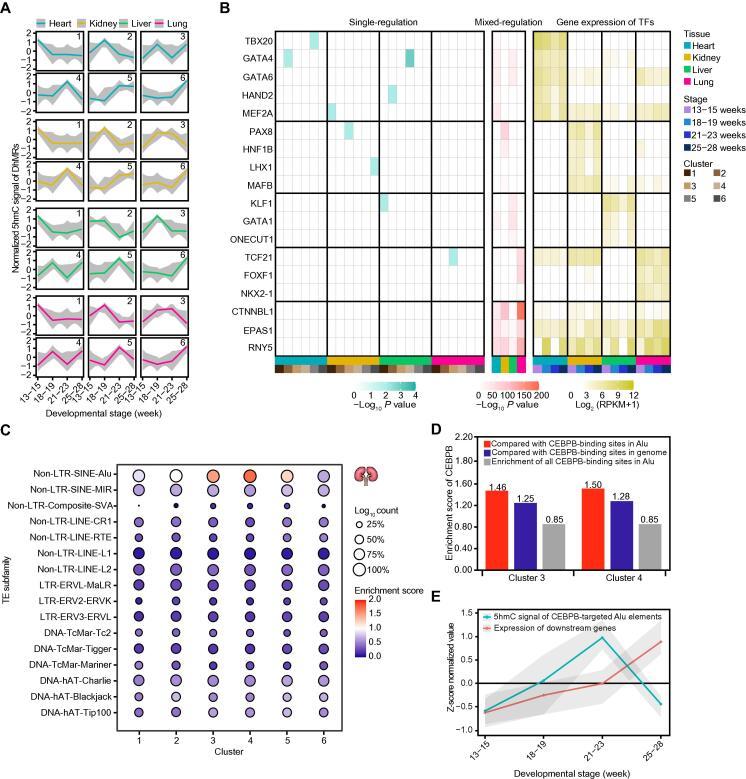
After implantation, complex and highly specialized molecular events render functionally distinct organ formation, whereas how the epigenome shapes organ-specific development remains to be fully elucidated. Here, nano-hmC-Seal, RNA bisulfite sequencing (RNA-BisSeq), and RNA sequencing (RNA-Seq) were performed, and the first multilayer landscapes of DNA 5-hydroxymethylcytosine (5hmC) and RNA 5-methylcytosine (mC) epigenomes were obtained in the heart, kidney, liver, and lung of the human foetuses at 13-28 weeks with 123 samples in total. We identified 70,091 and 503 organ- and stage-specific differentially hydroxymethylated regions (DhMRs) and mC-modified mRNAs, respectively. The key transcription factors (TFs), T-box transcription factor 20 (TBX20), paired box 8 (PAX8), krueppel-like factor 1 (KLF1), transcription factor 21 (TCF21), and CCAAT enhancer binding protein beta (CEBPB), specifically contribute to the formation of distinct organs at different stages. Additionally, 5hmC-enriched Alu elements may participate in the regulation of expression of TF-targeted genes. Our integrated studies reveal a putative essential link between DNA modification and RNA methylation, and illustrate the epigenetic maps during human foetal organogenesis, which provide a foundation for for an in-depth understanding of the epigenetic mechanisms underlying early development and birth defects.
胚胎植入后,复杂而高度特化的分子事件使功能不同的器官形成,而表观基因组如何塑造器官特异性发育仍有待充分阐明。在这里,进行了纳米 hmC-Seal、RNA 亚硫酸氢盐测序 (RNA-BisSeq) 和 RNA 测序 (RNA-Seq),并在总共 123 个样本的 13-28 周人类胎儿的心脏、肾脏、肝脏和肺中获得了 DNA 5-羟甲基胞嘧啶 (5hmC) 和 RNA 5-甲基胞嘧啶 (mC) 表观基因组的第一个多层图谱。我们分别鉴定了 70091 个和 503 个器官和阶段特异性差异羟甲基化区域 (DhMR) 和 mC 修饰的 mRNAs。关键转录因子 (TF),T 盒转录因子 20 (TBX20)、配对盒 8 (PAX8)、Krüppel 样因子 1 (KLF1)、转录因子 21 (TCF21) 和 CCAAT 增强子结合蛋白β (CEBPB),分别特异地促进不同阶段不同器官的形成。此外,富含 5hmC 的 Alu 元件可能参与调节 TF 靶向基因的表达。我们的综合研究揭示了 DNA 修饰和 RNA 甲基化之间的潜在联系,并说明了人类胎儿器官发生过程中的表观遗传图谱,这为深入了解早期发育和出生缺陷的表观遗传机制提供了基础。




 Zotero 插件