
莱姆关节炎和类风湿关节炎患者的生活质量评估。
Assessment of quality of life in patients with Lyme arthritis and rheumatoid arthritis.
作者信息
Yuskevych Valentyna Vasylivna, Zhulkevych Igor Valentynovych, Makhovska Oleksandra Stepanivna, Smiyan Svitlana Ivanivna
机构信息
Department of Internal Medicine No. 2, I. Horbachevsky Ternopil National Medical University, Ukraine.
Department of Oncology, Radiodiagnosis, Radiotherapy, and Radiation Medicine, I. Horbachevsky Ternopil National Medical University, Ukraine.
出版信息
Reumatologia. 2022;60(1):35-41. doi: 10.5114/reum.2022.114352. Epub 2022 Feb 28.
OBJECTIVES
Patients' quality of life is one of the key concepts of modern medicine, which characterizes the role of physical and mental functioning in the course of the disease. This article presents a stratification of factors influencing the quality of life in patients with rheumatoid arthritis (RA) and Lyme arthritis (LA).
MATERIAL AND METHODS
Ninety patients with RA were included in this study among them = 44 (48.89%) also with LA diagnosis and = 46 (51.11%) with RA. All studied patients were examined and questioned according to the Health Assessment Questionnaire-Disability Index and the 36-Item Short Form Survey (SF-36) to assess their quality of life. The disease activity score with examination of 28 joints was used to assess the activity of the disease. Multiple regression analysis was used to determine the most significant factors influencing patients' quality of life.
RESULTS
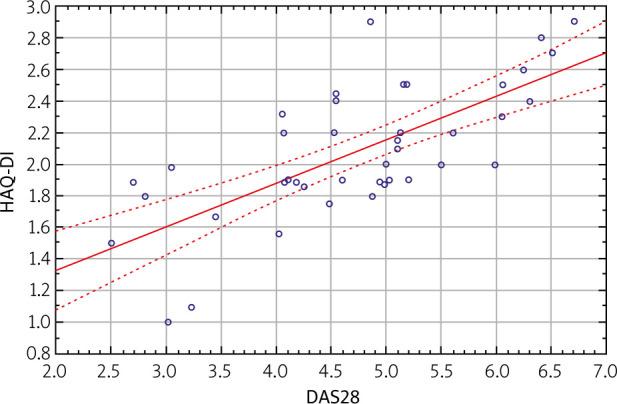
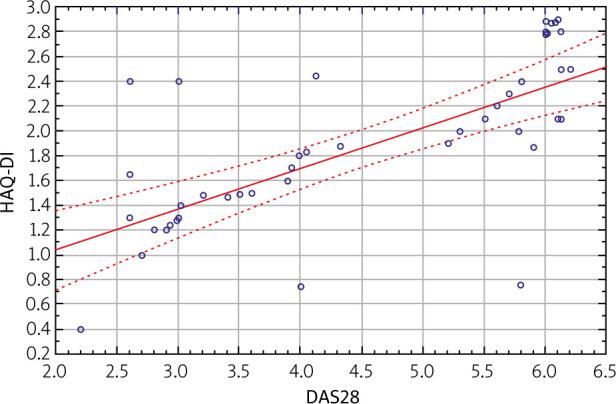
Patients who agreed to participate in the study had high and moderate disease activity; however, patients with LA showed significantly higher baseline data on the intensity of the inflammatory process. According to the analysis of the questionnaire responses, a significantly reduced physical activity of both groups was revealed, but patients with LA had significantly worse BP ( = 0.002), GH ( = 0.006), and Mental Component Summary scales ( = 0.001). The greatest relationship between disease activity and quality of life by Physical Component Summary according to SF-36 ( = -0.80) was found in patients with LA and ( = -0.72) - with RA.
CONCLUSIONS
The presence of in patients with arthritis not only significantly reduced the motor activity of patients, but also complicated the mental adaptation to their own disease. Factors that affect the quality of life - the activity and duration of the disease in patients of both cohorts, and age and total number of affected joints - for patients with RA.
目的
患者的生活质量是现代医学的关键概念之一,它表征了身心功能在疾病过程中的作用。本文呈现了影响类风湿性关节炎(RA)和莱姆关节炎(LA)患者生活质量的因素分层。
材料与方法
本研究纳入了90例RA患者,其中44例(48.89%)也被诊断为LA,46例(51.11%)仅患有RA。所有研究患者均根据健康评估问卷 - 残疾指数和36项简短调查问卷(SF - 36)进行检查和询问,以评估他们的生活质量。采用28个关节检查的疾病活动评分来评估疾病活动度。使用多元回归分析来确定影响患者生活质量的最显著因素。
结果
同意参与研究的患者疾病活动度为高和中度;然而,LA患者在炎症过程强度方面的基线数据显著更高。根据问卷回复分析,两组患者的身体活动均显著降低,但LA患者的BP(P = 0.002)、GH(P = 0.006)和心理成分总结量表(P = 0.001)显著更差。根据SF - 36身体成分总结,LA患者中疾病活动度与生活质量之间的最大相关性为(r = -0.80),RA患者为(r = -0.72)。
结论
关节炎患者中LA的存在不仅显著降低了患者的运动活动,还使患者对自身疾病的心理适应变得复杂。影响生活质量的因素——两个队列患者的疾病活动度和持续时间,以及RA患者的年龄和受累关节总数。
 Zotero 插件