
软性机器人外骨骼增强式高强度步态训练对脑卒中幸存者的影响:一项初步研究。
Soft robotic exosuit augmented high intensity gait training on stroke survivors: a pilot study.
机构信息
Max Nader Lab for Rehabilitation Technologies and Outcomes Research, Shirley Ryan AbilityLab, 355 E Erie St., Chicago, IL, 60611, USA.
Department of Physical Medicine and Rehabilitation, Northwestern University, 710 N Lake Shore Dr, Chicago, IL, 60611, USA.
出版信息
J Neuroeng Rehabil. 2022 Jun 3;19(1):51. doi: 10.1186/s12984-022-01034-2.
BACKGROUND
Stroke is a leading cause of serious gait impairments and restoring walking ability is a major goal of physical therapy interventions. Soft robotic exosuits are portable, lightweight, and unobtrusive assistive devices designed to improve the mobility of post-stroke individuals through facilitation of more natural paretic limb function during walking training. However, it is unknown whether long-term gait training using soft robotic exosuits will clinically impact gait function and quality of movement post-stroke.
OBJECTIVE
The objective of this pilot study was to examine the therapeutic effects of soft robotic exosuit-augmented gait training on clinical and biomechanical gait outcomes in chronic post-stroke individuals.
METHODS
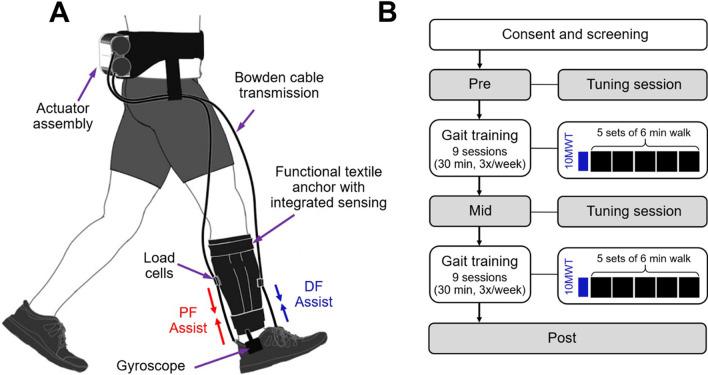
Five post-stroke individuals received high intensity gait training augmented with a soft robotic exosuit, delivered in 18 sessions over 6-8 weeks. Performance based clinical outcomes and biomechanical gait quality parameters were measured at baseline, midpoint, and completion.
RESULTS
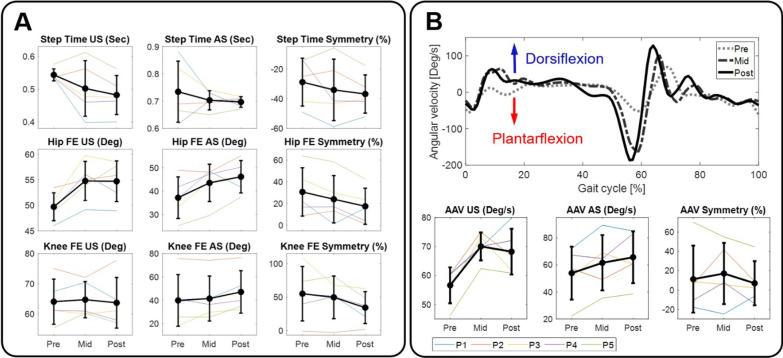
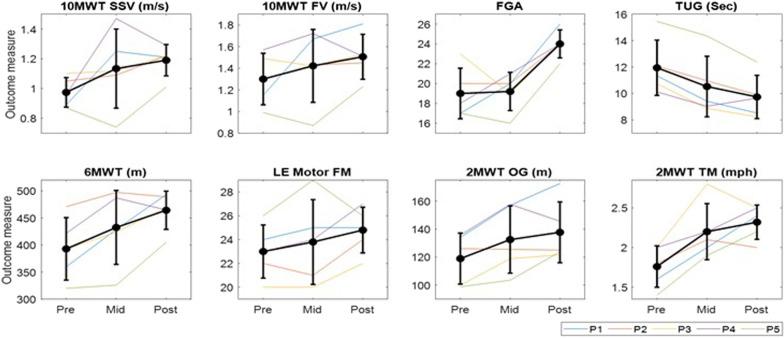
Clinically meaningful improvements were observed in walking speed ([Formula: see text] < 0.05) and endurance ([Formula: see text] < 0.01) together with other traditional gait related outcomes. The gait quality measures including hip ([Formula: see text] < 0.01) and knee ([Formula: see text] < 0.05) flexion/extension exhibited an increase in range of motion in a symmetric manner ([Formula: see text] < 0.05). We also observed an increase in bilateral ankle angular velocities ([Formula: see text] < 0.05), suggesting biomechanical improvements in walking function.
CONCLUSIONS
The results in this study offer preliminary evidence that a soft robotic exosuit can be a useful tool to augment high intensity gait training in a clinical setting. This study justifies more expanded research on soft exosuit technology with a larger post-stroke population for more reliable generalization. Trial registration This study is registered with ClinicalTrials.gov (ID: NCT04251091).
背景
中风是导致严重步态障碍的主要原因,恢复行走能力是物理治疗干预的主要目标。软机器人外骨骼是一种便携式、重量轻且不显眼的辅助设备,旨在通过促进中风后个体在行走训练过程中更自然的瘫痪肢体功能,来提高他们的移动能力。然而,目前尚不清楚使用软机器人外骨骼进行长期步态训练是否会对中风后的步态功能和运动质量产生临床影响。
目的
本研究旨在探讨软机器人外骨骼增强步态训练对慢性中风后个体临床和生物力学步态结果的治疗效果。
方法
5 名中风后个体接受了高强度步态训练,同时使用软机器人外骨骼进行辅助,在 6-8 周内进行了 18 次训练。在基线、中点和完成时测量基于表现的临床结果和生物力学步态质量参数。
结果
观察到步行速度([Formula: see text] < 0.05)和耐力([Formula: see text] < 0.01)以及其他传统的与步态相关的结果有显著的临床改善。步态质量测量包括髋关节([Formula: see text] < 0.01)和膝关节([Formula: see text] < 0.05)的屈伸表现出对称性的运动范围增加([Formula: see text] < 0.05)。我们还观察到双侧踝关节角速度增加([Formula: see text] < 0.05),表明行走功能的生物力学改善。
结论
本研究结果初步表明,软机器人外骨骼可以作为一种有用的工具,在临床环境中增强高强度步态训练。本研究为使用更大的中风后人群进行更广泛的软外骨骼技术研究提供了依据,以更可靠地推广。
试验注册
本研究已在 ClinicalTrials.gov 注册(编号:NCT04251091)。
 Zotero 插件