
遗传风险、体重指数轨迹与非小细胞肺癌风险的相关性:一项基于人群的队列研究。
Associations of genetic risk, BMI trajectories, and the risk of non-small cell lung cancer: a population-based cohort study.
机构信息
Department of Biostatistics, School of Public Health, Nanjing Medical University, 101 Longmian Avenue, Nanjing, 211166, Jiangsu, China.
Department of Environmental Health, Harvard T.H. Chan School of Public Health, Boston, MA, 02115, USA.
出版信息
BMC Med. 2022 Jun 6;20(1):203. doi: 10.1186/s12916-022-02400-6.
BACKGROUND
Body mass index (BMI) has been found to be associated with a decreased risk of non-small cell lung cancer (NSCLC); however, the effect of BMI trajectories and potential interactions with genetic variants on NSCLC risk remain unknown.
METHODS
Cox proportional hazards regression model was applied to assess the association between BMI trajectory and NSCLC risk in a cohort of 138,110 participants from the Prostate, Lung, Colorectal, and Ovarian (PLCO) Cancer Screening Trial. One-sample Mendelian randomization (MR) analysis was further used to access the causality between BMI trajectories and NSCLC risk. Additionally, polygenic risk score (PRS) and genome-wide interaction analysis (GWIA) were used to evaluate the multiplicative interaction between BMI trajectories and genetic variants in NSCLC risk.
RESULTS
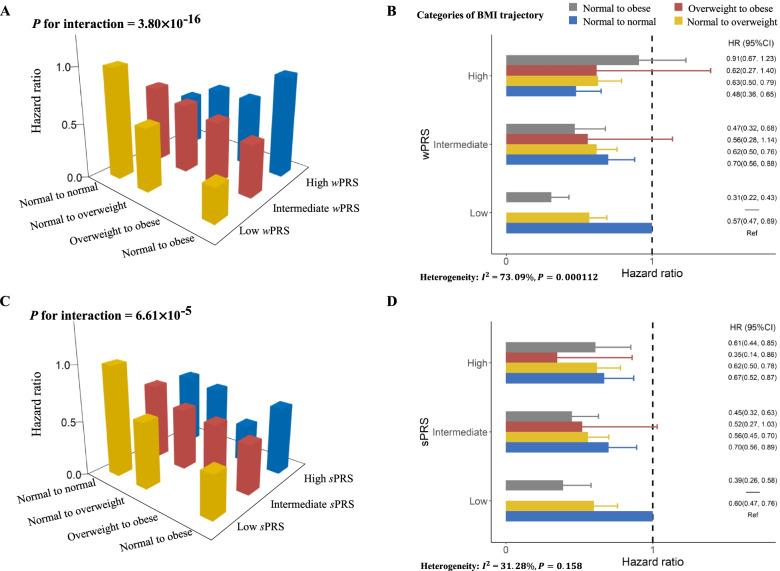
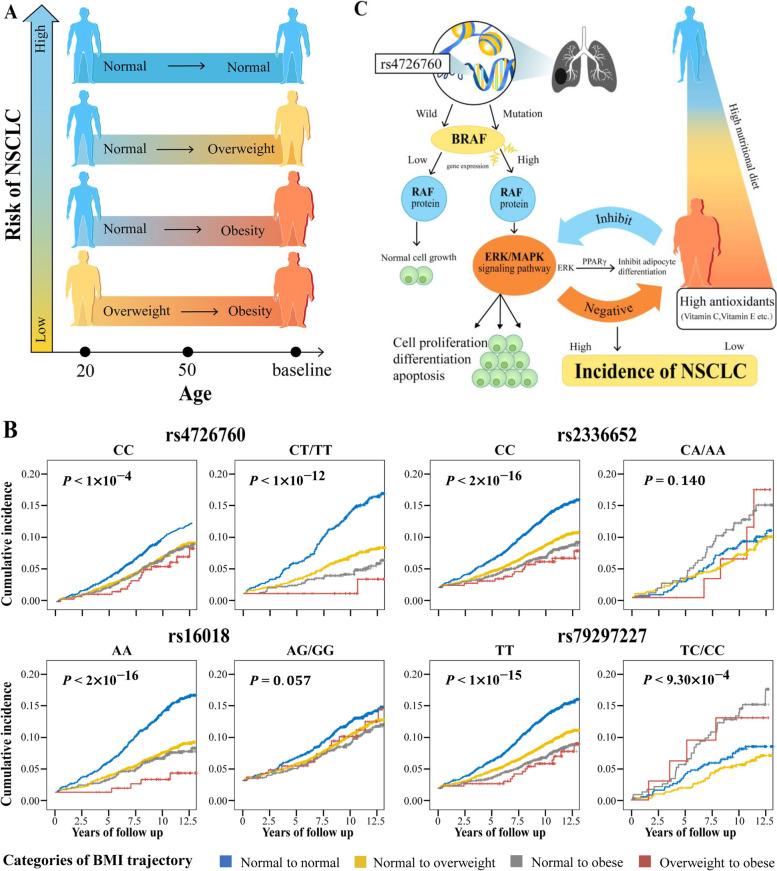
Compared with individuals maintaining a stable normal BMI (n = 47,982, 34.74%), BMI trajectories from normal to overweight (n = 64,498, 46.70%), from normal to obese (n = 21,259, 15.39%), and from overweight to obese (n = 4,371, 3.16%) were associated with a decreased risk of NSCLC (hazard ratio [HR] for trend = 0.78, P < 2×10). An MR study using BMI trajectory associated with genetic variants revealed no significant association between BMI trajectories and NSCLC risk. Further analysis of PRS showed that a higher GWAS-identified PRS (PRS) was associated with an increased risk of NSCLC, while the interaction between BMI trajectories and PRS with the NSCLC risk was not significant (P= 0.863 and P= 0.704). In GWIA analysis, four independent susceptibility loci (P < 1×10) were found to be associated with BMI trajectories on NSCLC risk, including rs79297227 (12q14.1, located in SLC16A7, P = 1.01×10), rs2336652 (3p22.3, near CLASP2, P = 3.92×10), rs16018 (19p13.2, in CACNA1A, P = 3.92×10), and rs4726760 (7q34, near BRAF, P = 9.19×10). Functional annotation demonstrated that these loci may be involved in the development of NSCLC by regulating cell growth, differentiation, and inflammation.
CONCLUSIONS
Our study has shown an association between BMI trajectories, genetic factors, and NSCLC risk. Interestingly, four novel genetic loci were identified to interact with BMI trajectories on NSCLC risk, providing more support for the aetiology research of NSCLC.
TRIAL REGISTRATION
CLINICALTRIALS
gov , NCT01696968 .
背景
体重指数(BMI)与非小细胞肺癌(NSCLC)风险降低有关;然而,BMI 轨迹的影响以及与遗传变异的潜在相互作用对 NSCLC 风险的影响仍不清楚。
方法
应用 Cox 比例风险回归模型评估 138110 名前列腺癌、肺癌、结直肠癌和卵巢癌(PLCO)癌症筛查试验参与者队列中 BMI 轨迹与 NSCLC 风险之间的关联。进一步采用单样本孟德尔随机化(MR)分析评估 BMI 轨迹与 NSCLC 风险之间的因果关系。此外,还使用多基因风险评分(PRS)和全基因组交互分析(GWIA)评估 BMI 轨迹与 NSCLC 风险中遗传变异的相乘交互作用。
结果
与维持稳定正常 BMI 的个体相比(n=47982,34.74%),BMI 轨迹从正常体重增加到超重(n=64498,46.70%)、从正常体重增加到肥胖(n=21259,15.39%)和从超重增加到肥胖(n=4371,3.16%)与 NSCLC 风险降低相关(趋势 HR=0.78,P<2×10)。使用与遗传变异相关的 BMI 轨迹进行的 MR 研究表明,BMI 轨迹与 NSCLC 风险之间没有显著关联。进一步的 PRS 分析表明,GWAS 确定的较高 PRS(PRS)与 NSCLC 风险增加相关,而 BMI 轨迹与 PRS 与 NSCLC 风险之间的相互作用不显著(P=0.863 和 P=0.704)。在 GWIA 分析中,发现四个独立的易感位点(P<1×10)与 NSCLC 风险的 BMI 轨迹相关,包括 rs79297227(12q14.1,位于 SLC16A7 中,P=1.01×10)、rs2336652(3p22.3,靠近 CLASP2,P=3.92×10)、rs16018(19p13.2,在 CACNA1A 中,P=3.92×10)和 rs4726760(7q34,靠近 BRAF,P=9.19×10)。功能注释表明,这些位点可能通过调节细胞生长、分化和炎症来参与 NSCLC 的发生。
结论
本研究表明 BMI 轨迹、遗传因素与 NSCLC 风险之间存在关联。有趣的是,确定了四个新的遗传位点与 NSCLC 风险的 BMI 轨迹相互作用,为 NSCLC 的病因学研究提供了更多支持。
试验注册

 Zotero 插件