
抗 CGRP 单克隆抗体治疗耐药性慢性偏头痛:系统评价。
Treatment of resistant chronic migraine with anti-CGRP monoclonal antibodies: a systematic review.
机构信息
Faculdade de Medicina da Universidade Do Porto (FMUP), Al. Prof. Hernâni Monteiro, 4200 - 319, Porto, Portugal.
Laboratório de Farmacologia, Departamento de Ciências Do Medicamento, Faculdade de Farmácia da Universidade Do Porto (FFUP), Porto, Portugal.
出版信息
Eur J Med Res. 2022 Jun 4;27(1):86. doi: 10.1186/s40001-022-00716-w.
BACKGROUND
Resistant chronic migraine is a highly disabling condition which is very difficult to treat. The majority of the treatments for migraine prophylaxis are nonspecific and present weak safety profiles, leading to low adherence and discontinuation. Currently, monoclonal antibodies (mAb) targeting the trigeminal sensory neuropeptide, calcitonin gene-related peptide (CGRP), are available for migraine prophylaxis being the first drugs developed specifically to target migraine pathogenesis. The main objective of the current work is to carry out a systematic review of randomised controlled trials that specifically analyse the effectivity and safety of anti-CGRP mAb, comparatively to placebo, in patients with resistant chronic migraine and possibly fill the literature gap or be a source of information to health professionals. Additionally the current knowledge on migraine, particularly resistant chronic migraine, was revisited and summarised.
METHODS
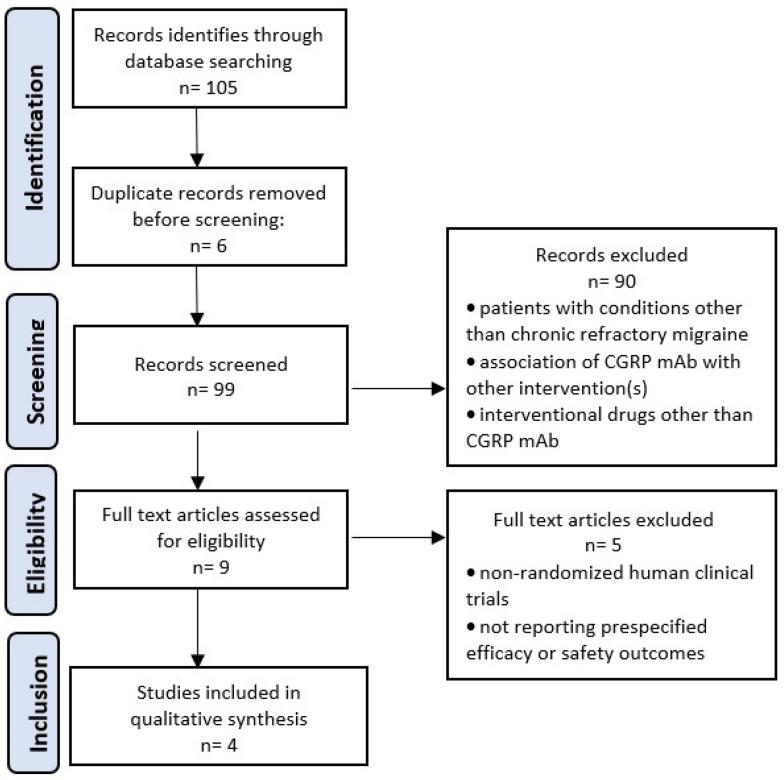
Literature search was carried out on MEDLINE, Scopus, Science Direct and ClinicalTrials.gov database, from inception to December 2021. Articles were selected according to prespecified criteria of inclusion and exclusion. Efficacy and safety outcomes included were: change from baseline in monthly migraine days (MMD); ≥50% reduction of MMD values from baseline; change from baseline in monthly acute migraine-specific medication days (MAMD); Migraine-specific Quality of Life Questionnaire (MSQ); and registered adverse events. Additionally, we used the Cochrane risk of bias tool (RoB 2) to assess the risk of bias of the included studies.
RESULTS
Four studies were included in this systematic review, involving 2811 resistant chronic migraine patients, 667 in a study using erenumab, 838 in a study using fremanezumab and 1306 in two studies using galcanezumab. When compared to placebo, all investigated anti-CGRP mAb and respective doses demonstrate effectiveness in decreasing MMD, reducing acute medication use and improving the MSQ scores, including, sometimes, reversion of chronic to episodic migraine (efficacy outcomes). Regarding the safety outcomes, the number and type of adverse events did not differ between anti-CGRP mAb-treated and placebo groups.
CONCLUSIONS
Anti-CGRP or anti-CGRP receptor monoclonal antibodies are a promising preventive migraine therapy which can be particularly useful for resistant chronic migraine patients.
背景
耐药性慢性偏头痛是一种非常致残的疾病,治疗难度很大。大多数偏头痛预防治疗是非特异性的,安全性较差,导致患者顺应性和停药率低。目前,针对三叉神经感觉神经肽降钙素基因相关肽(CGRP)的单克隆抗体(mAb)可用于偏头痛预防,是专门针对偏头痛发病机制开发的首批药物。本研究的主要目的是对专门分析抗 CGRP mAb 与安慰剂相比在耐药性慢性偏头痛患者中的有效性和安全性的随机对照试验进行系统评价,并可能填补文献空白或为卫生专业人员提供信息来源。此外,还回顾和总结了目前对偏头痛,特别是耐药性慢性偏头痛的认识。
方法
从建库到 2021 年 12 月,在 MEDLINE、Scopus、Science Direct 和 ClinicalTrials.gov 数据库中进行了文献检索。根据纳入和排除标准选择文章。纳入的疗效和安全性结局包括:每月偏头痛天数(MMD)自基线的变化;与基线相比,MMD 值减少≥50%;每月急性偏头痛特异性药物天数(MAMD)自基线的变化;偏头痛特异性生活质量问卷(MSQ);以及已登记的不良事件。此外,我们使用 Cochrane 偏倚风险工具(RoB 2)评估纳入研究的偏倚风险。
结果
本系统评价纳入了 4 项研究,共纳入 2811 例耐药性慢性偏头痛患者,1 项研究使用依那西普,838 例研究使用 fremanezumab,2 项研究使用 galcanezumab 各纳入 1306 例。与安慰剂相比,所有研究的抗 CGRP mAb 及其剂量均能有效降低 MMD,减少急性药物使用,并改善 MSQ 评分,包括有时将慢性偏头痛转为发作性偏头痛(疗效结局)。关于安全性结局,抗 CGRP mAb 治疗组和安慰剂组的不良事件数量和类型无差异。
结论
抗 CGRP 或抗 CGRP 受体单克隆抗体是一种有前途的偏头痛预防治疗方法,对耐药性慢性偏头痛患者尤其有用。

 Zotero 插件